

Background
Endometriosis is a chronic gynecological condition characterized by the growth of tissue similar to the endometrium outside the uterus, resulting in inflammation and scarring (WHO, 2025). Clinically, the condition is described across four subtypes: superficial peritoneal involvement; deep infiltrating endometriosis; ovarian cysts (endometriomas); and extra-pelvic lesions (As-Sanie et al., 2025).
Current evidence suggests that approximately 10% of women of reproductive age worldwide live with endometriosis (WHO, 2025). However, reported rates are not uniform (ranging from 2% to 71.4%), since they reflect variations in geography, clinical setting, symptom presentation, age distribution, and the methods used to establish the diagnosis (Ghiasi et al., 2020). For instance, in symptomatic women, prevalence varied between 35% and 100% (Nnoaham et al., 2011). In Portugal, where the present study was conducted, national estimates suggest that approximately 700,000 women may be affected, with the condition most often diagnosed between the ages of 25 and 30 (Adamson et al., 2010; Setúbal, 2023). Despite its prevalence, the etiology of endometriosis remains unclear, with potential causes including hereditary predisposition, immune dysfunction, and environmental factors such as lifestyle choices, smoking, and unhealthy dietary habits (Della-Corte et al., 2020; Wu et al., 2024).
Diagnosis is often challenging due to the nonspecific and sometimes atypical nature of symptoms, resulting in substantial delays (from 5 to 12 years) (De Corte et al., 2025). Laparoscopy remains the most accurate diagnostic method, offering direct visualization of lesions and facilitating treatment planning (Duarte & Righi, 2021; Hsu et al., 2010). Symptoms of endometriosis include dysmenorrhea and dyspareunia, chronic pain, and infertility, frequently resulting in significant psychological difficulties, including anxiety and depression, impairing women’s mental health and quality of life, social interactions, professional activities, and intimate relationships (Ameratunga et al., 2017; Facchin et al., 2020; Gruber & Mechsner, 2021; Laganà et al., 2017; Missmer et al., 2021; Rossel et al., 2025).
Quality of life
Quality of life (QoL), as defined by the WHO, represents “individuals’ perception of their position in life in the context of the culture and value systems in which they live and in relation to their goals, expectations, standards, and concerns” (WHO, 1997, p. 1). Models developed in pain research show that QoL is shaped by interactions between physical symptoms, emotional functioning, and social resources (e.g., the model of quality of life in a group of people with chronic low back pain), highlighting the relevance of these dimensions for understanding QoL in other chronic conditions such as endometriosis (Ziętalewicz & Bargiel-Matusiewicz, 2024).
For women with endometriosis, QoL is profoundly impaired by a combination of chronic pain, sexual dysfunction, and professional, social, and psychological challenges (Bień et al., 2020; Hudson et al., 2013). Research consistently shows that QoL in these women is diminished not only in physical domains but also across psychological and social dimensions; these reductions are primarily attributed to the symptoms of endometriosis rather than the diagnosis itself (Gao et al., 2006; Marinho et al., 2018).
Beyond the physical symptoms already mentioned, psychological effects such as depression and anxiety are frequently reported, along with disruptions in sexual and social relationships (Della-Corte et al., 2020; Li et al., 2025). The economic burden is another significant factor, as many women experience reduced working hours, reduced productivity, job transitions, or even withdrawal from the workforce due to debilitating symptoms (Della-Corte et al., 2020; Fourquet et al., 2010; Moradi et al., 2014). This often leads to financial strain, compounding emotional stress within couples and families.
The impact of endometriosis symptoms on intimate partner relationships has been shown to significantly affect women’s overall QoL, underlining the importance of addressing relational dynamics (Bień et al., 2020). Indeed, to improve the QoL of women with endometriosis, there is a growing call to address emotional, social, and sexual issues as integral components of care (Bień et al., 2020). However, a recent review has highlighted a lack of research into psychosocial factors that may further influence women’s QoL, namely in terms of social support (Kalfas et al., 2022).
Perceived social support and endometriosis
Endometriosis, while primarily affecting women, exerts a significant impact on their partners and families (Schick et al., 2022). The daily challenges and emotional burden associated with the disease often strain relationships, underscoring the pivotal role of social support in mitigating these effects. Despite its recognized importance, research on the influence of perceived social support on pain management and QoL in women with endometriosis remains sparse (Kalfas et al., 2022).
According to Zimet’s model (Zimet et al., 1988), perceived social support reflects individuals’ subjective appraisal of the support they believe is available from three key sources (including family, friends, and significant others), emphasizing perceived availability rather than the mere presence of people in one’s social network. Perceived social support, particularly from partners and family, is a well-established determinant of physical and mental well-being in the context of chronic diseases (Maguire et al., 2021). It enhances self-efficacy and reduces perceived stress, enabling individuals to better adapt to the challenges posed by chronic conditions (Luo et al., 2023). Evidence from other women’s health contexts indicates that social support plays a significant role in protecting psychological well-being and quality of life, even under emotionally demanding circumstances (e.g., complicated grief) (Skalski-Bednarz et al., 2026).
Also, women consistently identify support from partners as essential in navigating the condition (Márki et al., 2022). Partners provide emotional and practical assistance, including help with daily tasks, accompanying women to medical appointments, and engaging in treatment decisions (Culley et al., 2017). In a recent study it was found that perceived social support positively influenced partnership satisfaction in couples affected by endometriosis and infertility (van Eickels et al., 2024). Beyond family support, broader networks – such as friends, online communities, and support groups – offer women with endometriosis a sense of belonging, understanding, and hope (Márki et al., 2022).
To the best of our knowledge, no studies have specifically examined the role of perceived social support in the sexual satisfaction of women with endometriosis. However, research in other contexts, such as rheumatic diseases, has highlighted the importance of social support in influencing women’s sexual health. For example, dissatisfaction or lack of fulfillment in partner relationships has been associated with increased sexual dysfunction (Granero-Molina et al., 2018). Furthermore, studies have suggested that social support plays a crucial role in facilitating coping mechanisms for chronic illnesses, which, in turn, can contribute to improved sexual health outcomes (Kengen Traska et al., 2012; Schulman-Green et al., 2016). A systematic review by Sánchez-Fuentes et al. (2014) examining factors associated with sexual satisfaction identified variables related to social support, such as strong social networks and positive family relationships, as predictors of higher sexual satisfaction. However, the authors noted the limited research available on these topics.
Sexual satisfaction and endometriosis
According to the WHO, sexual health refers to “a state of physical, emotional, mental and social well-being in relation to sexuality; it is not merely the absence of disease, dysfunction or infirmity” (WHO, 2024, p. 1). Sexual health is recognized as a vital component of women’s quality of life, even in the context of chronic health conditions (Flynn et al., 2016). Sexual satisfaction is generally understood as a multidimensional construct influenced by interpersonal, behavioral, and psychological aspects. Theoretical frameworks describe it as a subjective appraisal of sexual experiences that extends beyond the presence of sexual problems, involving emotional closeness, relational processes, and personal sexual functioning. Models in this field highlight both individual dimensions, such as desire and well-being, and relational elements, including communication and perceived responsiveness (Sánchez-Fuentes et al., 2014).
Sexual satisfaction is often diminished in individuals coping with chronic illnesses (Flynn et al., 2016). Research shows that women with endometriosis often experience impaired sexual functioning and reduced levels of sexual satisfaction compared to women without the condition (Kfoury et al., 2023; Montanari et al., 2013; Vercellini et al., 2012). Also, a systematic review and meta-analysis revealed that women with endometriosis have an approximately twofold increased risk of experiencing sexual dysfunction compared to women without the condition (OR 2.38) (Pérez-López et al., 2020). Another systematic review corroborated these findings, reporting a 1.71-fold higher risk of sexual dysfunction in women with endometriosis (95% CI: 1.21-2.43). Women with endometriosis consistently scored lower across all domains of sexual functioning, including desire, arousal, lubrication, orgasm, satisfaction, and pain, as assessed by the Female Sexual Function Index (FSFI) (Zhu et al., 2023).
Among the primary contributors to poor sexual function are symptoms such as dyspareunia and deep pelvic pain, which are hallmark features of this condition (Shum et al., 2018; Youseflu et al., 2020). However, the impact of endometriosis on sexual health extends beyond physical pain. Psychological and emotional factors, including anxiety, depression, low self-esteem, and infertility-related challenges, also play a significant role in the development of sexual dysfunction (Norinho et al., 2020; Shi et al., 2023; Youseflu et al., 2020). Additionally, poor sleep quality – a common issue in women with chronic pain conditions – can further exacerbate sexual difficulties (Youseflu et al., 2020). These findings underscore the pervasive and multifaceted impact of endometriosis on women’s sexual health, highlighting the critical need for comprehensive management strategies.
The present study
Endometriosis has a profound impact on women’s QoL, affecting physical, psychological, and social domains. Chronic pain, sexual dysfunction and dissatisfaction, and relational challenges are central contributors to reduced QoL in this population (Bień et al., 2020; Hudson et al., 2013). However, the psychosocial mechanisms underlying QoL, particularly the roles of social support and sexual satisfaction, remain underexplored. Social support, a critical determinant of health and well-being in chronic diseases, is associated with improved coping strategies, reduced stress, and better overall outcomes (Luo et al., 2023; Maguire et al., 2021). Despite this, little research has examined the specific influence of social support on QoL in women with endometriosis, particularly its indirect effects through sexual satisfaction.
Sexual dysfunction and sexual dissatisfaction are prevalent problems in endometriosis (e.g., Pérez-López et al., 2020; Zhu et al., 2023). Research from other chronic disease contexts suggests that relational factors and social support are critical for sexual health (Granero-Molina et al., 2018; Kengen Traska et al., 2012; Sánchez-Fuentes et al., 2014). Dissatisfying relationships and lack of partner support have been linked to greater sexual problems, while adequate social support facilitates coping and enhances emotional well-being, potentially improving sexual functioning (Schulman-Green et al., 2016).
In this study, we tested a mediational model to investigate the relationships between social support, sexual satisfaction, and QoL in Portuguese-speaking women residing in Portugal with endometriosis. Specifically, we hypothesized that sexual satisfaction mediates the link between perceived social support and QoL. This model builds on prior evidence suggesting that social support not only directly enhances QoL but also exerts indirect effects by influencing the relational and psychological burdens associated with sexual dissatisfaction. By examining these pathways, our research sought to provide a more comprehensive understanding of the psychosocial factors influencing QoL in women with endometriosis and to inform the development of holistic interventions, tailored for women with this clinical condition.
Participants and procedure
Participants
Eligibility required having a formal medical diagnosis of endometriosis. Participants were asked to indicate whether a healthcare professional had diagnosed them with endometriosis, and only those who confirmed a medically established diagnosis were included. Other inclusion criteria for the study required participants to be women of reproductive age and currently experiencing at least one symptom related to the disease. Women with asymptomatic endometriosis, pregnant women, and those who were not proficient in Portuguese were excluded from the study. Furthermore, all participants were required to provide informed consent prior to participating in the research.
Using G*Power 3.1, we estimated that for a linear multiple regression with two predictors (social support and sexual satisfaction), assuming a medium effect size (f2 = .15), α = .05, and desired power of .90, a minimum sample of approximately 88 participants would be required. This cross-sectional study included 106 women who reported a diagnosis of endometriosis, aged between 18 and 52 (Mage = 33.54, SD = 7.43). Most of the participants (89.6%) were in a relationship. Regarding the presence of children, 19.8% of the women had at least one child. In terms of education, most of the participants had higher education (32.1% with a master’s degree and 25.5% with a bachelor’s degree).
In addition, 34% self-reported a diagnosis of infertility associated with endometriosis (see Table 1 for a detailed description of participants’ characteristics).
Table 1
Sociodemographic data of the sample
Measures
Quality of life. The Portuguese version of the WHOQOL-BREF was used to measure women’s QoL (Vaz Serra et al., 2006). It was selected because it is a theoretically grounded, multidimensional measure of quality of life that aligns with the WHO definition of health and has been widely validated for use in chronic health conditions. It is a 26-item self-report instrument designed to assess quality of life across four key domains: (1) Physical Domain: encompasses items related to physical health, including mobility, energy, pain, and sleep (item example: “How satisfied are you with your health?”); (2) Psychological Domain: addresses emotional well-being, self-esteem, body image, and mental health (item example: “How often do you have negative feelings such as blue mood, despair, anxiety, or depression?”); (3) Social Relationships Domain: evaluates satisfaction with personal relationships, social support, and sexual life (item example: “How satisfied are you with the support you get from your friends?”); and (4) Environment Domain: examines environmental factors such as safety, financial resources, healthcare access, and the physical environment (item example: “How satisfied are you with your transport?”).
Items are rated on a 5-point Likert scale, where higher scores indicate better quality of life. In the present study, the WHOQOL-BREF instrument demonstrated good internal reliability, with a Cronbach’s α value of .93 and ω coefficient of .92 for the overall questionnaire (the environment domain was not included as this study did not focus on environment issues).
Perceived social support. Perceived social support was measured using the Portuguese version of the Multidimensional Scale of Perceived Social Support (MSPSS; Carvalho et al., 2011). This instrument was selected because it is grounded in Zimet and colleagues’ theoretical model, which conceptualizes social support as deriving from distinct and meaningful sources (e.g., family, friends) with a focus on perceived support rather than objective presence of individuals.
It has 12 items and assesses three sources of support: family support (4 items; item example: “My family is willing to help me make decisions”), friend support (4 items; item example: “My friends really try to help me”, and support from significant others (4 items; item example: “There is a special person who is around when I am in need”). Items are rated on a 7-point Likert scale, ranging from 1 (strongly disagree) to 7 (strongly agree). In the present study, the MSPSS exhibited good psychometric properties, with a global Cronbach’s α of .95 and ω coefficient of .95 for the total score.
Sexual satisfaction. Sexual satisfaction was assessed using the Portuguese version of the New Sexual Satisfaction Scale (NSSS; Pechorro et al., 2016). This instrument was selected because it is grounded in contemporary theoretical models of sexual functioning and satisfaction, and captures both personal and relational dimensions of sexual experience.
It consists of 20 items, divided into two subscales: Self-Centeredness (10 items; item example: “The intensity of my sexual arousal”) and Partner and Sexual Activity-Centeredness (10 items; item example: “My partner’s emotional opening up during sex”. Items are scored on a 5-point Likert-type scale ranging from 1 (not at all satisfied) to 5 (extremely satisfied). In this study, Cronbach’s α was .96 and ω was .96 for the total score of the scale, indicating good internal reliability.
Procedure
This study was approved by the Ethics Committee of ISPA – University Institute (Reference: I-134-12-23). The questionnaires were distributed and completed through Google Forms to provide the flexibility to allow participants to complete the instruments at their convenience. Participants were recruited through social networks, including Facebook groups and Instagram pages (e.g., pages dedicated to endometriosis, pages of (in)fertility clinics, and pages managed by clinicians working in gynecology/reproductive medicine) between January and May 2024. Prior to initiating data collection (on the landing page), all participants were provided with detailed information about the study’s objectives, procedures, inclusion and exclusion criteria, and ethical considerations to ensure transparency and understanding. Informed consent was obtained from each participant before their participation.
Data were collected anonymously, with no identifiable information linked to participants’ responses to protect their confidentiality. Strict security measures were implemented to store and manage data, ensuring that they were only accessible to the research team. All data handling followed ethical guidelines and relevant data protection laws. Participants were also informed about how their data would be used, stored, and analyzed, aligning with the principles of ethical research (only for research purposes). Participants did not receive any type of incentives.
Data analysis
Data were analyzed using SPSS (v. 29). Pearson correlations were used to analyze correlations among study variables.
Mediation analysis was conducted using the PROCESS macro (model 4) (Hayes, 2017). The analysis focused on whether sexual satisfaction acts as a mediator between social support (independent variables) and QoL (dependent variables) in women with endometriosis. The PROCESS macro is a statistical tool that allows for the testing of direct, indirect, and total effects in mediation models. Bootstrapping with 5,000 resamples was performed to assess the significance of the indirect effects and provide confidence intervals, with a 95% confidence level. Direct, total, and indirect effects are reported. A significance level of p < .05 was adopted for all analyses.
Results
Correlational analysis
Social support was moderately correlated with sexual satisfaction and strongly correlated with quality of life. Sexual satisfaction also demonstrated a strong positive correlation with quality of life (see Table 2).
Mediational analysis
A mediation analysis was conducted to investigate whether sexual satisfaction mediated the relationship between social support and quality of life (see Figure 1), while controlling for participants’ age, marital status, and length of endometriosis diagnosis. Social support was positively associated with sexual satisfaction (B = .17, SE = .06, t = 2.84, p < .001, 95% CI [.05, .29]). Age was also associated with sexual satisfaction (B = –.03, SE = .01, t = –2.39, p < .05, 95% CI [–.06, –.01]). Marital status and length of endometriosis diagnosis were not associated with sexual satisfaction (p > .05).
Figure 1
Unstandardized direct, total, and indirect effects of social support and sexual satisfaction on quality of life of women (N = 106), controlling for age, marital status, and length of endometriosis diagnosis
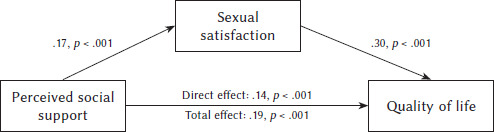
Social support had a significant total effect on quality of life (B = .19, SE = .03, t = 5.44, p < .001, 95% CI [.12, .26]). In the mediation model, sexual satisfaction was significantly associated with quality of life (B = .30, SE = .05, t = 5.88, p < .001, 95% CI [.20, .40]), and social support was also significantly associated with quality of life (B = .14, SE = .03, t = 4.44, p < .001, 95% CI [.08, .20]). Participants’ age, marital status, and length of endometriosis diagnosis were not associated quality of life (p >.05). The combined model explained 50.71% of the variance in quality of life (R2 = .51, F(6, 98) = 16.80, p < .001).
A significant indirect effect of social support on quality of life through sexual satisfaction was observed (indirect effect = .05, SE = .02, 95% CI [.01, .09]).
Discussion
This study aimed to investigate the complex interplay between perceived social support, sexual satisfaction, and quality of life in Portuguese-speaking women residing in Portugal with endometriosis, focusing on the mediating role of sexual satisfaction. By addressing these variables, the research sought to enhance understanding of the psychosocial factors influencing the well-being of these women living with this chronic condition, providing insights that may guide interventions to improve their overall quality of life.
As anticipated, perceived social support was positively associated with higher quality of life. This finding aligns with existing literature, which consistently emphasizes the vital role of social support in promoting both physical and mental well-being, particularly in the context of chronic diseases (e.g., Maguire et al., 2021). Social support serves to enhance individuals’ resources in managing the stress and challenges associated with chronic conditions, such as increasing self-efficacy, reducing perceived stress, and fostering resilience (Luo et al., 2023). Furthermore, studies have highlighted that support from various sources, particularly from partners, plays a crucial role in navigating chronic illnesses such as endometriosis. This support helps mitigate feelings of isolation and enhances hope and understanding, ultimately contributing to improved quality of life (Culley et al., 2017; Márki et al., 2022; van Eickels et al., 2024).
As anticipated, sexual satisfaction was positively associated with improved quality of life. This aligns with the understanding that sexual health, and sexual satisfaction specifically, plays a significant role in women’s overall well-being and quality of life (Flynn et al., 2016). A fulfilling sexual life may contribute to reducing symptoms such as anxiety, stress, and low self-esteem, which can have a profound impact on mental and emotional health (Fritzer et al., 2013; Gewirtz-Meydan et al., 2019; La Rosa et al., 2020).
Finally, as expected, social support was positively associated with quality of life through sexual satisfaction. This finding aligns with existing research across different contexts, which highlights the critical role of social and relational factors in sexual health (Granero-Molina et al., 2018; Kengen Traska et al., 2012; Sánchez-Fuentes et al., 2014). Poor or unsupportive relationships have been linked to increased sexual difficulties, while sufficient social support serves to facilitate coping mechanisms and boost emotional well-being, ultimately enhancing sexual function and satisfaction (Schulman-Green et al., 2016). Also, open and secure communication between partners is crucial to building satisfying relationships and enhancing various aspects, including sexuality and overall quality of life (Hudson et al., 2013; Law et al., 2025; Norinho et al., 2020). Overall, this study highlights the importance of social support and sexual satisfaction in improving the overall quality of life for women with endometriosis, offering valuable insights for promoting emotional and relational well-being.
Limitations and future research
This study has several limitations. First, the sample was relatively small, comprising Portuguese-speaking women residing in Portugal, which may limit the generalizability of the findings. Additionally, the use of self-reported data could introduce biases, such as social desirability or recall bias. Another limitation is the cross-sectional design, which limits the ability to draw causal inferences regarding the relationships between social support, sexual satisfaction, and quality of life. Another limitation is the reliance on self-reported dia- gnoses of endometriosis and infertility, which may be subject to misclassification or reporting bias. Also, because recruitment occurred through social networks without the ability to monitor reach or link access, we could not track how many individuals viewed the study announcement, accessed the survey, or were screened for eligibility. Only the final number of participants who met the inclusion criteria is available.
Future research should address these limitations by including larger, more diverse samples and employing longitudinal designs to better understand the causal relationships. Additionally, exploring the impact of specific types of social support (e.g., partner support versus family support) and examining other potential mediators and moderators of these relationships could provide deeper insights into how to improve quality of life for women with endometriosis. Further investigation into the role of psychological and emotional factors in shaping sexual satisfaction and quality of life is also warranted.
Practical implications
The findings of this study highlight several practical implications for healthcare professionals working with Portuguese-speaking women residing in Portugal with endometriosis. Firstly, fostering strong social support networks – whether through family, friends, partners, or healthcare providers – can significantly contribute to improving quality of life. Healthcare practitioners should emphasize the importance of emotional and relational support in managing chronic conditions such as endometriosis.
Additionally, addressing sexual health is crucial, as it plays a significant role in overall well-being. Interventions aimed at enhancing sexual satisfaction and managing sexual dysfunction could be integrated into treatment plans to support holistic care for women with endometriosis.
Lastly, promoting psychological counseling and support groups may help mitigate feelings of isolation and improve coping mechanisms, which are essential for managing both the physical and emotional challenges associated with the disease. By focusing on these areas, healthcare providers can offer more comprehensive and effective care.

