BACKGROUND
This study examined the relationship between subjective well-being (SWB) and peer-related social variables in upper-elementary school children. Well-being can be construed as a positive attitude towards one’s own life, satisfaction with one’s own circumstances and a general sense of happiness (Diener, 2009). Early adolescence represents a critical developmental period characterized by profound biological, psychological, and social transitions. During this stage, peer relationships assume heightened significance, playing a pivotal role in emotional development, identity formation, and social learning.
SWB encompasses an individual’s evaluative judgments about their quality of life and the emotional states that accompany these judgments. SWB is traditionally conceptualized as comprising two primary components: a cognitive dimension, reflecting life satisfaction, and an affective dimension, capturing the balance of positive and negative emotional experiences (Diener, 1984, 1994; Diener et al., 1999). In the context of childhood and adolescence, SWB serves as a vital indicator of developmental health and a predictor of adaptive functioning into adulthood (Huebner et al., 2004). In the research literature, the term SWB is often used interchangeably and considered synonymous with the term “happiness” (Diener, 1994; Seligman, 2002), although “happiness” itself is inconsistently defined and may refer to varied concepts such as life satisfaction, hedonic level, or positive affect.
Existing research underscores the multifaceted nature of SWB among young individuals, emphasizing the interplay between individual characteristics, family dynamics, and social contexts. For instance, self-esteem, emotional regulation, and a stable, supportive family environment have been consistently linked to higher levels of SWB (Huebner et al., 2004; Proctor et al., 2009). Conversely, exposure to adverse experiences, such as bullying, peer rejection, and academic stress, is associated with diminished SWB, underscoring the vulnerability of adolescents to their immediate social environments (Hawker & Boulton, 2000; Salmivalli, 2010; Wentzel et al., 2021). Furthermore, positive psychological states, including happiness and life satisfaction, are frequently regarded as outcomes of social and economic resources or achievements, despite evidence suggesting a bidirectional relationship (Lyubomirsky et al., 2005).
A significant portion of well-being is linked to social connections (Holder & Coleman, 2009; Lyubomirsky et al., 2005), and research has explored these connections both as antecedents (Hoza et al., 2000) and consequences (Maresky et al., 2021; Oberle et al., 2010) of high-quality relationships1.
For children, the relationship that influences their SWB most strongly is the one with their parents (Holder & Coleman, 2009; Konu et al., 2002). However, as they enter school and begin their academic career, the classroom becomes an important reference group where these relationships can form with peers. The relationships in the classroom have a profound effect on children’s learning skills, development, social engagement, adjustment, and well-being (Ladd et al., 1997; Ladd & Troop-Gordon, 2003; Løhre et al., 2014). From a developmental perspective, social bonds become increasingly important in early adolescence. As children start gravitating towards peers, their opinions become crucial in the construction of the self-image (Bukowski & Raufelder, 2018). Friendships and social standing in the peer group become an emerging focus for children, and consequently success or failure in this domain has a large effect on their subjective (both social and emotional) well-being, particularly in early and middle childhood (Schwartz-Mette et al., 2020).
The concept of social position, reflecting an individual’s perceived social status within their peer group, has been identified as an important determinant of various developmental outcomes. Among these outcomes, SWB has gained increasing attention in developmental psychology due to its implications for long-term mental health and adaptive functioning (Anderson et al., 2012; Kokai & Cole, 2021; Montecillo et al., 2024; Schwartz-Mette et al., 2020). More broadly, peer relationships occupy a central role in adolescent SWB. Positive peer interactions and the presence of close friendships are associated with higher levels of life satisfaction and emotional well-being (Demir & Urberg, 2004), whereas negative peer experiences, including victimization, exclusion, and conflict, are robust predictors of reduced SWB and heightened emotional distress (Newcomb et al., 1993). Children’s social relations are typically studied in four separate domains in the literature: sociometric position, popularity, friendships, and bullying2,3, all of which are considered below.
PARAMETERS OF SOCIAL RELATIONS IN EARLY ADOLESCENCE AND SWB
Sociometric position
Sociometric position, derived from the concepts of acceptance and rejection, is an area of research that has been studied extensively (Cillessen, 2009; Gifford-Smith & Brownell, 2003; Rubin et al., 2006).
Children are assigned to categories based on peer nominations for acceptance and rejection of every other student4. Five sociometric categories are used: controversial, popular, rejected, neglected, and average (Coie et al., 1982; Newcomb & Bukowski, 1983). This categorization uses strict, fixed criteria that leave a proportion of children without an assigned category5.
Sociometric studies most commonly focus on the behavioral differences associated with these sociometric categories, the processes that lead to high and low acceptance in the peer group (Coie et al., 1982; Ladd et al., 1997; Newcomb et al., 1993), and on the assessment of the numerous negative correlates of rejection and being assigned to the rejected category such as adjustment problems during the school years (Ladd et al., 1997; Ladd & Troop-Gordon, 2003) as well as future psychological adjustment problems (Broidy et al., 2003; Ladd, 2006), worse academic achievement (Ladd, 2006), and greater risk of victimization (Hodges et al., 1999).
Acceptance has been linked to well-being in upper elementary-school students (Weyns et al., 2021), and adjustment has also been assessed by sociometric categories by Munoz-Silva et al. (2020). Rejected children exhibited worse psychological adjustment profiles compared to children in other sociometric categories, while popular children had better scores on aspects including emotional and peer problems that are associated with SWB. This result was confirmed by other researchers linking the popular sociometric group to higher levels of well-being (Kaya & Siyez, 2008).
However, some evidence suggests no association between acceptance and SWB. A meta-analysis on the effects of friendships and acceptance found no significant association in this age group (Schwartz-Mette et al., 2020). Other recent studies have also found no direct association between acceptance and SWB (Tepordei et al., 2023). Additionally, some researchers argue that it is not acceptance itself but the perception of acceptance that influences negative outcomes, such as depression (Giovazolias, 2024).
Popularity
Popularity represents another important aspect of social standing in the peer group and has been conceptualized as two distinct constructs: sociometric popularity, defined by the frequency of acceptance nominations, and perceived popularity, assessed through direct nominations of who is considered popular (LaFontana & Cillessen, 2002; Parkhurst & Hopmeyer, 1998). Adolescents who enjoy high status often report elevated life satisfaction and reduced psychological distress, likely due to their greater access to social support and validation (Parkhurst & Hopmeyer, 1998). However, distinctions between sociometric and perceived popularity highlight the complexity of these dynamics. While sociometric popularity is generally associated with prosociality and positive outcomes, perceived popularity has been linked to social dominance, aggression, and norm-breaking behaviors aimed at appearing “cool” (Andrews et al., 2022; Parkhurst & Hopmeyer, 1998), and may correlate with increased stress and relational tension (LaFontana & Cillessen, 2002; Oberle et al., 2010). Frequency and number of peer interactions have also been considered important components of perceived popularity (Kosir & Pecjak, 2005; LaFontana & Cillessen, 2002). This distinction underscores the need for a nuanced understanding of how different forms of popularity relate to SWB in early adolescence.
Perceived popularity’s association with well-being has been shown to be curvilinear by several researchers in recent years (Ferguson & Ryan, 2019; Maresky et al., 2021). Low popularity’s negative effects stem from the hindrance of social goals that become increasingly important in early adolescence. However, evidence suggests that high popularity also entails risk factors for mental health. Possible theoretical explanations for this phenomenon have emerged focusing on the lack of authenticity, the manipulative strategies, and the engagement in risk behaviors that maintaining such a status usually requires (Ferguson & Ryan, 2019). These may have an adverse effect on close friendships, where self-disclosure and honesty are important factors. Consequently, negotiating these social and emotional goals may become conflicting and harder to maintain for children high in perceived popularity. For these reasons, some researchers argue that highly popular children may experience lower social contentment – the emotional stability and self-enhancement derived from intimate relationships – which in turn reduces well-being (Ferguson & Ryan, 2019; Maresky et al., 2021).
Friendships
Separate from the attitude of the larger peer group toward children, friendships are reciprocal, intimate, mutual relationships that have a marked influence on children’s well-being, psychological and school adjustment and therefore constitute a very important aspect of children’s social lives (Bagwell & Bukowski, 2018; Bagwell & Schmidt, 2011; Hartup & Stevens, 1997). Friendships help build a child’s self-image, improve self-esteem, and offer protection from the negative effects of peer adversities (Gifford-Smith & Brownell, 2003). They are also only moderately correlated with the other social aspects; it is therefore possible for a child to be rejected or bullied and have friends, and conversely it is also possible for a popular child not to have any mutual friendships (Gest et al., 2001).
Although generally considered a positive phenomenon, friendships can cause distress and may promote negative behaviors. Research about friendship quality has demonstrated that conflictual relationships negatively influence SWB (Bagwell & Schmidt, 2011; Schwartz-Mette et al., 2020). It has also been shown that risk behaviors such as tobacco and alcohol use can spread through friendship networks by the processes of peer contagion, deviancy training, similarity, and influence (Bagwell & Bukowski, 2018; Hussong et al., 2020), and that negative processes in which friends take part together, such as co-rumination, the act of talking excessively about negative emotions, may reduce psychological well-being, particularly in girls (Davila & Kornienko, 2022; Laursen et al., 2023; Rose, 2002). Beside negative influences, happiness and social well-being have also been found to be able to spread through friendship networks, as friends become more similar in well-being to their friends with time (van Workum et al., 2013).
Bullying
Another important domain of children’s social life is bullying – a widespread, complex phenomenon in which one or more aggressors repeatedly use physical, mental, or relational means to assert dominance over a victim who typically lacks the relational, psychological, or physical resources to defend themselves (Salmivalli & Peets, 2018; Veenstra et al., 2007).
The detrimental effects of bullying on victims are well documented. It has been shown to increase internalizing symptoms and build negative peer perceptions, which can lead to reactive aggression and feelings of loneliness. Bullying has also been demonstrated to be a potential source of later maladjustment (Ladd & Troop-Gordon, 2003; Salmivalli & Isaacs, 2005). Participation in bullying either as an aggressor or as a victim may therefore negatively influence SWB in children (Goswami, 2012; Konu et al., 2002).
Despite extensive research on peer dynamics and mental health, the combined relationship between key peer-relational domains – sociometric position, popularity, friendships, and bullying – and SWB in early adolescence remains insufficiently understood (Goswami, 2012; Schwartz-Mette et al., 2020). All four social variables may uniquely contribute to SWB. However, sociometric position, popularity, friendships, and bullying-related variables are often studied as separate domains in research (Cillessen & Bukowski, 2018; Gest et al., 2001; Gifford-Smith & Brownell, 2003). Examining their combined impact on SWB can enhance our understanding of children’s social connections, offering valuable insights for practical applications. This study therefore examines how sociometric position (acceptance and rejection), popularity, friendships, and bullying involvement are associated with adolescents’ SWB.
Based on the theoretical framework outlined above, we test the following hypotheses: a) Children in different sociometric categories differ in their levels of SWB; b) Intimate friendships are positively associated with SWB, while rejection and bullying experiences are negatively associated with SWB; c) Popularity is associated with lower SWB for both highly popular and unpopular children; d) Acceptance is uncorrelated with SWB.
PARTICIPANTS AND PROCEDURE
Procedure
Data were collected between April and October 2024. We used eSzocMet (https://eszocmet.hu/?translate=en), an online sociometric tool developed by the authors of this article (for more information: Hoffmann et al., 2026), which is widely used for sociometric assessment by practitioners in Hungary. Teacher and school psychologist volunteers were recruited from an organization that promotes the Boldogságóra Program (Lessons for Happiness – an extracurricular activity organized for the maintenance of mental health of children) and from the social media site of eSzocMet. University funding allowed us to offer a small financial incentive (ca. €20) for participation in the testing.
All participants received a detailed guide with step-by-step instructions for setting up and administering the test, as well as information about obtaining parental consent. In addition to the guide, we provided online technical support via email throughout the testing period. However, since the software is user-friendly and most participants were already familiar with it, technical assistance was requested only in a few cases during data collection.
After submission, all tests were checked for errors, missing participants, or missing responses by the researchers, and the final database included only those tests that were filled out by every child in each classroom6.
Educators and school psychologists who administered a test had access to their classroom database and could later use the results for applied purposes. Simultaneously, the application automatically generates an anonymized report that was used for this study. The data processing method used by the application was developed in compliance with guidelines from the Hungarian National Authority for Data Protection and Freedom of Information and the General Data Protection Regulation (GDPR) of the European Union. A skilled software engineer designed the system in consultation with technical and legal experts to ensure complete adherence to these standards. The process was reviewed and accepted by the Ethical Board of Eötvös Loránd University (ELTE).
Sample
The sample consisted of 498 upper-elementary school children (45% girls; 15.6% 5th grade, 34.7% 6th grade, 19.9% 7th grade, 29.8% 8th grade) across 24 classrooms (µclass-size = 22.8, SD = 5.5).
Further demographic data included the type of settlement for each classroom (33% Capital City, 21% District capital, 25% City, 21% Rural area). This distribution does not differ significantly from the general population’s distribution across settlement types in Hungary (χ2(2) = 3.98, p = .141) (KSH, 2021).
Measures
Sociometric variables. We used a sociometric questionnaire to assess acceptance and rejection with two questions using unlimited7 nominations. The total number of nominations was scaled to the average classroom size (M = 23) in the sample. This method ensures comparability across classrooms while preserving the original distribution of nominations. Children were assigned to six sociometric categories after standardizing their raw scores within-classroom using the method developed and introduced by Coie et al. (1982).
Friendships. Friendships were assessed using Mérei’s (1971) sociometric method, which is widely applied in classroom-based school psychology practice in Hungary. Three questions were used to assess friendships: one asking directly about best friends in the classroom and two asking which classmates the child would prefer to have with them in specific shared situations. Each question was limited to three nominations. A friendship was defined as at least one mutual nomination. Mutuality was calculated by combining nominations across the three questions into an adjacency matrix, resulting in a weighted classroom network with values ranging from 0 to 3 for each dyad. To account for variation in classroom size, scores were scaled to a standard classroom size of 23 (the sample mean).
The literature offers differing perspectives on how friendships are best captured sociometrically, particularly regarding whether mutuality is a necessary criterion (for a review, see Gifford-Smith & Brownell, 2003). Reciprocated nominations were used as the primary indicator of friendship, while outgoing and incoming friendship ties (in- and out-degrees) were included as secondary indicators of network involvement. Although friendship quality – an important dimension of peer relationships (Bagwell & Bukowski, 2018) – was not directly assessed, the number of reciprocated nominations between two children was used as an index of relational closeness.
Bullying. Bullying was measured with three peer-nomination items, one for perpetrator, one for victim, and one for defender. Since the term “bullying” may not be well understood by all children, the questions included a brief explanation of key aspects, such as power imbalance and intentionality. For these items, as with the friendship questions, the number of peers selected was limited to three. Self-nomination was allowed in victimization questions that were used as a separate self-reported binary variable in this study8.
Popularity. Perceived popularity was measured with one peer-nominated item, specifically asking for the most popular children in the classroom. Similarly to sociometric measurements, popularity nominations were scaled to the average classroom size, and unlimited nominations were allowed.
Subjective well-being. Following Diener et al. (1999), we used more than one measure to assess SWB. The Hungarian adaptation of the Happiness Measure for Schoolchildren (HMS) was used. This 30-item scale measures items regarding happiness and satisfaction in the week before testing on a four-point Likert scale. HMS has two subscales, one for positive and one for negative affect, which constitute separate aspects of well-being, each consisting of 15 items. Well-being is measured by the aggregate score of all 30 items (Ivens, 2007; Vargha et al., 2019).
To assess another aspect of well-being, the Mental Health Test (MHT) was also administered. The test is a 20-item six-point Likert-scale questionnaire based on positive-psychological literature that has been used previously to assess the level of well-being for adults, and then a special version for children was developed in Hungarian. It encompasses several aspects of mental health with its five subscales: well-being (WB), resilience, self-regulation, creative and executive competencies, and savoring (Oláh et al., 2018; Vargha et al., 2019). In this study we only used the WB scale (scores range from 1 to 6 on a Likert scale) for the main hypothesis testing. This subscale consists of three items asking for SWB on a wider timeframe than HMS.
In our sample, reliability analysis of the Ivens HMS test showed high internal consistency for both the total scale and the two subscales. For total SWB Cronbach’s α was .90 (M = 2.15, SD = 0.47). For the positive subscale, Cronbach’s α = .86 (M = 2.79, SD = 0.52), with item-rest correlations ranging from r = .36 to r = .68. Cronbach’s α could not be improved by dropping any of the items. For the negative subscale, the results were quite similar, Cronbach’s α = .88 with a somewhat lower mean, (M = 2.10, SD = 0.58), item-rest correlations ranging from r = .38 to r = .74.
Q-Q plots indicated only mild deviations from normality, supporting the use of Pearson correlations. The scales were correlated moderately and negatively (r = –.49, p < .001) with exactly the same value that was reported by the researchers testing the Hungarian adaptation (Vargha et al., 2019). The general SWB subscale also demonstrated excellent internal consistency (Cronbach’s α = .90, M = 2.60, SD = 0.48).
For the MHT, reliability analysis indicated acceptable reliability for the three items (Cronbach’s α = .78, M = 4.15, SD = 1.10), with inter-item correlations ranging from r = .50 to r = .57.
Statistical analyses
To test hypothesis a) and determine whether well-being levels differ across sociometric categories, we used ANOVA, with sociometric categories as the grouping variable and SWB as the dependent variable. To test the remaining hypotheses and estimate the impact of social standing on well-being, we constructed multiple regression models. Dependent variables included the positive and negative affect subscales from HMS, as well as the total SWB score from MHT and HMS. Independent variables included acceptance, rejection, perceived popularity, bullying nominations, defender nominations, friendship mutuality, and in- and out-degrees. Interaction effects for significant predictors were also tested to explore potential moderating relationships.
RESULTS
As presented in Table 1, SWB variables were moderately to strongly correlated with each other, indicating adequate internal consistency and convergence between SWB measures. Victim nominations showed significant and weak to moderate correlations with number of mutual friendships, popularity, acceptance, and rejection. Bullying nominations received were correlated moderately and positively with popularity and rejection nominations, while defender nominations were correlated positively with number of mutual friendships, acceptance, and popularity, and negatively and weakly with rejection.
Table 1
Correlation table of all variables investigated
Acceptance was weakly and negatively correlated with rejection and victimization but strongly and positively correlated with the number of mutual friendships and incoming friendship nominations. It was also moderately correlated with defender and perceived popularity nominations. Correlations indicated generally weak associations between SWB and the various aspects of social status in the classroom; significant correlations were small in their magnitude (r = .10-.23) but showed up in the directions suggested by prior research (i.e. victim nominations were negatively correlated with SWB, while defender nominations were positively correlated).
To test hypothesis a), we examined differences in SWB across sociometric groups. To decide whether only the original categories of Coie et al. (1982) should be used or to include the intermediate category as a separate group, we tested for the similarity of the average and intermediate groups in social and descriptive variables. There were no differences in gender (χ2(1) = 0.11, p = .741) and class level (χ2(3) = 5.53, p = .134) distributions between the groups. Mann-Whitney tests revealed a significant difference between the intermediate and average groups in acceptance (U = 7612, p < .001, rrb = .26) and rejection (U = 8507, p < .01, rrb = .17); children in the average group received fewer acceptance nominations and more rejection nominations than those in the intermediate group. Although these effects were small (Vargha & Delaney, 2000), they were significant, and therefore we decided to proceed with analyzing the intermediate group as a separate sociometric category in this study.
As shown in Table 2, SWB revealed significant differences between groups (F(5, 492) = 8.83, p < .001, η2 = 0.08). Tukey-Kramer post-hoc analysis indicated that the rejected group differed significantly from all other groups except the ambivalent group. In HMS, we found that total SWB differences (F(5, 492) = 3.48, p < .001, η2 = 0.04) were attributable to the differences between the popular and the intermediate group in comparison to the rejected group, with rejected children reporting lower well-being scores. A similar pattern emerged for positive affect (F(5, 492) = 4.36, p < .001, η2 = 0.04), but no differences were found for negative affect across sociometric groups (F(5, 492) = 1.55, p = .174).
Table 2
Mean values of sociometric groups in different SWB measures
Next, we constructed regression models for the positive and negative subscales of HMS, as well as for the aggregate scores of HMS and general well-being measured by MHT. We used a backward selection method for the multiple regression models. Assumptions of tolerance, variance inflation factor (VIF), Cook’s distance, and normality (assessed via Q-Q plots) were tested, and no violations were found. The independent variables initially included in all four regression models were acceptance, rejection, the total number of mutual friendships (one, two, and three mutual choices as separate variables), bullying, victimization, defender nominations, unilateral in- and out-degrees for friendship nominations, self-nomination for victimization, peer-nominated popularity, and a quadratic term to account for the potential curvilinear relationship between SWB and popularity. Significant interaction terms were then tested for the predictors remaining in the model. The tables below include only those variables retained after selection.
For positive affect, three significant predictors emerged, as shown in Table 3.
Table 3
Regression model for positive affect
| Predictor | Estimate | SE | t | p | β |
|---|---|---|---|---|---|
| Intercept | 39.80 | 0.87 | 45.62 | < .001 | |
| Rejection | –0.31 | 0.11 | –2.80 | .005 | –.12 |
| Defender | 0.39 | 0.12 | 3.12 | .002 | .15 |
| Out-degrees | 0.46 | 0.19 | 2.45 | .015 | .11 |
Defender nominations and out-degree were significantly and positively associated with positive affect, while rejection nominations were negatively associated. The size of these coefficients and the total variance explained (R2 = .07) indicate that each additional rejection nomination was associated with only a small decrease in positive affect, whereas defender nominations and outgoing ties corresponded to similarly small increases.
For negative affect, only victimization nominations emerged as a predictor, with no significant interactions (see Table 4); however, the overall explained variance was very low (R2 = .01), indicating only minor variation in negative affect across the observed range of victimization.
Table 4
Regression model for negative affect
| Predictor | Estimate | SE | t | p | β |
|---|---|---|---|---|---|
| Intercept | 30.78 | 0.47 | 65.81 | < .001 | |
| Rejection | 0.28 | 0.12 | 2.28 | .023 | .10 |
Two tables show the results for the SWB measures HMS (Table 5) and MHT (Table 6).
Table 5
Regression model for SWB (HMS)
Table 6
Regression model for SWB (MHT)
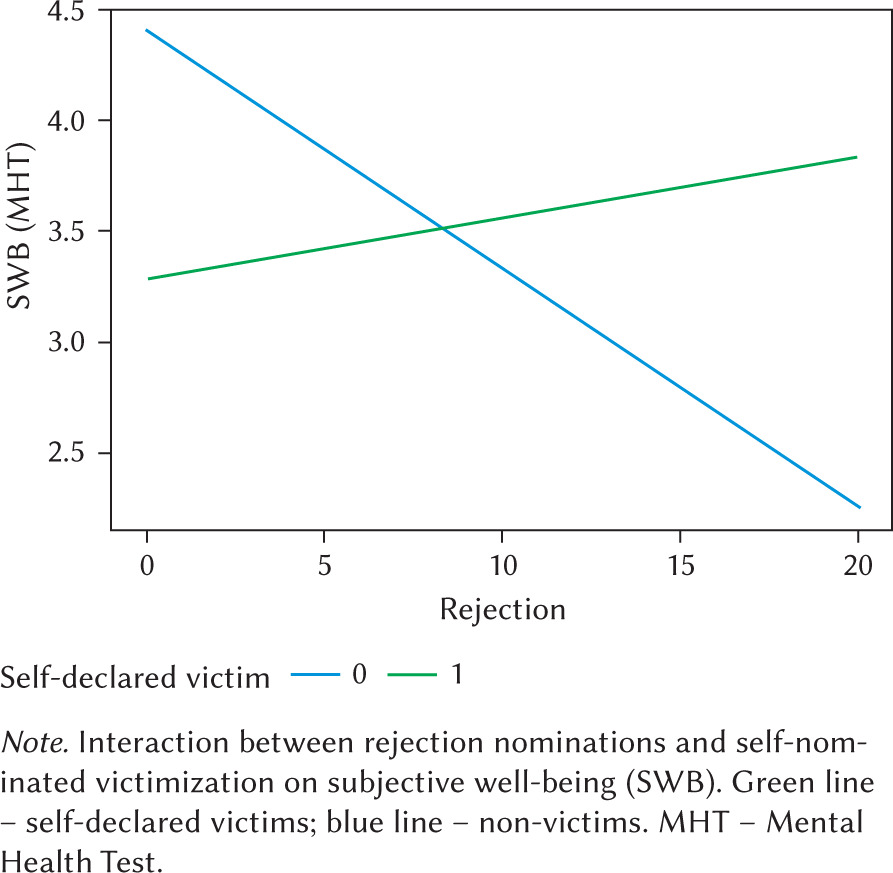
Rejection and self-nominated victimization were negatively associated with HMS well-being, whereas out-degree and three mutual friendship nominations were positively associated. The overall explained variance was small (R2 = .06). An interaction term also emerged as significant. An association between rejection and SWB was not observed among children who self-reported victimization, as can be seen in Figure 1.
Figure 1
Interaction between number of rejection nominations received and self-nomination for victimization on MHT
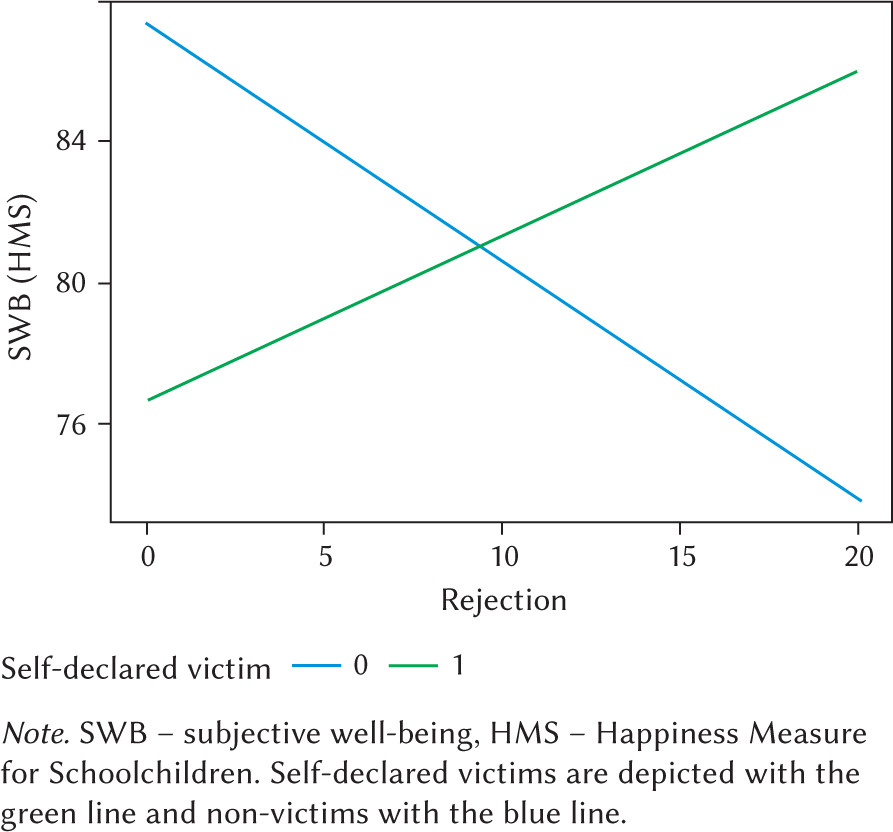
Rejection and self-nomination for victimization were negatively associated with SWB, while the total number of three-time mutual choice friendships was positively associated (R2 = .11). A significant interaction between rejection and self-nominated victimization indicated that the association between rejection and SWB was not evident among children who self-declared victimization (see Figure 2).
DISCUSSION
In this study we analyzed associations between SWB and various aspects of social relationships of early adolescents. Using a computerized method, we assessed peer-nominated friendship ties, sociometric position, perceived popularity, and bullying-related roles in a sample of 498 upper elementary-school children.
We identified some associations between the social variables measured and SWB. Rejection, victimization (self or peer-reported), outgoing friendship ties, defender nominations, friendship out-degrees and friendships with three mutual nominations showed a significant association with at least one of the SWB variables, whereas acceptance, friendship in-degrees, bullying nominations, incoming friendship ties, number of friendships with one or two mutual choices, total number of mutual friendships, and perceived popularity did not. Overall, these associations were statistically reliable but small in magnitude, indicating that peer-relationship variables explain only a limited proportion of variance in SWB. Below, we discuss the implications of these findings.
Correlational analysis showed strong correlations between SWB measures. Along with their good reliability, this indicates adequate measurement of SWB and supports the suitability of MHT for use with early adolescents.
Social status variables correlated in the expected directions that have been previously reported in the literature. Notably, rejection and acceptance were weakly and negatively correlated (Cillessen & Bukowski, 2018; Coie et al., 1982; Kosir & Pecjak, 2005), bullying was not correlated with acceptance and moderately correlated with rejection, while victimization was negatively correlated with acceptance and positively with rejection (Veenstra et al., 2007). Perceived popularity was uncorrelated with dislike but was moderately correlated with acceptance (Parkhurst & Hopmeyer, 1998). Most of the social variables showed significant but weak associations with SWB, a pattern that was also reflected in the regression analyses and their low explained variance.
We evaluated SWB across sociometric categories to assess hypothesis a). The results indicate that the rejected group had lower SWB than the average, intermediate, popular, and neglected groups, with a small-to-medium effect size. This finding contrasts with Kaya and Siyez (2008), who reported that differences in SWB were primarily driven by higher scores in the popular group compared to rejected and ambivalent children. Prior research suggests that popular children exhibit higher prosociality and have more high-quality relationships (Parker & Asher, 1993; Rubin et al., 2006), while rejected children tend to be more aggressive, victimized, and have fewer friends (Gest et al., 2001; Parker & Asher, 1993; Rubin et al., 2006). These findings provide theoretical support for associations in either direction.
Contrary to our hypothesis, the number of mutual friendships was significantly associated with only one SWB variable: total SWB. Specifically, having more than three mutual-choice friendships was associated with higher SWB, but not positive or negative affect. The limited number of associations is unexpected, given the consensus in the literature that close relationships are key determinants of well-being (Hartup & Stevens, 1997). Given that friendships are close relationships and that children at this age increasingly focus on forming and maintaining them (Bagwell & Bukowski, 2018), we hypothesized that friendships would be more significant determinants of well-being than our results suggest.
It is possible that the measure of friendship quantity used in this study could be improved to better capture the impact of friendships on SWB. We did not assess friendship quality directly, which has been shown to influence both positive and negative emotions, outcomes, and adjustment in children (Bagwell & Bukowski, 2018; Parker & Asher, 1993). While no study has directly assessed the association between the number of mutual choices and friendship quality, it has long been assumed that more mutual choices indicate higher-quality, closer friendships (Bronfenbrenner, 1944; Criswell, 1946; Mérei, 1971; Moreno, 1934; Northway, 1940). This indirectly suggests that high-quality friendships, rather than the total number of friendships, may be associated with SWB.
Outgoing and incoming friendship ties were also analyzed. The number of outgoing ties (the number of peers nominated on all three questions) was a significant predictor for one of the SWB measures and positive affect. Two possible explanations emerge for this finding. First, some researchers consider unreciprocated friendships meaningful ties (Newcomb et al., 1993). Children who feel connected to many peers may experience greater social integration and engagement, leading to higher SWB (Hartup & Stevens, 1997; Seligman, 2011). Second, network analysis is an emerging focus in the study of children’s social groups (Andrews et al., 2022; Gifford-Smith & Brownell, 2003; Rodkin & Ryan, 2012). Although not measured here directly, nominating many peers may indicate a more central network position, which could be associated with SWB. The link between SWB and network position remains underexplored and represents a promising area for future research. However, given the modest variance explained, such network characteristics likely represent only one of several factors contributing to well-being.
Contrary to our hypothesis c), perceived popularity was not a significant predictor of SWB in either linear or quadratic form. We tested the quadratic term based on the concept established by prior research that high popularity might damage close relationships, leading to lower SWB, similar to low popularity children who struggle to achieve social goals (Ferguson & Ryan, 2019). While some studies found higher depressive symptoms and loneliness, and lower self-esteem, among highly popular children (Ferguson & Ryan, 2019; Maresky et al., 2021), this quadratic relationship did not emerge in our study.
Rejection was associated with all four measures. As the most studied variable in sociometric research, rejection is widely recognized as a precursor or consequence of negative outcomes, such as victimization, depression, and loneliness, which reduce SWB (Cillessen, 2009; Ladd, 2006; Ladd & Troop-Gordon, 2003; Prinstein & Giletta, 2020; Rubin et al., 2006). Our findings align with the consensus that rejection negatively impacts SWB. However, the association between rejection and negative affect was notably weak in this study (β = .10), suggesting that rejection may exert a greater influence on reducing positive affect than directly generating negative affect.
Confirming hypothesis d), acceptance did not have a significant association with SWB. This is consistent with prior research showing no direct association between acceptance and SWB (Giovazolias, 2024; Schwartz-Mette et al., 2020). However, acceptance may indirectly influence SWB by enhancing academic competence, which has been linked to better adjustment (Ladd et al., 1997; Tepordei et al., 2023).
For negative affect we found a weak positive relationship with victimization. The evidence of the relationship between victimization and negative outcomes is very strong (Prinstein & Giletta, 2020; Rubin et al., 2006). Correlational analyses in the literature show similar magnitudes (Goswami, 2012; Katsantonis et al., 2023, 2024) to those found in this study. Self-nominated victimization was also shown to be a strong negative predictor for lower well-being. Victimization is a considerable risk factor for negative outcomes, and it was associated with lower SWB in preadolescent children, although the magnitude of this association was modest.
Peer-nominated bullying was not associated with SWB in any of the models, whereas defender nominations were significantly associated with positive affect. Specifically, in a classroom of 23 students, two defender nominations were associated with a one-point increase in positive affect. While defending behavior is often rewarded by peers (Huitsing et al., 2014), our analysis suggests that it is the behavior itself, rather than the associated social status, that enhances SWB. This aligns with the idea that engaging in prosocial acts, such as defending, may both contribute to and result from elevated SWB (Hui, 2022).
Finally, a counterintuitive interaction effect emerged for both SWB measures: the SWB of children who self-reported victimization did not vary with the number of rejection nominations received, whereas it did for non-victimized children. Although this finding was statistically reliable and consistent across both SWB measures, the small size of the non-victimized group (n = 35) relative to the victimized group (n = 472) may limit the generalizability of this result. This pattern may reflect a floor effect, whereby children who self-reported victimization already showed lower SWB, and additional rejection nominations were not associated with further decreases. Alternatively, because rejection and victimization were moderately correlated in this sample, their shared variance may have limited the unique association of rejection with SWB among self-declared victims.
CONCLUSIONS
The results of this study demonstrate that SWB is a multifaceted construct, with peer relationships in the classroom explaining only a portion of its variance. Large-scale studies have shown that the school environment accounts for approximately 20-25% of the variance in SWB among schoolchildren (Konu et al., 2002), increasing to about 40% when familial and other adult-related relationships are included (Goswami, 2012). Our findings align with these results, highlighting that while school relationships play a meaningful role in shaping SWB, their impact, as found in this study, was moderate. This suggests that well-being is influenced by multiple contextual and individual factors beyond peer relations alone.
The unique contribution of this study lies in its simultaneous examination of multiple peer-nominated social variables, which are often studied in isolation (Gest et al., 2001; Gifford-Smith & Brownell, 2003). By integrating friendships, bullying, and sociometric variables, our research provides a more holistic understanding of the complex social dynamics that influence children’s well-being. While peer-nominated methods are highly reliable and valid (LaFontana & Cillessen, 2002), our findings suggest that self-nominated measures also contribute unique insights. Combining the objective perspective of peers with the subjective experiences of individual children provides a more comprehensive understanding of social relationships and their impact on SWB.
Limitations and strengths
There are some limitations and strengths to the research presented in this paper.
First, we did not measure friendship quality, which is a critical aspect of mutual friendships. While the number of friendships may reflect a child’s social position in the classroom, the quality of these relationships has been shown to significantly influence whether friendships foster intimacy and happiness or cause distress (Bagwell & Bukowski, 2018).
Second, the traditional method that was used in this study to measure the number of friendships may be somewhat limited in its effectiveness in determining the number and strength of friendships in the classroom. Unlimited nominations have been shown to have better statistical properties and validity than limited nominations (Gommans & Cillessen, 2015); however, the Hungarian practical application of sociometry has used multiple limited nominations to measure this concept (Bronfenbrenner, 1944; Mérei, 1971). While there are clear advantages to the unlimited method, a case can be made for the other method as well, as it grasps an aspect of quality in the relationship by providing a weighted graph instead of a simple one. Even though total freedom to choose many peers is not available with this method, the use of multiple questions targeting a similar construct makes it possible for children to pick more than three friends, granting a more flexible approach than a single, limited nomination item. A direct comparison between the two measurement approaches, which has not been done before, would be a valuable avenue for future research. Such a comparison was beyond the scope of the present study.
Third, important variables such as socioeconomic status (SES), parental relationships, and school achievement (Konu et al., 2002) were not included in this study, limiting our ability to control for their effects. It is likely that these factors influence the results, and some of the variance explained by classroom relationships may reflect secondary effects. While the magnitude of these effects is difficult to estimate, prior studies have reported similar effect sizes for classroom relationships (Holder & Coleman, 2009; Konu et al., 2002).
Fourth, we employed a novel method for handling peer-nomination scores, which addresses limitations of traditional approaches such as in-classroom or grand mean centering (Kulawiak & Wilbert, 2020). However, this method assumes a linear association between scores in classrooms of different sizes (e.g., 5 nominations in a class of 20 is equivalent to 6 nominations in a class of 24). This assumption remains untested, and the validity of our approach depends on its accuracy.
Fifth, the cultural and methodological context of this study may limit the generalizability of the findings. The use of a Hungarian sample and measurement tools that have been used only in this country means that the results may not fully apply to other cultural or educational settings (i.e. where children in a classroom change more frequently or where the role of the classroom in the organization of curricular activities is less pronounced).
Finally, missing data in this study may introduce a minor limitation. There appears to be a systematic pattern that has been demonstrated by earlier studies (Cillessen & Marks, 2017) in which children who declined to complete the SWB questionnaires differed significantly from those who did, potentially biasing the results.
Despite these limitations, this study has several strengths. First, it simultaneously examined multiple aspects of social standing (e.g., friendships, acceptance, bullying), a rare approach that captures complex social processes not evident when analyzing single variables (Gest et al., 2001; Gifford-Smith & Brownell, 2003). Second, few studies have combined peer-nominated variables with SWB measures, making this research a valuable contribution to understanding how children’s self-perceived happiness interacts with peer evaluations. Third, the data collection method used here enables efficient, ethical, and large-scale gathering of peer-nomination data. The software developed for this study has facilitated the widespread use of sociometric measurements in Hungary and represents a significant advancement in both practical and research applications, as advocated in recent literature (van den Berg & Gommans, 2017).
Practical implications
The application used in this study for data collection provides a free and easy-to-use tool for educators to assess the sociometric properties of their own classroom that may help them in identifying those children in need of support in creating a better school experience.
This study provides further evidence of an association between rejection, victimization, and lower SWB in children; therefore, educators and school psychologists should pay special attention to identifying at-risk children. The results also suggest that rejected children, although aggressive and a potential challenge to educators, are less likely to be happy than children in other sociometric groups, which can increase feelings of empathy and patience in teachers that may be hard to access in tense situations.
Although school-based social factors only weakly determine well-being, efforts to enhance social cohesion in classrooms remain crucial. While factors such as personality, family relationships, and the broader social environment significantly influence children’s happiness, these are often beyond the control of school staff. However, by addressing risk factors such as rejection and victimization and fostering positive relationships, schools can contribute to their pupils’ SWB, although these effects should be considered supportive rather than determinative.