Background
Alopecia and psoriasis are chronic, autoimmune dermatological conditions that significantly affect physical appearance and psychological well-being (Hepat et al., 2023; Muntyanu et al., 2023). Alopecia occurs when the immune system mistakenly attacks hair follicles, leading to hair loss (Hunt & McHale, 2005). It can be classified as scarring or non-scarring. Scarring alopecia leads to permanent hair loss due to follicle destruction, while non-scarring alopecia (such as alopecia areata or androgenetic alopecia) is usually reversible and more common. Its development is influenced not only by genetic predisposition but also by environmental and psychological factors, such as stress, infections, hormonal changes, and medication use (Martins et al., 2024; Ozyurtlu & Cetin, 2022). On the other hand, psoriasis is a chronic, non-contagious inflammatory skin disease affecting 2-3% of the global population (Rendon & Schäkel, 2019). It is characterised by accelerated skin cell turnover, leading to red, scaly plaques. While it affects both genders, women tend to develop symptoms earlier (Parisi et al., 2020). Beyond skin symptoms, psoriasis is now recognised as a systemic condition linked to immune dysfunction, with a considerable impact on quality of life and mental health (Bhosle et al., 2006; Wannarit et al., 2023).
In both conditions, physical appearance is visibly altered, often leading to negative emotional and psychological consequences (Hepat et al., 2023; Muntyanu et al., 2023). Hair plays a central role in personal identity and social image, and it contributes not only to physical appearance but also to self-image and self-perception. In people with alopecia, sudden or severe hair loss can negatively impact self-esteem, body image, and feelings of attractiveness, often disrupting daily routines and diminishing quality of life. The inability to care for one’s hair, dissatisfaction with appearance, and concern about how others perceive them are key sources of distress among those affected (Aukerman & Jafferany, 2023; Clarke-Jeffers et al., 2024; Kaliyadan et al., 2013). Although alopecia is not life-threatening, it can significantly affect emotional well-being (Katara et al., 2023). Similarly, psoriasis causes visible skin changes (e.g., redness, scaling, lesions) depending on the type and severity of the condition. These physical manifestations frequently contribute to stigma, embarrassment, and social withdrawal. The impact of both conditions goes far beyond the skin, affecting various aspects of mental health, including anxiety, depression, and even suicidal ideation (Tuckman, 2017). The prevalence of psychological disorders among individuals with alopecia and psoriasis is often higher than in the general population, underscoring the importance of holistic care approaches that address both physical symptoms and emotional needs (Leisner et al., 2019; Macbeth et al., 2022).
Visible changes in appearance often lead individuals with alopecia and psoriasis to experience body image shame, which contributes to reduced self-esteem, social isolation, and increased symptoms of anxiety and depression (Dhami, 2021; Jankowiak et al., 2020; Mesinkovska et al., 2023). Shame is a complex, self-conscious emotion involving negative self-evaluation and is frequently linked to feelings of inferiority, powerlessness, and personal inadequacy (Dolezal & Gibson, 2022). It can be especially difficult in conditions where appearance is visibly affected and socially scrutinised. Shame can be understood through two key dimensions: internal shame, which reflects how individuals negatively judge themselves, and external shame, which relates to how they believe others perceive and judge them (Gilbert, 2003; Gilbert & Andrews, 2023). Internal shame involves self-criticism and low self-compassion, while external shame is driven by fear of rejection and social devaluation. Although distinct, these dimensions often co-occur and reinforce each other, affecting both self-image and social interactions (Gilbert & Andrews, 2023). Both types of shame are highly relevant in dermatological conditions such as alopecia and psoriasis, where visible symptoms may lead individuals to feel stigmatised or exposed. Several studies have shown that shame is strongly associated with these conditions and significantly contributes to poorer mental health outcomes (Furmańska et al., 2021; Homayoon et al., 2020; Sampogna et al., 2012).
Self-compassion has emerged as a key psychological resource in promoting emotional resilience and mental well-being. As conceptualised by Neff (2003a), self-compassion involves treating oneself with kindness and understanding in the face of suffering, failure, or perceived inadequacy, rather than with harsh self-criticism. It consists of three core components: self-kindness, recognition of common humanity, and mindfulness. This perspective helps individuals acknowledge that imperfection and struggle are part of the human experience, reducing feelings of isolation and promoting a more balanced emotional response. Gilbert (2005, 2009) frames self-compassion within an evolutionary and affect regulation model. The author emphasises the role of the soothing system, one of three affect regulation systems (alongside the threat and drive systems), which enables individuals to feel safe, soothed, and connected. In this approach, self-compassion is a form of inner relating that helps to calm the threat system, regulate shame, and build emotional resilience. It is particularly relevant for individuals prone to self-criticism and internalised shame, as it fosters a more supportive and accepting relationship with the self. Empirical evidence has shown that self-compassion is associated with reduced symptoms of stress, anxiety and depression (de Souza et al., 2020), and can buffer the negative psychological effects of chronic conditions, including dermatological disorders (Clarke et al., 2022). Self-compassion has been found to improve body image, reduce self-criticism, and enhance overall well-being (Pisitsungkagarn et al., 2014; Stapleton et al., 2017). A recent Portuguese study by Galhardo et al. (2022) further explored the relationship between emotional regulation variables (including experiential avoidance, self-judgement, and self-compassion) and psoriasis, also considering sociodemographic and clinical factors. This research highlighted the importance of incorporating emotional factors into treatment plans for psoriasis to achieve more effective outcomes.
Considering the above, the current study aimed to (a) compare levels of body shame, self-compassion, and symptoms of anxiety and depression across three groups: individuals from the general population, those living with alopecia, and those with psoriasis; (b) analyse the associations between these psychological variables within the dermatological groups; and (c) examine the mediating role of self-compassion in the relationship between body shame symptoms of anxiety and depression among people affected by alopecia and psoriasis.
Participants and procedure
Participants
Three distinct samples were recruited for this study: individuals from the general population (n = 377; Mage = 37.63 years, SD = 13.21), people living with alopecia (n = 78; Mage = 36.45 years, SD = 9.81), and individuals diagnosed with psoriasis (n = 67; Mage = 40.69 years, SD = 12.38). The sociodemographic characteristics of these groups are detailed in Table 1.
Table 1
Sociodemographic characteristics of the three study samples and chi-square tests for group differences
Of the sample of people with alopecia, 11.5% of participants had been diagnosed less than six months ago, 37.2% between six and 24 months ago, and 51.3% more than 24 months ago. The most reported types were androgenetic alopecia (55.1%) and alopecia areata (25.6%). The most affected body area was the scalp (95%), followed by the face (15%). A total of 65 participants (83.3%) reported hair loss in only one area of the body, whereas 10.3% of the sample were affected in five or more areas. When asked about the perceived severity of their condition, 25.6% described it as mild, 51.3% as moderate, and 23.1% as severe. Additionally, 23.1% of participants reported having sought psychological or psychiatric support due to alopecia.
Considering the sample of people with psoriasis, time since diagnosis varied widely, with 20 years (240 months) being the most common duration. The most frequently reported type of psoriasis was plaque psoriasis (47.8%), followed by guttate psoriasis (19.4%). In terms of affected body area, 26.9% indicated a small area, 52.2% a moderate area, and 20.9% a large area. When asked about the perceived severity of their condition, 20.9% of participants reported a mild condition, 52.2% moderate, and 26.9% severe. Most participants (89.6%) reported not receiving psychological support, while 10.4% had sought such assistance.
The chi-square test revealed significant group differences in education level. However, post-hoc pairwise comparisons with Bonferroni adjustment (adjusted p-value = .05 / 15 = .003) did not identify any significant differences between specific groups.
Procedures
This study was submitted to and approved by the Ethics Committee of Instituto Superior Miguel Torga (reference: CE-P11-24). Permission to use the assessment instruments was requested via email from their respective authors, all of whom granted approval. An online protocol was created in the Google Forms platform with relevant information about the study, including the research team, objectives, and ethical considerations (e.g., confidentiality, anonymity, voluntary participation, and exclusive use of data for research purposes). Subsequently, participants provided informed consent (based on the 1964 Declaration of Helsinki and later amendments) that they would accept by clicking to “proceed”. Participants who provided informed consent proceeded to complete a set of self-report questionnaires.
Data were collected between February and April 2024. Inclusion criteria for participants were age between 18 and 65 years and Portuguese nationality. Participants were recruited through social media platforms such as Facebook and Instagram. Given the specific interest in individuals with alopecia and psoriasis, the study was strategically promoted in relevant support groups, and flyers were distributed in hair salons and stores selling hair care products, locations likely to be frequented by individuals concerned with hair health, including those with alopecia. Additionally, the study was disseminated via email to dermatology clinics and specialists in psoriasis. It was also promoted through PSOPortugal – a Portuguese psoriasis association. No specific exclusion criteria were applied to participants with alopecia or psoriasis (e.g., illness stage, comorbidities). This multi-channel recruitment strategy and the absence of exclusion criteria were adopted to maximise the number of participants with these conditions.
Measures
A sociodemographic and clinical questionnaire developed by the authors was used to collect sociodemographic information (e.g., age, education, perceived socioeconomic status) and clinical data related to the dermatological condition under study (e.g., perceived condition severity, time since diagnosis, affected body areas).
The Body Image Shame Scale (BISS), originally developed by Duarte et al. (2015), is a 14-item self-report scale divided into two subscales – External Body Shame (EBS) and Internal Body Shame (IBS) – each containing 7 items. Its primary purpose is to assess the experience of shame focused on body image. Responses are given on a five-point scale ranging from 0 (never) to 4 (almost always), with higher scores indicating higher levels of body image shame. Participants are asked to respond based on how frequently they experience feelings or situations of shame. The original version of the Body Image Shame Scale (Duarte et al., 2015) reported a Cronbach’s α of .94 for the total scale, with subscale alphas of .93 for Internal Shame and .92 for External Shame. In the present study, Cronbach’s α values were .93 for the External Body Shame subscale and .91 for the Internal Body Shame subscale.
The Depression Anxiety and Stress Scales (DASS-21), originally developed by Lovibond and Lovibond (1995) and translated and adapted for the Portuguese population by Pais-Ribeiro et al. (2004), is a 21-item self-report scale divided into three subscales (depression, anxiety, and stress), each consisting of 7 items. Its primary purpose is to assess affective and emotional states of depression, anxiety, and stress. Responses are given on a four-point scale ranging from 0 (did not apply to me at all) to 3 (applied to me most of the time), with higher scores indicating more severe negative emotional states. Participants are asked to respond based on their experiences during the past week. In the original version (Lovibond & Lovibond, 1995), Cronbach’s α was .91 for depression and .84 for anxiety. In the Portuguese version (Pais-Ribeiro et al., 2004), Cronbach’s α was reported as .85 for depression and .93 for anxiety. In the present study, Cronbach’s α values were .91 for the depression scale and .91 for the anxiety scale.
The Self-Compassion Scale (SCS), originally developed by Neff (2003b) and translated and adapted for the Portuguese population by Castilho et al. (2015), is a 26-item self-report scale divided into six subscales: kindness/self-kindness, self-judgment, common humanity, isolation, mindfulness, and over-identification. Its main purpose is to assess self-compassion, defined as a compassionate attitude toward oneself. Responses are provided on a five-point scale ranging from 1 (almost never) to 5 (almost always), with higher scores indicating higher levels of self-compassion. Participants are asked to respond based on the frequency of their self-compassionate behaviours. The original version of the SCS (Neff, 2003b) had a Cronbach’s α of .92. The Portuguese version (Castilho et al., 2015) reported a Cronbach’s α of .85. In the present study, Cronbach’s α indicated good internal consistency, with a value of .93.
Data analyses
This study has quantitative and cross-sectional design. All statistical procedures, including descriptive analyses, reliability tests, correlation, and regression analyses, were performed using IBM SPSS Statistics (version 26) and JASP (version 0.19). To assess data normality, the Kolmogorov-Smirnov (K-S) test was used, alongside examinations of skewness and kurtosis values. Data normality was confirmed by a non-significant K-S test (p > .05) and skewness values below 3 and kurtosis values below 10 (Kline, 2011). To identify outliers, boxplot and quartile analyses were conducted.
The sample was characterized through the calculation of means, standard deviations, frequencies, and percentages of the studied variables. Descriptive statistics were conducted to examine the sample characteristics, while chi-square tests were employed to assess differences in sociodemographic variables across the three groups. To account for multiple comparisons, a Bonferroni correction was applied. ANOVAs were conducted to examine differences between the three groups. Effect sizes were interpreted using partial eta squared (η2p). Following Cohen’s (1988) guidelines, η2p values of 0.01, 0.06, and 0.14 were considered indicative of small, medium, and large effects, respectively. Post hoc comparisons were conducted using the Bonferroni correction to adjust for multiple testing.
The following references by Dancey and Reidy (2017) were used to interpret the correlation coefficients: values between .10 and .39 were considered weak; between .40 and .69 moderate; and above .70 strong.
Mediation analyses were conducted to examine whether self-compassion mediates the relationship between external body shame and two psychopathological outcomes: depressive symptoms and anxiety symptoms. Using a bootstrap approach with 5,000 resamples, direct, indirect, and total effects were estimated to assess the significance of the mediation pathways. External body shame was specified as the independent variable, self-compassion as the mediator, and depressive and anxiety symptoms as separate dependent variables in two distinct models. Mediation was considered significant if the 95% confidence interval of the indirect effect did not include zero.
Results
Preliminary analyses
Although the K-S test values were significant for the variables under study, the skewness and kurtosis values were within acceptable reference ranges for conducting parametric statistics (skewness < 3 and kurtosis < 10; Kline, 2011). Analysis of the boxplot and quartiles did not reveal any significant outliers, so no cases needed to be removed, thus ensuring the validity of the statistical procedures and maintaining sample variability.
Comparison of psychological variables between groups
Table 2 presents differences between the general population, people with alopecia and people with psoriasis, as well as effect sizes. Differences between groups were found for external shame, depressive and anxiety symptoms and self-compassion, with small effect sizes ranging between 0.015 and 0.034.
Table 2
Between-group ANOVA comparisons on psychological variables and effect size
Bonferroni-adjusted post hoc comparisons indicated that individuals with alopecia reported significantly higher levels of external body shame, depressive symptoms, and self-compassion compared to the general population. Additionally, individuals with psoriasis reported significantly higher levels of anxiety than those in the general population. No statistically significant differences were found between individuals with alopecia and those with psoriasis across the study variables.
Association between variables in people with alopecia and psoriasis
Pearson correlation analyses indicated strong positive correlations between internal and external body shame, and moderate positive associations between both types of shame and depressive and anxiety symptoms. Self-compassion was moderately to strongly negatively correlated with internal and external shame and depressive symptoms, and moderately negatively correlated with anxiety symptoms. No significant associations were found between perceived condition severity and any of the variables examined. All correlation coefficients are presented in Table 3.
Table 3
Pearson correlations between variables in people with alopecia and psoriasis (n = 145)
Self-compassion as a mediator between external shame and psychopathology in alopecia and psoriasis
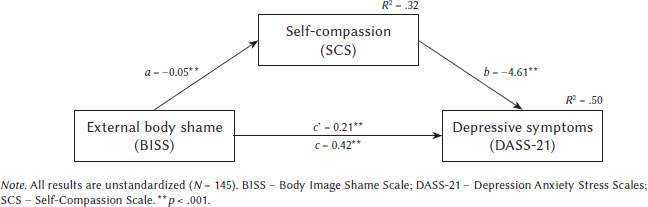
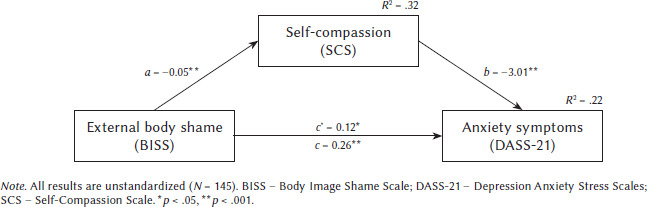
Given the absence of differences in psychological variables between individuals with alopecia and those with psoriasis, mediation analysis was conducted using the combined sample (n = 145). Additionally, given the absence of significant correlations between perceived condition severity and the dependent variables, this variable was not included as a covariate in the analyses. Two mediation analyses were conducted to examine whether self-compassion mediated the relationship between external body shame and symptoms of depression and anxiety.
The first model (Figure 1) explained 50% of depressive symptoms, F(2, 142) = 71.56, p < .001. External body shame significantly predicted depressive symptoms (c′ = 0.18, p < .001) and self-compassion (a = –0.05, p < .001). Self-compassion significantly predicted depressive symptoms (b = –3.80, p < .001). The indirect effect of external shame on depressive symptoms via self-compassion was significant (β = .21, p < .001, 95% CI [0.16, 0.25]), indicating partial mediation. The total effect of external shame on depressive symptoms was also significant (c = 0.42, p < .001), suggesting that lower self-compassion partially explains the association between higher external shame and greater depressive symptoms.
The second model (Figure 2) explained 22% of anxiety symptoms, F(2, 142) = 20.16, p < .001. External shame was a significant predictor of anxiety symptoms (c′ = 0.12, p = .048), and of self-compassion (a = –0.05, p < .001). Self-compassion significantly predicted anxiety symptoms (b = –3.01, p < .001). The indirect effect of external shame on anxiety symptoms through self-compassion was significant (β = .14, p < .001, 95% CI [0.06, 0.22]), again indicating partial mediation. The total effect of external shame on anxiety remained significant (c = 0.26, p < .001), supporting the role of self-compassion as a partial mediator in this relationship.
Discussion
Alopecia and psoriasis are autoimmune dermatological conditions that affect physical appearance. These changes are often associated with the development of body shame, which can increase the risk of symptoms of depression and anxiety (Hurrell, 2023). Conversely, self-compassion has been linked to improved psychological well-being, and studies about self-compassion in people with skin conditions are warranted (Clarke et al., 2022). Accordingly, this study aimed to compare psychological variables among the general population, individuals with alopecia, and those with psoriasis; to examine the associations between these variables; and to explore the role of self-compassion in the relationship between body shame and psychopathological symptoms among people with these dermatological conditions.
As expected, the results indicated that individuals from the general population generally reported lower levels of psychopathology and higher levels of self-compassion compared to those with dermatological conditions. More specifically, individuals with alopecia reported significantly higher levels of external body shame, depressive symptoms, and lower self-compassion than the general population. Those with psoriasis, on the other hand, reported significantly higher levels of anxiety. No significant differences were found between the alopecia and psoriasis groups. These findings are consistent with previous research showing that psychological disorders are more prevalent among individuals with dermatological conditions such as alopecia and psoriasis (Leisner et al., 2019; Macbeth et al., 2022). The burden of living with a visible skin condition, along with the associated changes in physical appearance, appears to contribute to increased body shame and reduced self-esteem, which in turn may lead to heightened symptoms of anxiety and depression (Bayani et al., 2023; Nazik et al., 2017; Welsh & Guy, 2009).
No significant differences in internal body shame were found between the three groups. As dermatological conditions, alopecia and psoriasis affect the skin and may lead individuals to fear negative evaluation from others (external body shame) due to visible deviations from socially accepted standards of beauty (Cash, 1999), such as hair loss or inflamed skin. In contrast, internal body shame reflects individuals’ own negative self-judgements about their bodies. It seems that individuals with alopecia and psoriasis expect others to judge their appearance more negatively than they judge it themselves.
The correlation analysis showed that internal and external shame were positively correlated with depressive and anxiety symptoms, which is in accordance with other studies reporting this association (Sick et al., 2020). A negative body image has been linked to poor mental health outcomes (Pawijit et al., 2019; Rodgers et al., 2023). Notably, among individuals with alopecia and psoriasis, external shame showed stronger correlations with depressive and anxiety symptoms compared to internal shame. This may be due to the nature of these dermatological conditions, which are beyond the individual’s control, potentially intensifying concerns about how others perceive them, rather than how they perceive themselves. The correlation analysis also revealed that self-compassion exhibited moderate to strong negative correlations with all other psychological variables. This suggests that being sensitive to one’s own suffering and responding with kindness and a desire to alleviate it (rather than with self-criticism and harshness) is inversely associated with shame, as well as symptoms of depression and anxiety. These results are also aligned with previous research on dermatological conditions (Clarke et al., 2022; Galhardo et al., 2022; Pisitsungkagarn et al., 2014; Stapleton et al., 2017).
Based on these associations, the mediation analysis predicting depressive symptoms and anxiety was tested, and the results demonstrated that for both outcomes, external shame and self-compassion exerted significant effects for people with alopecia and psoriasis. Specifically, external shame had a direct effect on depressive symptoms, with a significant part of this effect being mediated negatively through self-compassion. Similarly, external shame significantly predicted anxiety symptoms, with a significant part of this effect being mediated through self-compassion. These results provide evidence of the positive role of self-compassion on potentially decreasing the effect that feeling external shame in alopecia and psoriasis conditions might have in psychopathological symptoms such as depression and anxiety symptoms. Given that these conditions often involve visible changes in appearance (Hepat et al., 2023; Muntyanu et al., 2023), individuals may experience heightened concerns about how others perceive them, contributing to increased external shame. However, those who report greater self-compassion (characterised by self-kindness, mindful awareness, and a sense of common humanity) also tend to report fewer psychopathological symptoms. This association indicates that a more accepting and compassionate attitude toward oneself may be linked to better psychological outcomes in the face of appearance-related challenges. While no causal conclusions can be drawn, these results underscore the potential relevance of self-compassion in understanding how individuals psychologically respond to visible dermatological conditions.
Some limitations must be acknowledged. Firstly, as this is a cross-sectional study, any inference of causality should be made with caution. The sample sizes were relatively small, which is common in studies involving hard-to-reach populations, especially in Portugal due to its smaller population size. Additionally, there was an overrepresentation of women, which may reflect a greater willingness among women to participate in online surveys. This gender imbalance could also be influenced by the fact that alopecia tends to be more distressing for women, as hair loss in men is generally more expected and socially accepted. Accordingly, the demographic characteristics of the sample constrain the extent to which the findings can be generalised to broader populations. Although perceived condition severity was considered as a potential covariate, it did not show significant correlations with the dependent variables. A complementary assessment of severity using more formal and objective measures would have yielded more reliable and informative data. The mediation results should also be interpreted with caution, as alternative model structures may account for the relationships among variables; future research should compare different mediation models to clarify these pathways. Future research should also further analyse the specific components of self-compassion, as each may contribute differently to body shame and psychopathology in this population. It should also explore other important psychological factors, such as body image and illness adaptation, to help identify key areas to prioritise in therapeutic interventions. Such studies would benefit from larger, more representative samples and, where possible, longitudinal designs. Finally, additional potential confounders should be controlled for and measured using validated instruments, including condition severity, the presence of mental health diagnoses, and illness stage. Despite the limitations of the present study, the findings offer valuable insights into the interplay between body shame, depressive and anxiety symptoms, and self-compassion in individuals with alopecia. This study contributes to a relatively underexplored area of psychological research, offering novel perspectives and important empirical data. These findings may inform the development of tailored psychological interventions aimed at enhancing self-compassion and addressing emotional distress in this population. Clinically, this highlights the potential utility of compassion-focused therapies to mitigate body image shame and associated psychopathology in individuals living with visible dermatological conditions such as alopecia and psoriasis.