Background
Mental health disorders pose significant challenges to individual well-being and public health globally, prompting extensive research into their causes, consequences, and treatment approaches. Among these, obsessive-compulsive disorder (OCD) is a prevalent and chronic psychiatric condition characterized by intrusive, ego-dystonic thoughts (obsessions) and repetitive, ritualistic behaviors (compulsions) that severely impair daily functioning across personal, social, educational, and occupational domains (American Psychiatric Association, 2013; Vargas et al., 2021; White et al., 2024; Wu et al., 2023). OCD presents with notable clinical heterogeneity and is categorized into distinct subtypes such as cleaning, checking, repeating, ordering, hoarding, ritualistic thoughts, and pure obsession, each reflecting unique symptom profiles and underlying neurocognitive mechanisms (Moreno-Amador et al., 2023). Globally, OCD ranks as the fourth most common psychiatric disorder and is among the top ten causes of disability worldwide, with lifetime prevalence estimates between 1.9% and 3.3%. Epidemiological data consistently show a higher incidence in women, who are approximately 1.6 times more likely than men to be affected (Fawcett et al., 2020; Robbins et al., 2019).
Patients with OCD experience intrusive and distressing thoughts that they typically recognize as irrational but find difficult to control, resulting in significant psychological distress and functional impairment (Blanco-Vieira et al., 2023; Sadri Damirchi et al., 2020; Sharma et al., 2024). Contemporary dimensional models conceptualize OCD subtypes as emerging from the complex interplay of emotional vulnerabilities, primarily anxiety and depression, alongside cognitive inflexibility and dysregulation in goal-directed versus habitual behavioral systems (Robbins et al., 2019). This integrative perspective underscores the necessity of addressing both affective and cognitive factors in comprehensive treatment planning.
OCD is often considered within the anxiety disorder spectrum due to extensive symptom overlap and high rates of comorbidity. Up to 76% of individuals with OCD concurrently meet diagnostic criteria for at least one additional anxiety disorder, including generalized anxiety disorder, social anxiety disorder, or panic disorder (Berle et al., 2023; Fouche et al., 2022; Olatunji et al., 2013; Rosendahl et al., 2024; Sadri Damirchi et al., 2020). Anxiety symptoms not only exacerbate the severity of OCD but also act as proximal triggers for compulsive behaviors, such as checking rituals, which function as maladaptive coping strategies to alleviate distress (Radomsky et al., 2022). Experimental evidence further links anxiety-related impulsivity to greater OCD symptom severity (Wake et al., 2022). These findings highlight anxiety’s central role in maintaining OCD pathology and support targeting anxiety to optimize treatment outcomes.
Co-occurring depression is another common and debilitating condition in OCD populations, with over one-third of patients exhibiting clinically significant depressive symptoms (Belli et al., 2023; Pozza et al., 2021; Simkin et al., 2022). The chronic distress and impairment inherent in OCD frequently precipitate feelings of hopelessness, diminished self-worth, and depressive symptomatology, all of which predict poorer therapeutic response and functional outcomes (Kaur et al., 2023; Pozza et al., 2021; Tadayonnejad et al., 2022). Although evidence suggests a temporal pattern in which OCD symptoms often precede and may contribute causally to depression onset, the exact nature of this relationship remains incompletely understood. Moreover, studies report mixed findings regarding causality, with some indicating that improvements in OCD symptoms drive reductions in depression, while others propose that alleviating depression facilitates OCD symptom improvement (Bakhshaie et al., 2020; Simkin et al., 2022; Wetterneck et al., 2020). This bidirectional and complex interaction warrants further investigation to clarify treatment implications.
Given the high prevalence, significant burden, and complex clinical profile of OCD with its frequent affective comorbidities, it is imperative to refine and optimize effective treatment strategies. Exposure and response prevention (ERP) therapy is considered the gold-standard behavioral intervention for OCD, supported by a robust empirical base demonstrating its efficacy in reducing core OCD symptoms (Himle et al., 2024; Melchior et al., 2023; Reid et al., 2021a). Grounded in Mowrer’s two-factor theory of fear and avoidance, ERP targets the maladaptive conditioning processes that sustain OCD by systematically exposing patients to feared stimuli while preventing compulsive rituals that negatively reinforce avoidance behaviors (Hezel & Simpson, 2019; Himle et al., 2024; Melchior et al., 2023).
Through repeated and controlled exposure to anxiety-provoking triggers without a compulsive response, ERP facilitates habituation and inhibitory learning, enabling patients to tolerate distress and break the obsessive-compulsive cycle (Himle et al., 2024; Melchior et al., 2023; Reid et al., 2021a). Importantly, beyond symptomatic relief, ERP enhances emotional regulation, promotes psychological resilience, and improves quality of life (Remacle, 2022). Despite ERP’s well-documented efficacy for OCD symptoms, critical knowledge gaps remain regarding its effects on commonly co-occurring anxiety and depression. Specifically, the mechanisms by which ERP alleviates these affective symptoms are not fully elucidated, limiting the optimization of treatment approaches.
By disrupting avoidance behaviors and maladaptive emotional responses, ERP may reduce both anxiety and depressive symptoms, facilitating cognitive restructuring and improved distress tolerance. Understanding these mechanisms is vital, as anxiety and depression significantly influence OCD prognosis, treatment adherence, and functional recovery. Moreover, reductions in depression during ERP may enhance patients’ engagement and responsiveness to therapy, potentially serving as a predictor for improved overall outcomes.
Given these complexities, this study aims to rigorously evaluate the effectiveness of ERP therapy in reducing anxiety and depression symptoms among patients diagnosed with OCD. The findings seek to contribute to the advancement of integrated treatment models that comprehensively address the multifaceted challenges faced by individuals living with OCD and its common comorbidities.
Participants and procedure
Participants
This randomized controlled trial (RCT) employed a pretest-posttest design with two parallel groups. Participants were individuals diagnosed with OCD who were referred to the Razi Outpatient Clinic in Tabriz, Iran, between 2022 and 2023. Diagnoses were independently conducted by a licensed clinical team comprising psychologists and psychiatrists. Diagnostic procedures adhered to the Structured Clinical Interview for DSM-5 Disorders, Clinical Version (SCID-5-CV; First et al., 2016), supplemented by the self-report version of the Maudsley Obsessive-Compulsive Inventory (MOCI; Hodgson & Rachman, 1977). Both tools were administered by the clinical team to confirm OCD diagnoses prior to participant enrollment.
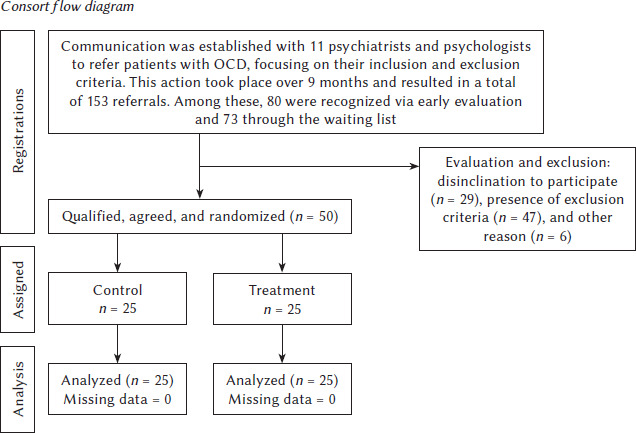
Out of 153 patients screened by a multidisciplinary team of 11 licensed psychiatrists and psychologists, 50 individuals met the DSM-5 diagnostic criteria for OCD and fulfilled all inclusion and exclusion criteria. The final sample (n = 50; 25 per group) was determined based on feasibility and prior ERP studies reporting medium between-group effect sizes (d ≈ 0.50) for symptom reduction (Abramowitz, 2006; Olatunji et al., 2013). To transparently assess statistical sensitivity, post hoc power calculations were performed using the pwr package in R. Assuming a between-group standardized effect of d = 0.50 (α = .05), a two-sample t test with n = 25 per group yields an achieved power of approximately 0.41. Using a conservative, approximate conversion (d → partial η2 → f2) to estimate sensitivity under the ANCOVA framework with one covariate (numerator df = 1; denominator df = 47), the achieved power is about 0.40. These calculations confirm that the study was underpowered to detect medium effects with high certainty. Accordingly, we report effect sizes (partial η2) and 95% confidence intervals alongside p-values and interpret the results with caution, emphasizing their clinical rather than purely statistical significance following conventional benchmarks for medium effects (Cohen et al., 2018), and underscoring the need for replication in larger and more diverse samples.
Participants were selected using stratified random sampling based on age (18-30 vs. 31-60) and sex to ensure balanced demographic representation across groups. Random assignment to the experimental (ERP) and control (waiting list) groups was conducted using the random number generator function in SPSS. The experimental group received ERP, while the control group was placed on a waiting list and received no active intervention during the study period. To uphold ethical standards, ERP treatment was offered to the control group after data collection was completed.
Each ERP session lasted 90 minutes and was delivered once a week over eight weeks. The intervention followed a manualized, evidence-based protocol adapted from Abramowitz’s (2006) cognitive-behavioral framework. This protocol has been previously validated in Iranian clinical settings (Ghassemzadeh et al., 2017), supporting its cultural relevance and contextual feasibility. To ensure treatment fidelity, therapists followed a structured session-by-session protocol. Adherence was monitored through supervision checklists, session recordings, and weekly clinical review meetings. Therapist engagement was maintained via real-time behavioral coaching, exposure planning, and motivational support. Repetition and progression through the exposure hierarchy were determined collaboratively with the client based on Subjective Units of Distress Scale (SUDS) ratings. To minimize bias, outcome assessments were conducted by trained clinical assessors who were blinded to participants’ group assignments. These assessors were independent of the ERP therapists, ensuring separation of intervention delivery and evaluation.
Baseline equivalence across groups was assessed both demographically and clinically. Chi-square tests revealed no significant between-group differences in sex, age group, marital status, or education level (p > .05), confirming demographic comparability. Clinical homogeneity was also established. Baseline anxiety and depression scores, assessed using validated measures, showed no statistically significant differences between groups (p > .05), as detailed in Table 2. This confirms clinical comparability and strengthens the internal validity of the trial. Independent-sample t-tests confirmed no statistically significant differences between groups at baseline (p > .05), supporting clinical comparability and strengthening the internal validity of the trial. A CONSORT flow diagram illustrating participant allocation and study progression is presented in Figure 1.
Table 1
Demographic characteristics of participants
Table 2
Means and standard deviations of pre-treatment and post-treatment anxiety and depression
Participants were eligible for inclusion if they met the following criteria: a primary diagnosis of OCD confirmed using the SCID-5-CV (First et al., 2016), age between 18 and 60 years, completion of at least high school education, permanent residence in Tabriz, Iran, absence of major psychiatric or medical conditions (other than secondary anxiety or depression symptoms), no history of substance or alcohol abuse, and willingness to participate voluntarily in all study phases. Exclusion criteria included: active suicidal ideation, unwillingness or inability to adhere to the research schedule, concurrent participation in other psychotherapy treatments, age below 18 or above 60 years, insufficient literacy to complete assessment tools, non-residence in Tabriz, and a history of severe psychiatric, neurological, or chronic physical illness.
The study adhered strictly to the ethical guidelines of the Declaration of Helsinki (2013 revision), emphasizing respect for individual autonomy, informed consent, confidentiality, and the right to withdraw at any time without consequences. The research protocol received full approval from the Ethics Committee of Salamat Gostar Research Center at the University of Mohaghegh Ardabili, Iran. All procedures involving human subjects were conducted under institutional oversight to ensure compliance with both local regulations and international ethical standards. Before enrollment, eligible candidates were provided with detailed oral and written information about the study’s purpose, methods, potential risks, and expected benefits. Written informed consent was obtained, with clear assurances that participants could withdraw at any time without penalty. Personal information was anonymized using secure coding and management systems, with unique identifiers assigned to each participant. No personal information was disclosed in any reports or publications, ensuring complete anonymity. Financial or therapeutic compensation was not provided, ensuring that all consent was voluntary and free from external pressure. Ethical standards were rigorously maintained throughout the study to protect participants’ rights, ensure their well-being, and uphold the integrity of the research. To enhance transparency and reproducibility, the authors confirm that de-identified data, analysis scripts, and ERP session materials are available upon reasonable request from the CORRESPONDING AUTHOR for academic and non-commercial use.
Instruments
In this study, the primary outcome measures were the Beck Anxiety Inventory (BAI) and Beck Depression Inventory (BDI), used to assess symptoms of anxiety and depression, respectively. Although the Structured Clinical Interview for DSM-5 (SCID-5-CV) and the Maudsley Obsessive-Compulsive Inventory (MOCI) were administered by the clinical team at the Razi outpatient clinic during the initial diagnostic screening to confirm OCD diagnosis, these instruments were not employed by the researchers for data collection, outcome measurement, or hypothesis testing. Therefore, they are not considered part of the study’s methodological framework.
Demographic characteristics checklist. A researcher-developed checklist was employed to collect baseline demographic data including age, sex, education level, and marital status. The checklist was designed for ease of administration and comprehensive data capture. Its face validity was confirmed by a panel of four experts in clinical psychology and health research.
Beck Anxiety Inventory (BAI). The BAI is a 21-item self-report questionnaire designed to assess the severity of anxiety symptoms. Total scores range from 0 to 63, with higher scores reflecting greater anxiety intensity (Beck et al., 1988). Each item is rated on a four-point Likert scale from 0 (not at all) to 3 (severely – I could barely stand it). The BAI has demonstrated excellent psychometric properties, including a high internal consistency (Cronbach’s α = .92) and good test-retest reliability (r = .77) (Beck et al., 1988). In a Persian validation study, Khesht-Masjedi et al. (2015) reported strong psychometric indices for the BAI, with an internal consistency of α = .88 and a test-retest reliability of r = .67. In the current study, the BAI demonstrated strong internal consistency, with a Cronbach’s α of .83.
Beck Depression Inventory (BDI). The BDI is a 21-item self-report questionnaire designed to assess the severity of depressive symptoms. Each item is rated on a scale from 0 to 3, yielding a total score ranging from 0 to 63, with higher scores indicating more severe depression (Beck et al., 1996). A comprehensive review of the BDI’s psychometric properties across diverse populations worldwide has demonstrated that it is a reliable and cost-effective instrument for measuring depression severity in both research and clinical settings (Smith et al., 2022). The BDI has undergone comprehensive validation in Iran, with numerous studies confirming its strong psychometric properties. Notably, Ahmadi et al.’s (2019) research demonstrated excellent scale reliability, reporting a Cronbach’s α of .87, further supporting the BDI’s effectiveness as a depression assessment tool in the Iranian population. In the present study, the BDI demonstrated strong reliability, achieving a Cronbach’s α coefficient of .81.
Exposure and response prevention (ERP). The experimental group participated in eight weekly ERP sessions, each lasting 90 minutes, implemented using a structured and evidence-based protocol adapted from Abramowitz’s (2006) cognitive-behavioral framework. The protocol’s efficacy has been supported in Iranian clinical settings (Ghassemzadeh et al., 2017), ensuring its cultural relevance.
ERP aimed to reduce compulsive behaviors by encouraging patients to actively face anxiety-inducing thoughts, images, or situations without performing rituals. The therapeutic process followed a graduated exposure plan, beginning with imaginal exposure and moving toward real-life (in vivo) exposure once patients demonstrated reduced distress and avoidance.
The ERP intervention consisted of five core phases:
Psychoeducation and diagnostic assessment: Patients were introduced to the cognitive-behavioral model of OCD and the rationale behind ERP. Baseline symptom assessments were conducted using structured clinical interviews.
Case conceptualization and problem definition: Individualized profiles of obsessions and compulsions were developed for each patient.
Construction of exposure hierarchy: A personalized and graded hierarchy of feared stimuli was collaboratively developed, based on the Subjective Units of Distress Scale (SUDS), ranging from 20 to 100. This included both covert (thought-based) and overt (situation-based) triggers.
ERP implementation and exposure techniques: Sessions involved prolonged and repeated exposures using techniques such as:
Imaginal exposure to intrusive thoughts (e.g., imagining contaminating a family member or forgetting to lock the gas valve).
In vivo exposure to feared situations (e.g., touching dirty objects without washing hands, or leaving home without checking repeatedly for safety).
Response prevention was enforced under therapist supervision during and between sessions.
Relapse prevention and maintenance: Patients learned strategies to handle trigger situations, monitor residual symptoms, and apply learned ERP techniques independently.
To ensure treatment fidelity, therapists followed a session-by-session manualized protocol, and adherence was monitored through supervision checklists and weekly clinical review meetings. Therapist engagement was maintained through active involvement in exposure planning, real-time behavioral coaching, and motivational reinforcement to sustain client participation.
Statistical analysis
Data were analyzed using SPSS version 23. Descriptive statistics (means and standard deviations) were used to summarize all variables. Group differences in post-treatment anxiety and depression were examined using one-covariate ANCOVA, controlling for baseline scores, with α = .05.
Prior to analysis, assumptions for ANCOVA were carefully checked. Normality of residuals was confirmed via Shapiro-Wilk tests (all p > .05), indicating approximate normal distribution. Levene’s tests showed homogeneity of variances for anxiety (F(1, 48) = 0.72, p = .400) and depression (F(1, 48) = 1.03, p = .310). Homogeneity of regression slopes was supported by non-significant interaction effects between group and pre-test scores for anxiety (F(1, 47) = 0.35, p = .560) and depression (F(1, 47) = 0.42, p = .520). Independence of observations was ensured through randomization.
Given that only two primary ANCOVAs were conducted, no correction for multiple comparisons was applied, maintaining the significance level at 0.05. Partial η2 was reported as the effect size for all ANCOVA results. Finally, an approximate post hoc power check confirmed that achieved power for medium effects was below the ideal level, justifying cautious interpretation of results in conjunction with the effect sizes and 95% confidence intervals.
Results
Table 1 presents the demographic characteristics of participants in both the experimental and control groups (n = 25 each). Chi-square tests confirmed no baseline differences in sex (χ2(1) = 1.00, p = .317), age group (χ2(1) = 0.16, p = .690), education level (χ2(2) = 1.20, p = .548), or marital status (χ2(1) = 0.08, p = .779), demonstrating demographic equivalence and supporting the internal validity of subsequent comparisons.
Table 2 summarizes means and standard deviations for anxiety and depression before and after treatment. In the experimental group, anxiety decreased from M = 33.80 (SD = 4.15) to M = 24.24 (SD = 3.80), Δ = –9.56, and depression from M = 31.15 (SD = 3.20) to M = 17.44 (SD = 3.60), Δ = –13.71. In contrast, the control group exhibited no meaningful change in mean scores across time points for either anxiety or depression, indicating stable symptom levels. These descriptive results indicate a clear intervention effect in the experimental group, warranting further inferential statistical testing.
Table 3 reports ANCOVA results controlling for baseline scores. For anxiety, there was a significant between-group effect, F(1, 47) = 19.20, p < .001, partial η2 = .290, consistent with a significant reduction in post-treatment anxiety in the ERP group. Baseline anxiety was also a significant predictor, F(1, 47) = 14.12, p < .001, partial η2 = .231. For depression, the between-group effect was larger, F(1, 47) = 115.91, p < .001, partial η2 = .711, with baseline depression also significant, F(1, 47) = 10.95, p = .002, partial η2 = .189. The reported partial η2 values informed post hoc power analyses and confirmed that the study was sufficiently sensitive to detect medium and large effects. These results demonstrate that, after controlling for baseline scores, ERP produced statistically significant and potentially clinically meaningful improvements.
Table 3
ANCOVA results for anxiety and depression symptoms
Table 4 presents adjusted post-treatment means, standard errors, and 95% confidence intervals (CIs) for anxiety and depression. After controlling for baseline scores, the ERP group’s adjusted mean for anxiety was 24.29 (SE = 1.19; 95% CI [21.89, 26.69]), compared to 33.85 (SE = 1.19; 95% CI [31.45, 36.25]) in the control group. For depression, the ERP group had an adjusted mean of 17.32 (SE = .68; 95% CI [15.95, 18.69]), versus 31.17 (SE = .68; 95% CI [29.80, 32.54]) in controls. These 95% CIs represent the range of adjusted mean values most consistent with the observed data under the fitted ANCOVA model, not the probability that the population mean lies within this interval. The largely non-overlapping intervals reflect the significant between-group effects and align with the effect sizes reported in Table 3, confirming the sensitivity of the study for medium to large effects and supporting the clinical relevance of ERP for symptom reduction.
Table 4
Adjusted posttreatment means, standard errors, and 95% confidence intervals for anxiety and depression
Discussion
The present study provides compelling evidence for the effectiveness of exposure and response prevention (ERP) therapy in reducing symptoms of anxiety and depression among individuals diagnosed with OCD. The medium to large effect sizes observed for both outcomes highlight the clinical relevance of ERP, extending beyond statistical significance. Moreover, the stability of anxiety and depression scores in the control group reinforces the specificity of ERP’s therapeutic effects and reduces the likelihood that the improvements were due to spontaneous remission or placebo responses. While these findings align with previous research identifying ERP as the gold-standard treatment for OCD, the present study extends the evidence base by demonstrating its substantial impact on comorbid affective symptoms. To fully appreciate the implications of these findings, it is crucial to examine the underlying behavioral and cognitive mechanisms underlying ERP and explore its broader therapeutic potential.
Given the relatively small sample size and limited statistical power, the findings should be interpreted with caution. Low power may increase both Type I and Type II error risks and reduce effect size stability. Thus, we emphasized partial η2 values from Table 3 and 95% confidence intervals from Table 4, interpreting the results by their clinical rather than statistical significance. These constraints, including the underpowered design and limited generalizability, underscore the importance of replication in larger, more diverse samples.
Behavioral and cognitive mechanisms of ERP
ERP operates on the foundational principles of Mowrer’s (1951) two-factor theory of fear and avoidance, which posits that anxiety responses are conditioned through classical conditioning and maintained via operant reinforcement. However, contemporary models of ERP emphasize additional mechanisms that contribute to its efficacy, particularly in addressing both anxiety and depression symptoms. One of the central mechanisms underlying ERP is prediction error, a concept rooted in inhibitory learning theory (Craske et al., 2014; Himle et al., 2024). During ERP, patients are systematically exposed to feared stimuli without engaging in compulsive behaviors, leading to a mismatch between their catastrophic expectations and the actual outcomes. This mismatch, or prediction error, disrupts maladaptive fear associations and facilitates the formation of new, non-threatening associations. Over time, this process reduces the intensity of anxiety responses and enhances the patient’s ability to tolerate uncertainty, which is a core difficulty in OCD (Hezel & Simpson, 2019). The repeated experience of prediction error not only diminishes fear but also fosters emotional resilience, enabling patients to confront distressing situations with greater confidence.
In addition to behavioral mechanisms, ERP induces significant changes in neural fear pathways. Neuroimaging studies have demonstrated that ERP reduces hyperactivity in the cortico-striato-thalamo-cortical loop, a neural circuit implicated in OCD pathology (Feusner et al., 2022; Melchior et al., 2023). Specifically, successful ERP has been associated with decreased activity in the orbitofrontal cortex and caudate nucleus, regions linked to obsessive thoughts and compulsive behaviors. Furthermore, ERP strengthens top-down regulatory control mediated by the prefrontal cortex, allowing patients to inhibit maladaptive responses and engage in more adaptive cognitive and emotional processing. These neural changes are critical for breaking the cycle of obsessions and compulsions and for reducing the heightened anxiety that characterizes OCD.
Another key mechanism is the role of cognitive processes in ERP. By systematically confronting feared stimuli and refraining from compulsive rituals, patients challenge and modify dysfunctional beliefs about harm, responsibility, and control. This cognitive restructuring fosters greater psychological flexibility and resilience, allowing patients to reinterpret intrusive thoughts as benign rather than threatening (Peeters et al., 2021; Reid et al., 2021b). Additionally, ERP promotes metacognitive awareness, helping patients recognize and disengage from unhelpful thought patterns. This is particularly beneficial for reducing both anxiety and depression symptoms, as it addresses the cognitive distortions that often underlie these affective states.
ERP and anxiety reduction
The significant reduction in anxiety symptoms observed in this study underscores ERP’s efficacy in targeting the core emotional and physiological responses associated with OCD. Anxiety is not only a hallmark feature of OCD but also a key driver of compulsive behaviors, as patients often engage in rituals to alleviate distress. ERP directly addresses this cycle by exposing patients to anxiety-provoking stimuli and preventing the use of compulsions as a maladaptive coping strategy. Over time, this process leads to habituation, wherein the patient’s anxiety diminishes naturally without the need for avoidance or ritualistic behaviors (Abramowitz, 2006; Song et al., 2022).
Moreover, ERP enhances emotional regulation by teaching patients to tolerate distress and uncertainty. This is particularly important in OCD, where intolerance of uncertainty often fuels obsessive thoughts and compulsive behaviors. By repeatedly confronting feared situations without engaging in avoidance, patients learn that anxiety is transient and manageable, which reduces their reliance on compulsions as a means of coping. This improved emotional regulation not only alleviates anxiety but also contributes to broader improvements in psychological well-being and daily functioning (Rosendahl et al., 2024).
ERP and depression reduction
In addition to its impact on anxiety, ERP significantly reduces depressive symptoms in patients with OCD. Depression frequently co-occurs with OCD, exacerbating functional impairment and distress. The mechanisms through which ERP alleviates depression are multifaceted. First, by breaking the cycle of avoidance and withdrawal, ERP aligns with principles of behavioral activation, a well-established treatment for depression. Patients who engage in ERP experience increased exposure to rewarding and meaningful activities, which counteracts the anhedonia and hopelessness characteristic of depression (Bakhshaie et al., 2020; Himle et al., 2024).
Second, ERP enhances self-efficacy and a sense of mastery over one’s symptoms. As patients successfully confront their fears and reduce compulsive behaviors, they gain confidence in their ability to manage distressing thoughts and emotions. This empowerment directly alleviates feelings of helplessness and low self-worth, which are central to depressive symptomatology (Song et al., 2022). Finally, ERP’s impact on emotional regulation and distress tolerance likely generalizes to depressive affect, further supporting its transdiagnostic utility (Melchior et al., 2023).
Clinical implications
The findings of this study have important implications for clinical practice. ERP should be delivered within a structured and supportive therapeutic framework, with skilled clinicians tailoring exposure hierarchies to the individual needs of each patient. Such expertise is critical for calibrating the intensity and pacing of exposures to optimize prediction error and inhibitory learning, while maintaining a supportive alliance that bolsters patient engagement (Himle et al., 2024). Embedding ERP within a broader cognitive–behavioral framework, one that integrates targeted cognitive restructuring of maladaptive beliefs and mindfulness techniques to enhance distress tolerance, can further amplify outcomes and guard against relapse (Melchior et al., 2023).
At a systems level, improving access to ERP is paramount. Expanding telehealth delivery, which has shown comparable efficacy to in-person ERP for OCD (Feusner et al., 2022), can overcome geographical and resource barriers, particularly in underserved regions. Incorporating measurement-based care, regularly tracking BAI and BDI scores, and deploying digital adjuncts, such as mobile apps for between-session assignments and ecological momentary assessments, can refine treatment responsiveness and promote patient self-management (Rosendahl et al., 2024; Song et al., 2022). Ultimately, investing in widespread clinician training programs, creating stepped care pathways that offer ERP as a first line intervention, and integrating technology-facilitated supports will ensure that the transformative benefits of ERP reach a broader spectrum of patients with OCD.
Conclusions
The present study provides compelling evidence for the efficacy of exposure and response prevention (ERP) therapy in significantly alleviating both anxiety and depression symptoms among individuals diagnosed with OCD. These findings not only reaffirm ERP’s well-established role as the first-line, evidence-based intervention for OCD, but also emphasize its broader therapeutic capacity to target frequently co-occurring affective disturbances.
The substantial improvements observed in both anxiety and depressive symptoms underscore ERP’s potential to enhance overall psychological functioning and promote greater autonomy in daily life among those living with OCD. This multifaceted effectiveness positions ERP as a clinically indispensable and pragmatically viable intervention, not only for core OCD pathology but also for its pervasive emotional comorbidities.
Given these outcomes, the integration and prioritization of ERP within routine clinical care are strongly recommended. This approach holds significant promise for optimizing long-term treatment outcomes and improving the overall quality of life for individuals contending with this complex and often debilitating disorder.
Limitations and future research directions
Despite the strengths of this study, which include a randomized controlled design and the use of psychometrically validated instruments, several limitations should be acknowledged. Identifying and addressing these limitations can guide future research and support the refinement of exposure and response prevention (ERP) for individuals diagnosed with OCD.
First, although the sample size was determined through an a priori power analysis with a statistical power of 0.90, the final number of participants (n = 50) is relatively small for evaluating the efficacy of a psychological intervention. Post hoc power calculations based on the observed effect sizes (partial η2 from ANCOVA) indicate that the study was underpowered for detecting medium effects with high certainty (achieved power ≈ 0.40), which increases the risk of Type II errors and warrants cautious interpretation of non-significant findings. This limited sample size may also restrict the generalizability of the results, particularly given the substantial heterogeneity in OCD symptom severity and presentation.
Second, the absence of a follow-up phase is an important limitation. Although the study demonstrated meaningful reductions in anxiety and depression symptoms immediately after the intervention, it remains unclear whether these improvements are sustained over time. Assessing long-term outcomes is particularly important in the context of chronic psychiatric conditions such as OCD. Future research should include follow-up assessments at multiple intervals, such as three, six, and twelve months after treatment, to examine the durability of ERP outcomes and to identify predictors of long-term maintenance (Song et al., 2022).
Third, conducting the study exclusively among patients in Tabriz, Iran, may limit the generalizability of the results to other populations or cultural contexts. Cultural differences can significantly affect the expression of OCD symptoms, treatment-seeking behaviors, and therapeutic responses (Rosendahl et al., 2024). Therefore, future research should seek to replicate these findings in various cultural and geographical settings in order to assess the broader applicability of ERP and to explore potential cultural modifications that may enhance its effectiveness.
Fourth, ERP was evaluated as a stand-alone intervention in this study. Although it is considered the most evidence-based treatment for OCD, recent research suggests that combining ERP with other therapeutic approaches, such as cognitive restructuring, mindfulness-based interventions, or pharmacotherapy, may lead to more comprehensive treatment outcomes (Melchior et al., 2023). Future studies are encouraged to explore the comparative effectiveness of integrated treatment models that combine ERP with complementary interventions.
Finally, although purposeful sampling was methodologically appropriate for this study’s clinical population, it may introduce selection bias and limit the external validity of the findings. This type of sampling tends to prioritize participants who meet specific inclusion criteria, which may reduce the representativeness of the sample. Future studies should consider using random sampling procedures and recruiting from multiple clinical sites. Moreover, the inclusion of individuals with a wider range of OCD symptom subtypes and comorbid conditions could offer a more comprehensive evaluation of ERP’s effectiveness across diverse clinical profiles.
In summary, while the present study offers valuable evidence on the effectiveness of ERP in reducing anxiety and depression among individuals with OCD, future research should address the noted limitations. By employing larger and more diverse samples, conducting long-term follow-ups, testing ERP across cultures, and integrating complementary interventions, future studies can contribute to optimizing ERP and expanding its clinical utility in broader and more complex treatment contexts.