

Background
Dyslexia, the most common developmental learning disability, affects reading and spelling skills, significantly disrupting the effectiveness of school learning in childhood or early adolescence. However, it is also a challenge for many adults in their everyday functioning (Catts et al., 2024). Depending on the source and developmental period considered, epidemiological data indicate that these difficulties affect between 7% (Yang et al., 2022), 10% (Hoeft et al., 2015), and even up to 20% (Shaywitz et al., 2021) of the population. This means that on average, one in 10 people struggles with this neurodevelopmental disorder. Today, it is well documented that dyslexia is shaped by various genetic, neurobiological, and environmental factors (Fletcher & Miciak, 2019; Habib, 2021; Peterson & Pennington, 2015; Richlan, 2020; Richlan et al., 2011; Zeffiro & Eden, 2000), and due to this complex set of factors, it is also a significant diagnostic challenge. Over the past decades, a few models for diagnosing developmental dyslexia have been analyzed and tested. In the United States, the procedures for identifying dyslexia in schools are overseen by the guidelines in the Individuals with Disabilities Education Improvement Act of 2004 (IDEA 2004; USA, 2011). IDEA 2004 details three methods for identifying dyslexia: (1) identifying a substantial gap between intellectual ability and achievement; (2) employing alternative research-based procedures, typically implemented through a pattern of strengths and weaknesses (PSW) approach; and (3) evaluating a student’s response to evidence-based intervention, commonly known as response to intervention (RtI). Fletcher et al. (2019) provide a detailed review of these methods.
In response to substantial criticism of models based on the discrepancy criterion and intervention response, significant hopes are attached to the PSW model (Hale et al., 2010). In this model, the diagnosis of dyslexia is based on identifying the presence of a PSW characteristic of this disorder within the structure of a student’s cognitive abilities (Schultz et al., 2012). Intelligence assessment can be an important source of information about the cognitive ability profiles of students within this model (Hale et al., 2010). Through accurate testing, alongside proper evaluation of strengths and weaknesses, the PSW differentiates specific learning disabilities from other conditions and determines the type and degree of the disorder. It can also provide tailored interventions based on the individual’s strengths and weaknesses profile (Mather & Schneider, 2023). The PSW model is based on the analysis of a broad spectrum of cognitive functions. Currently, the widely accepted theoretical framework for this is the Cattell-Horn-Carroll (CHC; McGrew & Evans, 2023) theory of intelligence.
In recent decades, this model has gained significant attention among researchers in psychology and education. The framework posits a hierarchical structure of intelligence that includes both narrow and broad cognitive abilities such as fluid reasoning, crystallized intelligence, quantitative reasoning, and short-term memory (Carroll, 1993; McGrew & Evans, 2023; McGrew, 2009). The popularity of CHC theory can be attributed to its comprehensive nature, which provides a coherent model that unifies previous theories, and its strong empirical foundations (Schneider & McGrew, 2018). In addition, its applicability in areas such as special education and cognitive assessment enables researchers to identify specific cognitive strengths and weaknesses, facilitating targeted interventions (Schultz et al., 2012). As a result, CHC theory has become a dominant paradigm in understanding cognitive functioning and educational outcomes in contemporary research (McGrew et al., 2023). Therefore, the authors of modern versions of well-known intelligence tests increasingly base their assessments on this theory (Roid, 2003; Roid et al., 2017; Wechsler, 2014). This alignment allows a more reliable evaluation of cognitive abilities, as these tests can effectively measure a broad spectrum of intelligence components outlined in the CHC framework.
However, this may present certain challenges. Our knowledge of cognitive profiles is primarily based on the variables currently included in the first stratum of CHC theory (Fletcher et al., 2019; McGrew, 2009; Poletti, 2016; Shaywitz & Shaywitz, 2005; Tobia & Marzocchi, 2014; Vellutino et al., 2004). It should be noted, however, that our understanding of how to effectively utilize the broader variables from the second stratum in diagnosing disorders based on the PSW paradigm remains limited. In the context of dyslexia, studies that comprehensively analyze all (or most) variables from the second stratum are notably lacking. Researchers often focus on individual variables (Abu-Hamour & Hmouz, 2018) or studies are conducted on exceedingly small groups (Becker et al., 2021). Analyzing the available research on dyslexia in the context of the second stratum variables, one can predict which areas individuals with dyslexia are likely to score lower in and those in which they should achieve scores comparable to the general population. The scope and number of broad variables of the CHC stratum II have evolved over the years (Carroll, 1993; Flanagan et al., 2000; Horn & Noll, 1997; McGrew, 1997; McGrew & Flanagan, 1998). Modern intelligence scales such as the Wechsler Intelligence Scale for Children, Fifth Edition (WISC-V; Wechsler, 2014) and Stanford-Binet Intelligence Scales, Fifth Edition (SB5; Roid, 2003; Roid et al., 2017) enable diagnosis of a maximum of five key variables (Table 1). Therefore, we focus on these in further considerations.
Table 1
Correspondence between SB5 and WISC-V indices and abilities in the CHC model
[i] Note. SB5 – Stanford-Binet Intelligence Scales, 5th ed.; WISC-V – Wechsler Intelligence Scale for Children, 5th ed.; CHC model –Cattell-Horn-Carroll model. Based on: Grégoire (2017), Roid (2003), Roid et al. (2017), and Wechsler (2014).
Students with dyslexia typically do not have deficits in fluid reasoning; rather, they usually experience challenges in the area of crystallized intelligence (Callens et al., 2012; Floyd et al., 2006; González-Valenzuela & Martín-Ruiz, 2022). Crystallized intelligence is reflected in a person’s general knowledge, vocabulary, and reasoning based on acquired information and is understood as the outcome of cultural and educational experiences, interacting with fluid reasoning (Happe, 2013). Fluid reasoning and students’ reading achievements support each other (Stanovich, 2008). It has been found that defects in semantic knowledge are the primary cause of dyslexia in students who do not have difficulties with word recognition (Catts et al., 2006). Furthermore, quantitative reasoning is not involved in the mechanism of reading difficulties. Notably, however, arithmetic learning disorders often co-occur with reading disorders (for an overview see Moll et al., 2014). Visual-spatial processing and skills are essential due to the complex visual sensory processing required for reading. Research indicates that children with dyslexia often struggle to develop effective visual strategies, and some of their reading difficulties may be related to visual-spatial deficits (Gori & Facoetti, 2015; Stein, 2014; Vidyasagar & Pammer, 2010). Nevertheless, the connection between visual-spatial abilities and reading proficiency remains inconclusive (for an overview see Giovagnoli et al., 2016).
Another important variable when considering dyslexia is working memory, which, along with memory span, is a key element of the short-term memory factor in the CHC model. Working memory is a cognitive system responsible for the temporary storage and manipulation of information. It refers to the limited amount of information that can be temporarily held and utilized while performing cognitive tasks, in contrast to long-term memory, which encompasses the extensive information accumulated over a person’s lifetime (Cowan, 2014). Research by Swanson and Berninger (1996) showed that a deficit in working memory capacity distinguishes children with and without dyslexia. Furthermore, other research has demonstrated that individuals with dyslexia exhibit inferior working memory performance compared to their non-dyslexic counterparts (Everatt et al., 2008; Swanson & Berninger, 1996; Taroyan et al., 2007). De Clercq-Quaegebeur and colleagues (2010) investigated the cognitive profiles of children with dyslexia, revealing that the Working Memory Index is significantly lower than other indices, with this deficiency present in 70% of the examined population. In addition, Beneventi et al. (2010) demonstrated in their research that deficits in working memory among dyslexic children can be observed through fMRI examinations. The fMRI data revealed reduced activation in the prefrontal and parietal cortices, as well as the cerebellum, in dyslexic individuals compared to the control group. There is, therefore, substantial evidence indicating that individuals with dyslexia exhibit lower working memory efficiency compared to the general population.
Fawcett and Nicolson (2017) highlight processing speed as a key factor affecting reading difficulties in individuals with dyslexia. For McInnes et al. (2003), students with specific learning disabilities (SLDs) also often struggle with processing speed. In this regard, Toffalini et al. (2017) investigated the cognitive profiles of children with various SLDs, including difficulties in reading, spelling, mathematics, and writing. Their findings indicated that all subgroups exhibited similar deficits in both working memory and processing speed.
For the reasons mentioned, it is essential to determine whether an assessment of intelligence, understood as a spectrum of broad cognitive abilities within the second stratum of the Carroll (1993) theory, reveals a profile of strengths and weaknesses among individuals with dyslexia.
In this study, a profile of the strengths and weaknesses of individuals with dyslexia was developed using the Stanford-Binet Intelligence Scales, Fifth Edition (SB5; Roid, 2003; Roid et al., 2017), as it is one of the leading intelligence tests currently providing the broadest depiction of intelligence (Gibbons & Warne, 2019). Therefore, this study sought to address the following questions:
What pattern of strengths and weaknesses across broad cognitive abilities (fluid reasoning, crystallized intelligence, quantitative reasoning, visual-spatial processing, short-term memory, and processing speed) is evident in individuals with dyslexia as measured by the SB5?
Does the SB5 reveal a relative weakness in crystallized intelligence and/or working memory (short-term memory) among individuals with dyslexia, consistent with previous research (Callens et al., 2012; De Clercq-Quaegebeur et al., 2010; Floyd et al., 2006; González-Valenzuela & Martín-Ruiz, 2022)?
To what extent does visual-spatial processing contribute to the cognitive profile of individuals with dyslexia as assessed by the SB5, considering the mixed findings in the literature (Fawcett & Nicolson, 2017; Giovagnoli et al., 2016; Gori & Facoetti, 2015; McInnes et al., 2003; Stein, 2014; Toffalini et al., 2017; Vidyasagar & Pammer, 2010)?
Participants and procedure
Participants
The study utilized data from the intelligence assessment of 3,458 children and adolescents diagnosed with dyslexia who were beneficiaries of the psychological-educational support system in Poland. The data were obtained from a publicly available national research panel (Olech et al., 2024). Participants included in the analysis met the following criteria: (1) they had a confirmed diagnosis of dyslexia; (2) their age ranged from 10 years and 0 months to 19 years and 11 months; and (3) they had undergone a comprehensive intelligence assessment using the full version of the Stanford-Binet Intelligence Scales, Fifth Edition (SB 5; Roid, 2003; Roid et al., 2017) with complete results available. None of the participants included in the study had any diagnosed comorbid disorders, ensuring that the cognitive profiles examined are specific to dyslexia without the confounding effects of additional diagnoses. Missing data were allowed for demographic variables, except for gender and age.
The mean age of participants was 13.13 years (median = 13, SD = 1.95). Among them, 2,213 (64%) were boys and 1,245 (36%) were girls. The distribution of participants by residential area was as follows: countryside – 1,007 participants (29%), city – 2,443 participants (71%), and data were missing for 8 participants (< 1%). The distribution of maternal education levels was: primary or lower secondary – 155 participants (4%), vocational – 422 participants (12%), secondary – 758 participants (22%), higher – 1,026 participants (30%), and data were missing for 1,097 participants (32%). The distribution of paternal education levels was: primary or lower secondary – 89 participants (3%), vocational – 375 participants (11%), secondary – 400 participants (12%), higher – 340 participants (10%), and data were missing for 2,254 participants (65%).
In summary, the sample predominantly comprised boys (64%), which may reflect a higher identification or diagnosis rate of dyslexia in this demographic. A considerable proportion of participants lived in cities (71%), potentially indicating better access to psychological-educational support systems in urban areas. However, a significant amount of missing data regarding parental education, especially for fathers (65%), poses limitations on analyzing the influence of this variable. Despite these constraints, the large sample size offers valuable insights into the characteristics of children and adolescents with dyslexia in Poland.
Ethics approval and consent to participate
This study was performed in line with the principles of the Declaration of Helsinki. Approval was granted by the Ethics Committee for Research Projects at the Faculty of Social Sciences, University of Gdansk, Poland (decision no. 13/2022). The protocol of this study has been registered at https://clinicaltrials.gov/ , registration number: NCT06215092. Parental consent was obtained for all participants.
Results
To examine the extent to which the intelligence scores of children and adolescents diagnosed with dyslexia differ from the established population norms, a series of one-sample t-tests were conducted for each of the 18 standardized SB5 scores. This approach allowed us to determine whether the mean scores in the sample significantly differed from the population average standardized for each test: for the 10 SB5 subtests, the population mean was M = 10, SD = 3, while for the 8 IQ scores, the population mean was M = 100, SD = 15.
In cases where statistically significant differences were identified, Cohen’s d was calculated to estimate the magnitude of the effect. The interpretation of Cohen’s d followed the standard guidelines for small, medium, and large effects (Cohen, 1988). Table 2 provides the descriptive statistics, t-test results, Cohen’s d values, and the interpretation of effect sizes. In addition, Figures 1 and 2 present a graphical illustration of the intelligence profile of children and adolescents diagnosed with dyslexia using box-and-whisker plots. The plots display the means (dots within the boxes), medians (lines within the boxes), and assumed population scores (dashed lines).
Table 2
Descriptive statistics, t-test results, and effect sizes (Cohen’s d) for SB5 scores in children and adolescents diagnosed with dyslexia
Figure 1
Box-and-whisker plot for nonverbal and verbal SB5 subtest scores in children and adolescents diagnosed with dyslexia
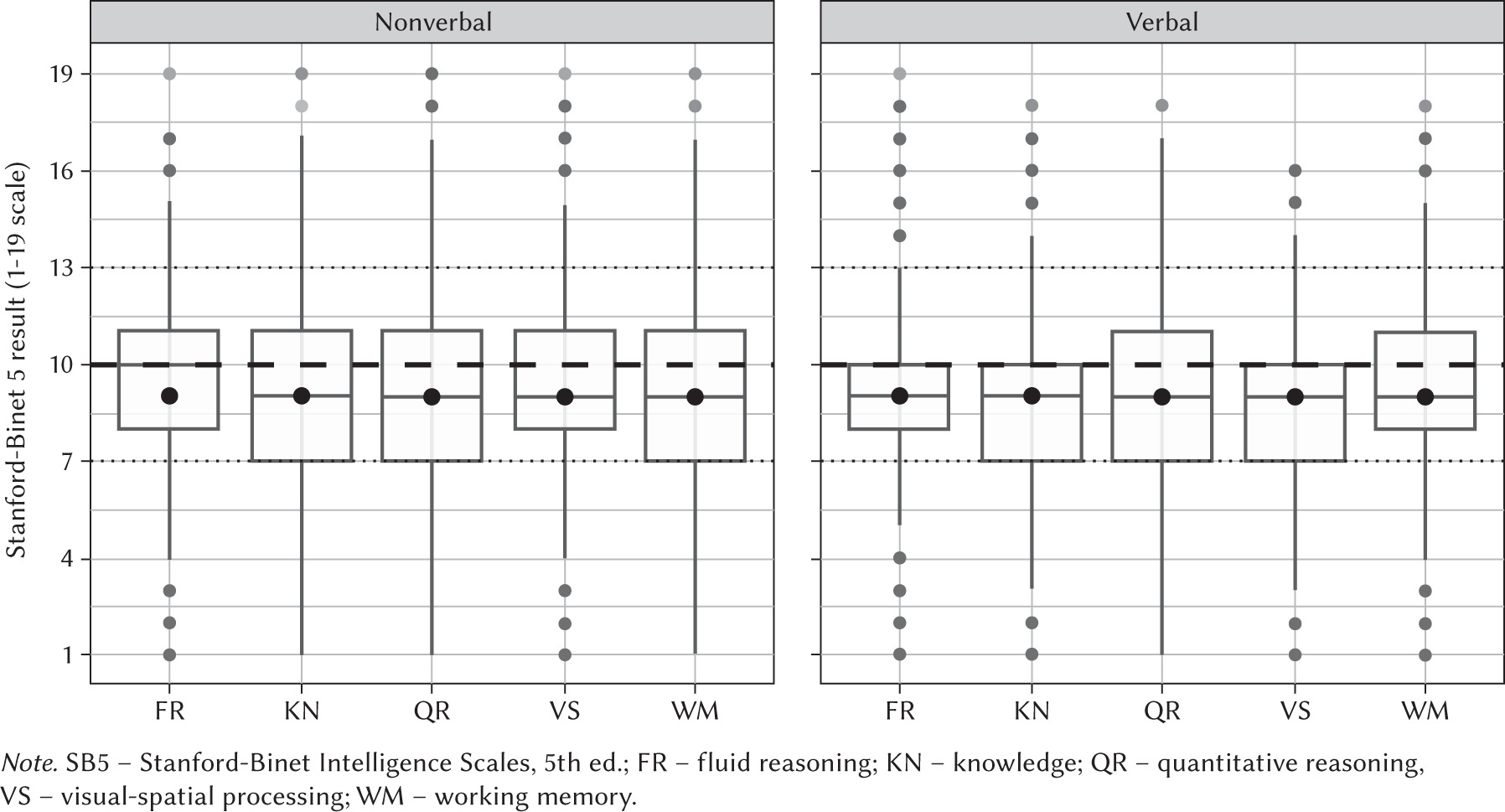
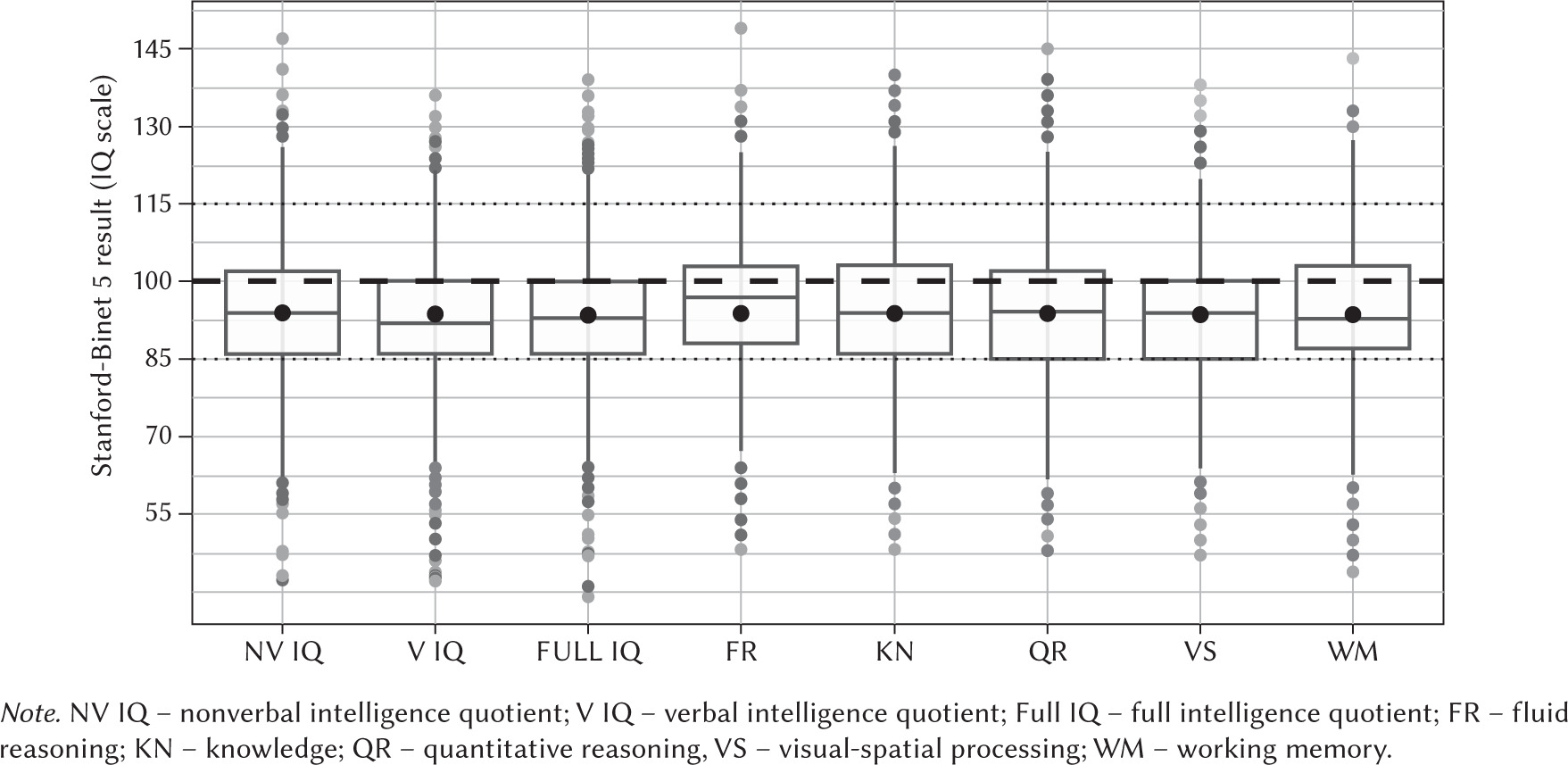
The results indicate that children and adolescents diagnosed with dyslexia score significantly lower than the population average across all 18 SB5 measures, with effect sizes ranging from small to large. The largest deficits were observed in verbal abilities (knowledge and visual-spatial processing) and specific IQ indices including verbal IQ, general IQ, knowledge IQ, visual-spatial processing IQ, and working memory IQ, suggesting that these areas are particularly impacted in this population.
Discussion
The findings of this study provide substantial empirical support for the applicability of the CHC theory in understanding the cognitive profiles of individuals with dyslexia. Consistent with previous research (Callens et al., 2012; Floyd et al., 2006), our results indicate that individuals with dyslexia exhibit significant weaknesses in crystallized intelligence, visual-spatial processing, and working memory, while their fluid reasoning remains relatively preserved. These findings align with the CHC model’s distinction between broad cognitive abilities and their respective impact on learning outcomes (McGrew & Evans, 2023).
While our findings emphasize significant deficits in crystallized intelligence, working memory, and visual-spatial processing, a closer examination of the results reveals a distinct pattern of relative strengths within the sample. Specifically, fluid reasoning emerged as the most preserved domain, as indicated by the smallest effect sizes across the SB5 subtests and indices associated with this construct. This is consistent with prior research showing that individuals with dyslexia often perform comparably to the general population on tasks requiring novel problem-solving and abstract reasoning (Callens et al., 2012; Floyd et al., 2006). Quantitative reasoning also showed relatively mild deficits, which may reflect its reliance on similar fluid cognitive processes. These preserved abilities are of practical importance, as they may serve as a foundation for developing compensatory strategies in areas of weakness. Educational interventions that incorporate problem-solving, logical reasoning, and pattern-based approaches may be particularly beneficial in leveraging these cognitive strengths to enhance overall academic functioning.A key implication of our results is the nuanced relationship between intelligence profiles and dyslexia diagnosis within the PSW framework. While PSW approaches emphasize cognitive variability in identifying dyslexia (Hale et al., 2010), our findings reinforce concerns regarding their diagnostic accuracy (Dombrowski et al., 2025). As our study demonstrates, cognitive deficits among individuals with dyslexia follow a generalizable pattern rather than highly individualized variations. This calls into question the extent to which the PSW model, relying on intra-individual discrepancies, can be used as a primary diagnostic tool for dyslexia. Instead, a multidimensional assessment incorporating phonological processing measures and reading-specific deficits remains essential (Snowling et al., 2020).
The significant weaknesses observed in working memory corroborate prior studies that highlight its crucial role in reading and learning (De Clercq-Quaegebeur et al., 2010; Swanson & Berninger, 1996). Working memory deficits are well documented in individuals with dyslexia and associated with difficulties in phonological processing, reading fluency, and text comprehension (Beneventi et al., 2010; Cowan, 2014). Our findings further emphasize that working memory should be considered a core component in dyslexia assessments, aligning with the broader CHC framework, which positions working memory as an integral cognitive ability (McGrew, 2009).
Our study also highlights the role of visual-spatial processing in dyslexia. Although the relationship between visual-spatial processing and reading proficiency remains inconclusive (Giovagnoli et al., 2016), our findings suggest that children with dyslexia perform significantly lower on tasks requiring visual-spatial skills. This finding supports the hypothesis that reading difficulties may partly stem from deficits in visual-spatial attention (Stein, 2014; Vidyasagar & Pammer, 2010). However, given the variability in previous findings, further research is needed to clarify the exact role of visual processing in dyslexia.
Our findings also contribute to the ongoing debate regarding the role of general intelligence in dyslexia. While our results confirm that individuals with dyslexia score significantly lower on measures of general intelligence (IQ), these deficits are not indicative of intellectual disability. Instead, they reflect specific cognitive weaknesses that impact reading development (Kavale & Forness, 2000). This supports the growing consensus that dyslexia should not be conceptualized as a disorder linked to global intellectual functioning but as a specific learning disability with distinct neurocognitive correlates (Pennington, 2006; Peterson & Pennington, 2015).
In conclusion, our study underscores the relevance of the CHC theory in understanding the cognitive underpinnings of dyslexia. The observed weaknesses in crystallized intelligence, working memory, and visual-spatial processing highlight the importance of targeted interventions aimed at addressing these cognitive deficits. Moreover, our findings call for a balanced approach to dyslexia diagnosis, where intelligence testing serves as a supplementary rather than a definitive criterion. By integrating cognitive assessment within a broader diagnostic framework, clinicians and educators can develop more effective support strategies for individuals with dyslexia.
Limitations and future research
Despite the significant contributions of this study, several limitations must be acknowledged. First, while our sample size is large, it is limited to children and adolescents diagnosed with dyslexia within the Polish educational system. Future studies should aim to replicate these findings in diverse cultural and linguistic contexts to ensure broader generalizability.
Another limitation is the cross-sectional nature of our study. Longitudinal research is needed to examine how cognitive profiles evolve over time in individuals with dyslexia and whether targeted interventions can mitigate observed deficits in working memory, crystallized intelligence, and visual-spatial processing. In addition, the exclusion of processing speed from the SB5 assessment limits our ability to explore its potential role in dyslexia, despite existing evidence suggesting its relevance (Fawcett & Nicolson, 2017; Toffalini et al., 2017). Future research should therefore explore the impact of processing speed using alternative assessment tools.
Furthermore, while our study contributes to the discussion on the diagnostic value of the PSW model, more research is needed to determine the most effective diagnostic approaches. Combining cognitive assessment with neuroimaging techniques could provide deeper insights into the neural mechanisms underlying dyslexia and help refine existing diagnostic frameworks.
Conclusions
This study reinforces the value of the CHC theory in understanding the cognitive profiles of individuals with dyslexia, highlighting specific weaknesses in crystallized intelligence, visual-spatial processing, and working memory. These findings challenge the reliance on the PSW model as a primary diagnostic tool, suggesting a more consistent pattern of cognitive deficits across individuals with dyslexia. The critical role of working memory in reading and learning is further emphasized, advocating for its inclusion as a core component of dyslexia assessments and targeted interventions.
Ultimately, this research underscores the need for a comprehensive and theoretically grounded approach to dyslexia diagnosis and intervention. By integrating cognitive assessment within the CHC framework alongside measures of phonological processing and reading-specific skills, clinicians and educators can develop more effective and targeted interventions. Intelligence testing should serve as a supplementary tool, and future research should focus on longitudinal studies to examine the evolution of cognitive profiles and the effectiveness of targeted interventions in mitigating deficits associated with dyslexia.

