

Background
Empathy is essential for effective practice in helping professions, particularly in patient-centered care (Omid et al., 2018). High empathy fosters professionalism among medical and psychology students. To develop these skills, educators implement interventions aimed at maintaining or enhancing empathy (Batt-Rawden et al., 2013; Chen et al., 2017; Williams et al., 2015). However, research highlights a persistent decline in empathy among students in both medical and social sciences, underscoring the need for stronger interventions (Konrath et al., 2011; Sobczak et al., 2021).
Empathy levels correlate with psychological and neurodevelopmental conditions, including autism spectrum disorder (ASD), narcissism, and borderline personality disorder (BPD) (Baron-Cohen, 2015). Observational studies suggest a rising prevalence of ASD traits among students, aligning with global trends in ASD diagnoses (Sobczak et al., 2021). Whether this increase reflects improved awareness, refined diagnostic criteria, or genuine prevalence shifts remains uncertain (Elsabbagh et al., 2012; Latif & Williams, 2007). Further research is needed to explore these patterns and their implications.
Empathy decline also relates to broader psychological and societal changes, including a rise in narcissistic traits. While empathy fosters prosocial behavior, narcissism – especially in its pathological form – diminishes emotional resonance and impairs relationships (Burgmer et al., 2021; di Giacomo et al., 2023). Lower empathy may reinforce self-focused behaviors linked to narcissistic personality disorder (NPD) (Eddy, 2023; Hepper et al., 2014). Although NPD remains relatively rare, its prevalence appears to be increasing (Gawda, 2018; Tyrer et al., 2015). Durrani (2023) reported a 30% rise in narcissistic traits over four decades, while Pickering (2023) identified a 17% prevalence of NPD among first-year medical students, suggesting that academic environments may shape these traits.
Narcissism, marked by inflated self-importance, a need for admiration, and low empathy, significantly impacts interpersonal relationships and social functioning (Milligan et al., 2022; Podzimek, 2019). The Narcissistic Personality Inventory (NPI) remains the most widely used tool for assessing narcissistic traits. Research links narcissism to factors such as gender and age, but findings vary across cultures and educational settings (McManus et al., 2022; Weidmann et al., 2023). The academic environment and field of study may also influence its expression.
Recent research highlights increasing narcissistic traits among university students, though cultural differences play a role (Twenge et al., 2008). Some studies suggest that academic environments shape personality traits differently. Medical students, for instance, face intense academic pressure and competition, fostering confidence and assertiveness—traits associated with narcissism (Steiner-Hofbauer & Holzinger, 2020; Yu et al., 2016). In contrast, psychology students engage in empathy-driven education, potentially developing different personality traits. However, findings on field-of-study differences in narcissism remain inconsistent (Giusti et al., 2021; Wielewska et al., 2022). While some studies have reported higher narcissism among medical students, others have found no significant differences (Bujok et al., 2024).
Cultural context also shapes narcissistic traits, with societal values and education systems influencing how narcissism manifests across demographics (Hudson, 2012; Li & Benson, 2022). Understanding these factors is crucial in a globalized education landscape.
This study examines the relationship between narcissism, gender, and academic field (medicine vs. psychology) in an international context. By analyzing data from students at Polish and French universities, it investigates whether gender and academic field interact in shaping narcissistic traits. Additional demographic factors, such as age, are considered to provide a comprehensive perspective on narcissism in young adults.
Drawing on data from 1,092 students from two Polish universities and one French university, this study offers insights into how personality traits develop across educational and cultural contexts. Its findings may inform educational strategies, psychological interventions, and international research on personality development.
Participants and procedure
Study design
The research followed the principles of Enhancing the QUAlity and Transparency of Health Research (EQUATOR) guidelines, specifically Strengthening the Reporting of Observational Studies in Epidemiology (STROBE).
This cross-sectional study used a quantitative method with the computer-assisted web interview (CAWI) technique. We administered the digitized questionnaire through a professional online research platform (www.eBadania.pl). Implementing the CAWI technique enhanced the study’s credibility and validity. The online questionnaire format improved sampling quality, especially in sensitive research areas, by eliminating the researcher’s presence, ensuring respondent anonymity, and allowing participants to withdraw at any time. Additionally, it enabled respondents to choose when and where to participate.
From a technical perspective, digitizing the survey reduced missing data and prevented survey farming (multiple submissions by the same respondent) by automatically blocking the IP addresses of devices attempting repeated access.
However, this method has limitations. A key drawback is the lack of representativeness and the inherently inclusive nature of participant selection, even in targeted sampling. Additionally, internet access constraints limit respondent availability, and researchers cannot calculate the response rate or ensure representativeness beyond quota sampling.
Data collection
The data were collected between May 10, 2023, and February 19, 2024. Invitations to participate in the study were distributed to the participants through the administrative structures of the universities. For recruitment, we used university mailing lists, newsletters, student research clubs, and university social media platforms.
Sample
Participants (N = 1092, Mage = 21.90, SDage = 2.40) were students of medicine and psychology in France and Poland (Table 1). In France (n = 506), both medicine and psychology students were recruited at the University of Caen Normandy. In Poland (n = 586), psychology students came from the University of Gdansk and medicine students from the Medical University of Gdansk. The total sample included 825 women (77.5%), with 400 in the French sample (79.1%) and 425 (72.5%) in the Polish sample. Women were the majority both among psychology and medicine students, but the gender disproportion was higher for those studying psychology (84.9% vs. 67.8% women in France and 83.6% vs. 65.7% women in Poland). Current year of study was not controlled during the recruitment process. As a result, students from Poland (M = 22.70, SD = 4.20) were older than students from France (M = 20.90, SD = 4.00). In the French sample, the average age of psychology (M = 20.90, SD = 4.70) and medicine (M = 21.00, SD = 2.10; t(495.26) = 0.58, p = .559) students was similar, while in the Polish sample, psychology (M = 23.80, SD = 4.70) students were older than medicine students (M = 22.00, SD = 2.50; t(273.86) = –4.27, p < .001). Details about the year of studies and age can be found in Tables 2 and 3, respectively.
Table 1
Size and characteristics of the study group
Table 2
Counts and percentages for gender and year of study groups
Instrument
Narcissistic Personality Inventory. In the study, we used the Narcissistic Personality Inventory (Raskin & Hall, 1979) in its French adaptation (Braun et al., 2016) and in a Polish translation. Although a Polish adaptation of the NPI test exists (Bazińska & Drat-Ruszczak, 2000), we did not use it due to the modified response format. In the original tool and its French adaptation, a forced-choice format was applied, where participants selected one of two statements. The entire NPI test consisted of 40 pairs of statements. In the Polish adaptation, the anchoring of the statements was modified to a 5-point scale: 1 (not me), 2 (rather not me), 3 (hard to say), 4 (rather me), 5 (this is me). Aware of the limitations, we used a Polish translation of the NPI version based on the dichotomous response format (IDRlabs, 2024). In the pilot study, linguistic corrections were made to the French version, which were consulted with and approved by the psychologists conducting this study (see Supplementary materials).
In the current sample, both French and Polish versions achieved satisfactory internal consistency measured with Cronbach’s α (αFrance = .84, αPoland = .84). Alhough French and Polish versions are adaptations of the same instrument, they were not designed to be equivalent. Indeed, the mean total score in the Polish sample (M = 13.90, SD = 6.60) was higher than in the French sample (M = 10.60, SD = 6.00). Thus, to avoid unwarranted comparisons, for some analyses NPI results were z-scored, separately for French and Polish samples.
In addition to the NPI test, we included a section in the questionnaire to collect independent variables for this study, focusing on the socio-demographic situation of the participants, their motivation for pursuing studies, and two questions regarding participation in psychological therapy and psychiatric treatment. Three additional questions addressed self-assessment: the enjoyment of helping others and the perception of one’s self-worth (see Supplementary materials). Due to the extensive material, in this article we limited the presentation of results to the analysis of the frequency of narcissistic traits and participation in psychological therapy and psychiatric treatment.
Ethical considerations
We informed participants about the study’s assumptions, objectives, procedure, duration, and conduct. Each participant provided informed consent before taking part. Participation was entirely voluntary and anonymous. Participants could withdraw from the study at any time. Additionally, we provided students with information about how their personal data would be processed. The study did not collect or process images or sensitive data. All participants gave informed consent before inclusion in the study. The research was positively evaluated and approved by the Independent Bioethics Commission for Research at the Medical University of Gdansk (NKBBN/859/2022-2023) and approved by Comité d’Éthique de la Recherche en Santé Université de Caen Normandie). An agreement on cooperation, specifying the framework of the research, research procedures, and the principles of collecting and processing personal data of patients, has been concluded between the entities implementing the study. The study was conducted under the supervision of the Data Protection Officer, in accordance with the provisions of the European Parliament and of the Council (EU) Regulation (EU) 2016/679 of 27 April 2016 on the protection of natural persons with regard to the processing of personal data.
Data analysis
Since narcissism is known to be higher in men and to decrease with age (Weidmann et al., 2023) and our sample was not balanced with respect to these variables, we decided to use an ANCOVA (analysis of covariance) model to test our main hypothesis regarding the mean narcissism level in medicine and psychology students. The model included age as a covariate and gender as the other factor (with program being the factor of interest). Separate models were tested for French and Polish samples. Our hypothesis did not predict an interaction of program with gender, so initially the interaction term was not included in the model. After we had inspected the data, we decided to run an exploratory analysis that included the interaction term and to further test a three-way model that included country as a factor and allowed us to compare the effects observed within countries.
To test the normality of residuals of our models we used the Shapiro-Wilk test. Homogeneity of residual variances was tested with Levene’s test. Interaction of the covariate with model factors was tested using ANOVA (analysis of variance). To adjust for multiple comparisons, p-values of post-hoc tests were calculated using the multivariate t distribution and Monte Carlo method.
For all the analyses we used the significance level α = 0.05.
We analyzed the data using R statistical software (R Core Team, 2024). We used the car package for ANCOVA (Fox & Weisberg, 2011), emmeans (Lenth et al., 2024) for post-hoc tests, and tidyverse (Wickham et al., 2019) for data wrangling and visualization.
Results
Raw NPI scores
Students from France on average obtained 10.60 (SD = 6.00) points in the NPI. Students from Poland scored 12.90 points (SD = 6.60). The difference between Polish and French samples was significant (t(1086.1) = –6.19, p < .001), but it may be a result of either true differences in the narcissism level or the differences in the NPI-40 measurement characteristics, as different language versions were used. In both samples, NPI-40 test results indicated higher levels of narcissism in men than in women (tFrance(116.73) = –2.44, pFrance = .016, tPoland(235.61) = –2.93, pPoland = .004). Means and standard deviations are provided in Table 4.
Table 4
Means and standard deviations of the Narcissistic Personality Inventory results
NPI scores and program
In both samples, medical students scored slightly higher to a minor degree in NPI-40, but in neither case was the difference statistically significant (tFrance(284.9) = 1.48, pFrance = .141, tPoland (479.3) = 1.25, pPoland = .211; see Table 4 for means and standard deviations). Distributions of z-scored NPI results are presented in Figure 1.
Figure 1
Narcissistic Personality Inventory (NPI) results z-scores among medicine and psychology students from France and Poland
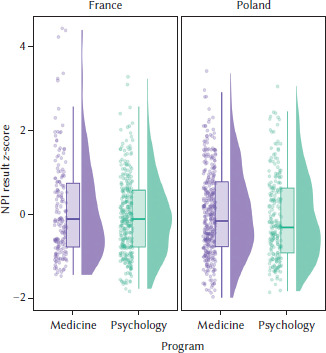
Analysis of variance showed that when age and gender were controlled, there were also no significant differences in NPI scores between medicine and psychology students (FFrance(1, 490) = 0.75, pFrance = .386, FPoland(1, 573) = 0.47, pPoland = .492). At the same time, male gender was a significant predictor of higher NPI-40 scores in both France (F(1, 490) = 10.58, p = .001) and Poland (F(1, 573) = 8.30, p = .004; see Table 4 for means and standard deviations). In the French sample, narcissism differed with age (F(1, 490) = 16.17, p < .001). For the Polish students, narcissism and age were not significantly related (F(1, 573) = 0.08, p = .781). It should be noted that the model including just age, gender and program of studies explained less than five percent of the variance of the NPI results in the French sample (R2adj = .04, F(3, 490) = 8.73, p < .001) and about one percent of the variance in the Polish sample (R2adj = .01, F(3, 573) = 3.51, p = .015). For the model fitted on the data from France, variances of the residuals were not homogeneous (F(3, 490) = 5.74, p < .001). There was no similar issue with the model fitted on the Polish sample (F(3, 573) = 0.92, p = .431).
Exploratory analysis: interaction of gender and program
After visual inspection of the data (see Figure 2), we decided to run an additional analysis using models that included an interaction term for gender and program. The interaction term was significant for both France (F(1, 489) = 4.60, p = .032) and Poland (F(1, 572) = 12.76, p < .001). Gender was again a significant predictor of NPI result in both France (F(1, 489) = 10.03, p = .002) and Poland (F(1, 572) = 18.79, p < .001), while program remained non-significant (France: F(1, 489) = 3.76, p = .053; Poland: F(1, 572) = 2.73, p = .099). Post-hoc tests showed that in France, men studying medicine were more narcissistic than men studying psychology (t(489) = 2.30, p = .042), while for women this difference was not significant (t(489) = –0.23, p = .967). In Poland, there also was no significant difference between women studying medicine and those studying psychology (t(572) = 2.17, p = .060). Opposite to the results for France, men studying psychology were significantly more narcissistic than those studying medicine (t(572) = –2.90, p = .008). Once again, the models explained up to 5% of the variance of the NPI-40 scores (France: R2adj = .05, F(3, 490) = 7.74, p < .001; Poland: R2adj = .03, F(4, 572) = 5.87), p < .001).
Figure 2
Differences in Narcissistic Personality Inventory (NPI) z-scores between men and women studying medicine and psychology
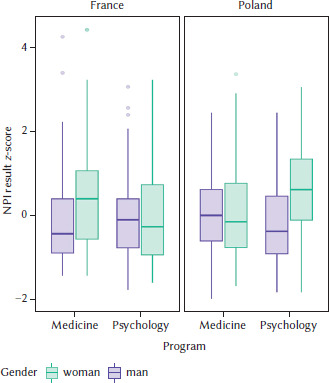
To evaluate whether the directions of the gender-program interactions were significantly different in France and Poland, we fit a model that included country as a factor. The three-way interaction between country, gender, and program was significant (F(1, 1062) = 17.06, p < .001), but this result should be interpreted with extreme caution.
Participation in psychological therapy
In France, 46.6% of students reported that they had participated in psychological therapy, while in Poland this percentage was slightly lower (42.5%), but the difference was not statistically significant (χ2(1, 1092) = 1.73, p = .189).
Women participated in psychological therapy more often than men among Polish (47.1% vs. 27.0%, χ2(1, 577) = 17.75, p < .001) and French students (48.0% vs. 38.3%), but in France this difference in proportions between men and women was not statistically significant (χ2(1, 494) = 2.51, p = .113). The proportion of those who had participated in psychological therapy was significantly higher among psychology compared to medicine students in both the Polish (51.1% vs. 37.1%, χ2(1, 586) = 10.54, p = .001) and the French sample (51.5% vs. 37.4%, χ2(1, 506) = 8.62, p = .001). This result was potentially a consequence of the higher proportion of women among psychology students. Thus, we checked whether psychotherapy participation was more common among psychology students than among medicine students for women and men separately. It was so among women both in Poland (χ2(1, 425) = 3.85, p = .0497, please note the marginal value of p) and in France (χ2(1, 400) = 4.95, p = .026). Among men, psychotherapy participation was similarly common among medicine and psychology students (Poland: χ2(1, 152) = 0.04, p = .851; France: χ2(1, 94) = 0.88, p = .349).
Participation in psychiatric treatment
Students from Poland reported participation in psychiatric treatment more often than students from France (31.4% vs. 12.1%, χ2(1, 1092) = 57.28, p < .001).
In Poland, the proportion of those who had used psychiatric treatment was higher among women than men (35.3% vs. 18.4%, χ2(1, 577) =14.16, p < .001. The usage of psychiatric treatment was not related to the study subject in the total sample (χ2(1, 586) = 2.62, p = .105), among women (χ2(1, 425) = 0.19, p = .661), or among men (χ2(1, 152) = 0.00, p = 1.000).
In the French sample, the proportions of those who had used psychiatric treatment among men (10.6%) and women (12.5%) were similar (χ2(1, 494) = 0.10, p = .748). There was not enough statistical evidence to conclude that the usage of psychiatric treatment differed between psychology and medicine students either in the total sample (χ2(1, 506) = 2.48, p = .116) or in the group of women (χ2(1, 400) = 0.56, p = .456) or men (χ2(1, 94) = 2.31, p = .129).
Discussion
Our study found significant differences in NPI-40 scores based on gender, country, and field of study. Men scored higher in both France (M = 10.60, SD = 6.00) and Poland (M = 12.90, SD = 6.60), with a statistically significant gender difference (t(235.61) = –2.93, p = .004). ANOVA confirmed that gender significantly predicted narcissism levels in both countries (France: F(1, 490) = 10.58, p = .001; Poland: F(1, 573) = 8.30, p = .004). Although medical students scored slightly higher than psychology students, this difference was not statistically significant (t(479.3) = 1.25, p = .211). Interaction analysis revealed that in France, male medical students had significantly higher NPI-40 scores than male psychology students (t(489) = 2.30, p = .042). In Poland, the opposite pattern emerged, with psychology students scoring higher than medical students (t(572) = –2.90, p = .008). However, the statistical models explained only a small proportion of variance in NPI-40 scores – 5% in the French sample and 3% in the Polish sample – suggesting that additional factors contribute to narcissism levels.
It is important to distinguish between narcissism, narcissistic personality traits, and narcissistic personality disorder (NPD). These related concepts differ significantly in severity, impact, and clinical diagnosis.
We define narcissism in line with the original conceptualization by Raskin and Hall (1979, 1981), who emphasized the relevance of diagnostic criteria (from the DSM-III at that time) but also recognized that NPD represents an extreme form. To address this, they introduced the concept of subclinical narcissism, which outlines a milder version of the DSM-defined disorder. They retained core elements from the clinical syndrome – grandiosity, entitlement, dominance, and superiority – refining them through large student samples and incorporating them into the Narcissistic Personality Inventory (NPI) (Morf & Rhodewalt, 2001; Paulhus & Williams, 2002). At the same time, we acknowledge that brief subclinical measures cannot replace clinical assessments of personality disorders (Paulhus et al., 2021). (Subclinical) narcissism is a personality trait characterized by an inflated sense of self-importance, a strong need for admiration, and a lack of empathy for others. It appears in varying degrees across individuals and does not necessarily lead to functional impairment. People with narcissistic traits may exhibit arrogance, entitlement, and a tendency to exploit others for personal gain (Urbonaviciute & Hepper, 2020; Wallace, 2011).
The agency-communion model of narcissism suggests that narcissistic behavior stems from motives for grandiosity, esteem, entitlement, and power. People high in narcissism may pursue these motives through either agentic or communal means (Gebauer et al., 2012). While both types share similar motivational drivers, they differ in their expression. Those high in agentic narcissism seek validation through competence and uniqueness, whereas individuals high in communal narcissism enhance their self-image by emphasizing warmth and agreeableness (Gebauer et al., 2012; Womick et al., 2020). Although narcissistic traits can lead to problematic behaviors and strained relationships, they do not always cause severe dysfunction.
Narcissistic personality disorder (NPD) is a severe and persistent personality disorder marked by pervasive grandiosity, a constant need for admiration, and a profound lack of empathy, which significantly disrupts an individual’s functioning (di Giacomo et al., 2023). NPD affects less than 1% of the general population, with men receiving this diagnosis more frequently than women (McGrath & Reynolds, 2024).
Mental health professionals diagnose NPD based on criteria outlined in the Diagnostic and Statistical Manual of Mental Disorders (DSM-5; APA, 2013) and the International Classification of Diseases (ICD-11; WHO, 2019). A comprehensive evaluation of an individual’s history and symptoms is required for an accurate diagnosis (Ronningstam & Weinberg, 2023).
Narcissism is a complex and heterogeneous construct filled with apparent paradoxes (Morf & Rhodewalt, 2001). Recognizing the distinction between subclinical narcissistic traits and NPD is crucial for determining when narcissistic behaviors may escalate to a level requiring professional intervention.
NPI scores and field of study
In this international study, we analyzed data from 1,092 psychology and medical students from two Polish universities and one French institution. We acknowledge that this study used different language versions of the NPI-40 questionnaire, which presents a limitation when comparing our findings with those of other researchers. Therefore, the following summaries should be interpreted cautiously, not as direct comparisons but as an overview providing a broader perspective.
Contrary to our hypothesis, we did not find differences in narcissism scores between psychology and medical students in either Poland or France. A visual inspection of the data suggested that gender might influence these differences. The interaction effect between gender and field of study was significant in both countries, but with contrasting patterns: in Poland, male psychology students exhibited higher narcissism scores than male medical students, whereas in France, male medical students scored higher than their psychology counterparts. We did not observe similar differences among women. These findings suggest that narcissistic motives may play a greater role for men than for women when choosing a field of study, and that these motives may function differently across cultural contexts. However, these results require cautious interpretation due to the limited number of male participants: 30 psychology and 122 medical students in Poland, and 40 psychology and 54 medical students in France.
Our analyses also showed that men exhibited narcissistic traits more frequently than women, in line with previous research (Chan & Cheung, 2022; Gruda et al., 2024). When comparing NPI-40 scores, Polish students scored higher (M = 12.90, SD = 6.60) than their French counterparts (M = 10.60, SD = 6.00), with a mean difference of 2.3 points. Among medical students, those in Poland (M = 13.90, SD = 6.60) also scored higher than their peers in France (M = 11.16, SD = 6.99), with a difference of 2.7 points. A similar pattern emerged among psychology students, where Polish participants (M = 12.50, SD = 6.50) scored 2.2 points higher than French students (M = 10.26, SD = 5.43).
We positioned our results within the context of previous research on similar study-specific groups. In a 2018 study of healthcare workers (n = 188), Ingram found that nurses and midwives (n = 56) scored M = 8.32, SD = 5.33, while doctors averaged 12.89 points (SD = 6.13). However, the sample of medical doctors was small (n = 9), limiting comparability (Ingram, 2018). Similarly, Bucknall et al. (2015) reported that healthcare workers (n = 248) scored significantly lower on narcissism (M = 12.0) than the general population (p < .001). Within that cohort, surgeons scored the highest (M = 15.0, p = .03).
From the perspective of research on narcissism in students pursuing helping professions and healthcare workers, personality traits that facilitate or hinder patient care are particularly relevant. Studies indicate a negative correlation between narcissism and empathy (Baron-Cohen, 2015; Ingram, 2018). Additionally, researchers have linked narcissistic traits to social anxiety, which increases susceptibility to substance use, including alcohol, tobacco, cannabis, hallucinogens, and excessive social media engagement (Lee, 2024; Moraes et al., 2023). A large-scale study by Stinson et al. (2008) involving 43,093 Americans found that narcissistic traits significantly correlated (p < .01) with other mental disorders such as depression, dysthymia, bipolar disorder, anxiety disorders (including agoraphobia, social phobia, and generalized anxiety), and substance addictions.
Regarding psychological therapy participation, medical students in France reported the highest rates (n = 65, 37.4%), followed closely by Polish medical students (n = 134, 37.1%). Among psychology students, therapy participation was similarly high: 51.5% (n = 171) in France and 51.1% (n = 115) in Poland. These findings suggest that students recognize the importance of mental well-being and self-care, despite limited systemic mental health resources. As meta-analyses suggest, psychological interventions for students in helping professions – particularly in medical fields – can enhance stress management strategies and resilience (Mohmand et al., 2022), even though these students experience greater psychological burdens due to the nature of their education (Wielewska et al., 2022).
We also asked participants about psychiatric treatment history. Among medical students, 8.62% (n = 15) in France had undergone psychiatric treatment, compared to 28.8% (n = 104) in Poland. Among psychology students, 13.9% (n = 46) in France and 35.6% (n = 80) in Poland reported receiving psychiatric care. These differences warrant further investigation. Notably, Polish students had higher psychiatric treatment rates – over three times higher among medical students and 2.5 times higher among psychology students – compared to their French peers.
Importantly, we did not find any correlation between participation in psychological therapy and/or psychiatric treatment and NPI scores.
Limitations
Although this study has many strengths, we also recognize its limitations. The first major limitation is the overrepresentation of women and first- to third-year students. The uneven distribution of independent variables required different margin-of-error estimations for the analyzed groups.
Two key challenges emerged in the analysis. First, the sample was imbalanced, with more women than men, more psychology students than medical students in France, and more medical students than psychology students in Poland. Additionally, since students came from different years of study, age differences between groups may have affected the results. The combination of class imbalance and unequal residual variances suggested the use of non-parametric tests. However, we also needed to statistically control for age. Given that age significantly correlated with narcissism in the French sample, we chose to use standard linear models in our exploratory analyses.
Secondly, we treated the NPI as a one-factor instrument, though its factor structure may be more complex. The authors of the original English version suggested that a general factor effectively characterizes responses on the scale but also presented evidence supporting alternative structures (Raskin & Terry, 1988). Previous studies on the French version also indicated a one-factor structure (Braun et al., 2016), whereas research on the Polish version suggested a four-factor solution (Bazinska & Drat-Ruszczak, 2000). Despite these variations, both the French and Polish versions in this study demonstrated high internal consistency.
Another limitation is the lack of data on the psychometric equivalence of the French and Polish versions of the NPI. For example, the Polish sample had a higher mean raw score, but we cannot determine whether this difference stems from cultural factors or questionnaire characteristics. To address this issue, we avoided direct comparisons between countries and presented results as z-scores to prevent misinterpretation.
A methodological limitation of our study is the use of different language versions of the NPI-40 questionnaire – French and Polish. Linguistic and cultural differences may introduce subtle yet significant variations in question interpretation, affecting result comparability. The French language version used in this study is the Belgian adaptation, which could further influence the findings. This limitation is particularly relevant in international analyses, as variations in question wording may alter how respondents perceive content, leading to inconsistencies. Additionally, differences in the adaptation process of each language version may impact validity and reliability, reducing the ability to directly compare results between countries.
Conclusions and implications
Our study found that among psychology and medical students, men scored higher on the NPI-40 test more frequently than women. We also observed that a high percentage of students from Poland and France participated in psychotherapy, suggesting their awareness of mental health. However, Polish students were significantly more likely than their French counterparts to undergo psychiatric treatment. Among Polish medical students, the psychiatric treatment rate was three times higher than in France, while among psychology students, it was two and a half times higher. These findings highlight the need for targeted mental health support programs, particularly for Polish medical students, to enhance psychological well-being and interpersonal relationships.
Our results have important implications for educational practices and psychological interventions, particularly in fostering empathy and addressing narcissistic tendencies among medical and psychology students. Given the observed differences across academic disciplines, universities can implement targeted interventions to improve student well-being and interpersonal skills. To strengthen empathy, academic programs should incorporate experiential learning, interdisciplinary collaboration, and mindfulness training.
Patient-centered communication training and reflective practice can further support empathy development, especially in high-stress environments like medical education. Addressing narcissistic traits requires tailored psychological interventions, including psychotherapy, peer support groups, and cognitive-behavioral strategies to promote self-awareness and healthier interpersonal behaviors.The high psychotherapy participation rates observed in this study suggest a growing awareness of mental health, which universities can integrate into structured support programs. The significant differences in psychiatric treatment rates between Polish and French students underscore the need for country-specific mental health resources. Universities should implement destigmatization campaigns, resilience training, and tailored psychological support to reduce burnout and enhance students’ well-being.
To improve interpersonal relationships, institutions should incorporate conflict resolution training, communication workshops, and mentorship programs into their curricula. Empathy-focused coursework and exposure to real-world ethical dilemmas can encourage perspective-taking and reduce self-focused behaviors. Regular assessments using validated tools, such as the NPI-40, can help universities refine interventions over time. Additionally, our findings highlight the need for more efficient assessment tools. Implementing faster and more accessible evaluation methods could improve the early identification of students who may benefit from targeted support, creating a more responsive and effective educational environment.
By adopting these strategies, universities can foster a culture of empathy while reducing narcissistic tendencies, ultimately enhancing patient care and interpersonal dynamics in helping professions.
Supplementary materials are available on the journal’s website.

