

Background
Post-COVID syndrome (PCS) describes a condition that “occurs in individuals with a history of probable or confirmed SARS-CoV-2 infection, usually three months from the onset, with symptoms that last for at least two months and cannot be explained by an alternative diagnosis” (World Health Organization, 2021). PCS affects 6.5% of individuals at 6 to 12 months after infection (Peter et al., 2022). The World Health Organization (WHO) estimated a prevalence of 10% to 20%. The primary symptoms are fatigue/weakness, depression, anxiety, memory loss, concentration difficulties, and insomnia (Han et al., 2022). In total, over 200 symptoms are reported (Davis et al., 2021). The pathogenesis of PCS remains unclear, and no causal treatment or cure has been identified. Understanding the factors that influence a milder PCS experience can significantly assist those affected in managing this illness.
Due to the absence of causal therapy or treatment, examining the preconditions and managing the situation are crucial. Personality traits explain 36.3% to 41.0% of the variance for depression and anxiety in a PCS sample. Accordingly, extraversion, openness, and emotional stability were found to act as protective factors (Delgado-Alonso et al., 2022). Few studies have examined the motives that influence the handling of PCS. Recognizing key motives, such as personal achievement motives, might help in understanding patient behavior during PCS recovery.
Achievement motives can be distinguished as explicit and implicit motives (Weinberger & McClelland, 1990). Implicit achievement motive testing traces back to McClelland et al.’s (1953) original measurements with thematic apperception tests and describes “a more primitive motivational system derived from affective experiences” (Murray, 1938). While implicit achievement motives cannot be experienced through introspection, explicit or self-attributed ones represent one’s self-image (Brunstein, 2006; McClelland et al., 1989). Explicit achievement motives are differentiated into hope of success (HS) and fear of failure (FF). Explicit and implicit achievement motives share slight variance (Spangler, 1992; Weinberger & McClelland, 1990).
Generally, individuals with strong achievement motives aligning with their goals experience less inner conflict, improved well-being, and better health. In contrast, the incongruence of high-achievement goals and low-achievement motivation reduces subjective well-being (Job et al., 2009). Patients with PCS often face limitations in personal goals due to the symptoms associated with PCS, which commonly include debilitating fatigue. For PCS patients aiming to restore their health, a predisposition towards achievement motives is vital for their overall mental health.
PCS patients show lower emotional stability, which is negatively associated with anxiety and depression. Extraversion and openness were also correlated with these outcomes (Delgado-Alonso et al., 2022). Further risk factors for PCS are depression, anxiety, worry, stress, and loneliness before initial infection (Wang et al., 2022). Associations for increased anxiety symptoms, depression symptoms, and higher FF, as well as the opposing effect for HS, are reported in a study focusing on explicit achievement motives in an amyotrophic lateral sclerosis (ALS) sample (Finsel et al., 2024). Generalization to other illness samples is not permissible due to the lack of research in the field; however, those results can provide an initial starting point, and we expect similar results.
To our knowledge, this is the first published manuscript about explicit achievement motives in a PCS sample. Past research focused on interactions between general goal commitment, achievement motives, and mental health variables, and investigated groups of specific ages and illnesses (Davis et al., 2021; Finsel et al., 2024; Job et al., 2009; Wang et al., 2022). First, we wanted to examine whether PCS patients’ symptomatology and mental health are associated with HS or FF to determine whether these are risk or protective factors. We aimed to identify clusters of HS and FF in the sample and compare them based on mental health indicators and symptomatology to ascertain risk patterns.
Participants and procedure
Data collection procedure
This study was conducted at a multidisciplinary center in Bavaria, Germany, focusing on post-COVID indications. Patients treated at the center took part in a study investigating PCS. The ethics committee of the first author’s institution approved the study. The study sample comprised the second survey (T1) from October 2023 to February 2024, conducted at least three months after the initial survey (T0). The time between T0 and T1 for each patient ranged from three to ten months.
Patients included had a confirmed SARS-CoV-2 infection, experienced persistent symptoms for at least three months, and had no other confirmed explanation. Patients needed to be referred through a general practitioner. Additionally, patients had to complete the Achievement Motives Scale (AMS-10) and were required to be at least 18 years old. At T0, patients underwent medical and psychosomatic examinations by a physician specializing in psychosomatic medicine, along with neuropsychological assessments (Hanc et al., 2025; Morawa et al., 2023).
Patients completed an online questionnaire battery at home, which included sociodemographic data and validated questionnaires assessing mental and physical health indicators. After the initial survey (T0), patients received a letter and a mail invitation to participate in T1. Non-responders received reminder emails weekly for three consecutive weeks, starting one week after the initial contact. A phone call followed after four weeks. The T1 survey took approximately 45 minutes to complete.
Measures
Sociodemographic characteristics. The sample’s sociodemographic characteristics included gender, age group, marital status, number of children, level of education, and occupation.
Clinical and COVID-19-related characteristics. We examined year of infection, course of the acute SARS-CoV-2 infection, prior PCR confirmation before PCS symptom onset, number of vaccinations, and prior psychological treatment.
Post-COVID Syndrome Score (PCS-S). The score assesses PCS symptomatology (Bahmer et al., 2022). It includes items related to symptoms such as loss of taste or smell, fatigue, reduced physical stamina, joint or muscle pain, discomfort in the throat/nose/ears, lung/breathing issues, heart-related symptoms, digestive problems, neurological symptoms, skin issues, signs of infection, and sleep disturbances. Each item is answered with a yes or no response and is weighted from two to seven. A sum score is calculated, and PCS severity is categorized as no/mild PCS (≤ 10.75), moderate PCS (> 10.75 to ≤ 26.25), or severe/relevant PCS (> 26.25). In the present sample, McDonald’s ω was .68.
DePaul Post-Exertional Malaise Screening Tool (PEM). The German version of the PEM assesses complete and disproportionate exhaustion induced by physical or mental tasks (Cotler et al., 2018; Froehlich et al., 2021; Schäfer et al., 2024). It consists of 10 items, with items 1 to 5 relevant to this study. The severity of PEM is measured through responses ranging from zero for no symptoms to ratings of one to four for severity and frequency. A sum score is calculated for both. In the present sample, Cronbach’s α for items one to five was .88.
Fatigue Severity Scale (FSS). Fatigue was measured using the German version of the FSS, consisting of nine items reflecting fatigue symptoms, rated on a seven-point Likert scale. Total scores range from nine to 63 points, calculated as a sum score (Krupp et al., 1989). In the present study, Cronbach’s α was .94.
Patient Health Questionnaire (PHQ-9). The test measures depression symptoms (Kroenke et al., 2001). The total scores for the nine items range from zero to 27 points, with each item scoring between zero and three points, and are added to a sum score. Cronbach’s α was .80 in the present sample.
Generalized Anxiety Disorder Scale (GAD-7). Anxiety symptoms were assessed using the GAD-7, consisting of seven items scored from zero to three points, yielding a total sum score of zero to 21 points (Löwe et al., 2008; Spitzer et al., 2006). Cronbach’s α was .89.
Achievement Motives Scale (AMS-10). The German version of the AMS-10 was used to assess explicit achievement motives (Gjesme & Nygard, 1970; Lang & Fries, 2006). It comprises five items reflecting HS and five items reflecting FF. Items are scored from zero to three and summed together. The FF sum scores are subtracted from the HS sum scores to identify a tendency to HS or FF. HS is dominant for values above 0 points, while FF is dominant for values below zero points. Cronbach’s α for HS and FF was .89 each.
Data analysis
Data analyses were performed using IBM SPSS Version 29. The sample’s sociodemographic, clinical, and COVID-19-related characteristics were described with frequencies and percentages: gender, age group, children, marital status, education level, and occupation. Bivariate correlations were calculated for PCS-S, PEM, FSS, PHQ-9, GAD-7, HS, and FF. Correlation coefficients were interpreted as follows (Cohen, 1988): small (r ≥ 0.1), medium (r ≥ 0.3), and large (r ≥ 0.5). A linear regression analysis was conducted for PCS-S (dependent variable) and HS, FF, FSS, PEM, PHQ-9, GAD-7, and the interaction between HS and FF (independent variables). Additional sociodemographic variables (gender, age group, and education level) were included as control variables. A forced entry method was selected, and variance inflation factors (VIF) below 10 were considered acceptable. A two-step cluster analysis was used to identify homogeneous types of achievement motives associated with HS and FF. Log-likelihood distance measures were applied, with the number of clusters determined by the Bayesian information criterion (BIC), considering a maximum of 15 clusters. The quality of the clusters was evaluated using the silhouette coefficient, with values above 0.25 deemed acceptable. One-way ANOVA was implemented to compare types of achievement motives for PCS-S, PEM, FSS, PHQ-9, and GAD-7. Effect sizes for the one-way ANOVA were interpreted as small (η2 ≥ 0.01), medium (η2 ≥ 0.06), and large (η2 ≥ 0.14; Cohen, 1988). Pairwise group comparisons were conducted using Bonferroni tests; the Games-Howell test was performed in cases of non-homoscedasticity. Effect sizes for the pairwise group comparison were classified according to Cohen (1988): small (d ≥ 0.2), medium (d ≥ 0.5), and large (d ≥ 0.8). The significance level was set to p < .05 for all calculations.
Results
Characteristics of the sample
Table 1 shows the sociodemographic, clinical and COVID-19-related characteristics, including gender, age group, number of children, marital status, level of education, occupation, acute clinical course, prior PCR confirmation before PCS symptom onset, number of vaccinations, and received psychological treatment.
Table 1
Sociodemographic, clinical and COVID-19-related characteristics of the total sample
Among the 332 patients, more than two-thirds were female, with the most prevalent age group being 40 to 59 years old. Three-quarters resided with a partner, mostly married, and over half had children. The majority of the sample had completed higher education, whereas one-sixth of the participants had attained primary education. The most common occupations among the participants were in healthcare and in service and sales. Most infections occurred in 2022, with 10.8% of participants requiring hospitalization. Only 18 individuals had never been vaccinated against COVID-19, and the majority of infections were confirmed by PCR testing. Approximately half of the sample had received prior psychological treatment, primarily outpatient psychotherapy.
Association of achievement motives, post-COVID symptomology, and mental health
Results for the correlation analysis are shown in Table 2, and those for the regression analysis are in Table 3 and Table S1 in Supplementary materials. Small to medium effect sizes were found for positive correlations between HS and FF (r = .49, p < .001), HS and PCS symptoms (r = .11, p < .05), HS and fatigue symptoms (r = .14, p < .05), HS and depressive symptoms (r = .24, p < .001), HS and anxiety symptoms (r = .31, p < .001). FF showed positive correlations of small effect sizes with fatigue symptoms (r = .11, p < .05) and of medium effect size with anxiety symptoms (r = .39, p < .001).
Table 2
Correlation between achievement motives, mental health and post-COVID symptom measures
| Variables | M | SD | FF | HS |
|---|---|---|---|---|
| PCS-S | 38.97 | 11.19 | 0.10 | 0.11* |
| PEM | 10.46 | 5.29 | 0.04 | 0.05 |
| FSS | 52.89 | 11.55 | 0.11* | 0.14* |
| PHQ-9 | 11.81 | 5.04 | 0.08 | 0.24** |
| GAD-7 | 6.69 | 5.12 | 0.39** | 0.31** |
| HS | 6.31 | 2.12 | 0.49** | 1 |
| FF | 6.85 | 2.18 | 1 | 0.49** |
[i] Note. FF – Fear of Failure (AMS-10 subscale); HS – Hope of Success (AMS-10 subscale); PHQ-9 – Patient Health Questionnaire-9; GAD-7 – Generalized Anxiety Disorder Scale-7; PCS-S – Post-COVID Syndrome Score; FSS – Fatigue Severity Scale; PEM – Post-Exertional Malaise Screening Tool (severity subscale). N = 328; *p < .05, **p < .01.
Table 3
Key linear regression estimates
[i] Note. PCS-S – Post-COVID Syndrome Score; PEM – Post-Exertional Malaise Screening Tool (severity subscale); FSS – Fatigue Severity Scale; PHQ-9 – Patient Health Questionnaire-9; GAD-7 – Generalized Anxiety Disorder Scale-7; HS – Hope of Success (AMS-10 subscale); FF – Fear of Failure (AMS-10 subscale); HS.FF – interaction between Hope of Success and Fear of Failure. Age groups are 1 – under 20 years, 2 – 20-39 years, 3 – 40-59 years, 4 – 60-79 years. N = 328; R2 = .42, R2adjusted = .39
The final linear regression model, with the severity of PCS symptoms as the dependent variable, was significant and explained 42% of the variance, with variance inflation factors considered acceptable. Being female (β = –.18, p < .001) and having received less than three vaccinations (β = .12, p = .007) were associated with more severe PCS-S. Higher HS values were linked to lower PCS-S (β = –.12, p = .040), whereas PCS-S values increased with higher levels of PEM (β = .35, p < .001) and depression symptoms (β = .35, p < .001).
Cluster analysis
Four distinct clusters were identified with HS weighting of 1.0 and FF of 0.71. The quality of these clusters, indicated by a silhouette coefficient of 0.5, was assessed as medium to good. These clusters are shown in Figure 1. Cluster 1 (16.9%, n = 56) was characterized by low scores on HS (M = 4.20, SE = 1.14) and low scores on FF (M = 4.58, SE = 1.50) compared to the total means. Cluster 2 (30.4%, n = 101) had HS values (M = 7.72, SE = 1.24) above the total mean, and FF values (M = 4.94, SE = 1.04) below the total mean. Cluster 3 (27.1%, n = 90) had lower scores of HS with M = 6.65 (SE = 0.84) than the total mean and higher scores of FF (M = 7.62, SE = 1.10). Cluster 4 (25.6%, n = 85) displayed high scores on HS (M = 9.84, SE = 1.23) and high scores on FF (M = 8.75, SE = 1.68).
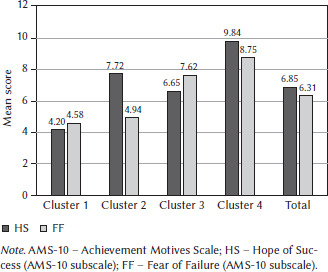
Group comparison between clusters
Homoscedasticity was violated for GAD-7 but the ANOVA was nevertheless performed due to robust group sizes. The only notable independent variables were PHQ-9 and GAD-7, explaining 5% and 10% of the variance, respectively (Table 4).
Table 4
Between-group ANOVA on clusters
[i] Note. PCS-S – Post-COVID Syndrome Score; PEM – Post-Exertional Malaise Screening Tool (severity subscale); FSS – Fatigue Severity Scale; PHQ-9 – Patient Health Questionnaire-9; GAD-7 – Generalized Anxiety Disorder-7. dfbetween groups = 3 for all variables; dfwithin groups = 321 for all variables.
Post-hoc tests revealed that for PHQ-9, cluster 4 achieved significantly higher values than cluster 3 (d = 0.58, p = .004) and cluster 1 (d = 0.59, p = .011) with medium effect sizes. For GAD-7, cluster 4 showed significantly higher anxiety levels than cluster 3 (d = 0.74, p < .001) with a medium effect size and showed significantly higher anxiety levels than cluster 1 (d = 0.86, p < .001) with a large effect size. Cluster 2 revealed higher anxiety levels than cluster 3 (d = 0.43, p = .017) and cluster 2 than cluster 1 (d = 0.56, p < .001). All post-hoc tests can be found in Table S2 in Supplementary materials.
Discussion
This study assessed achievement motives in a PCS sample, examined associations with PCS-relevant health measures, identified clusters of achievement motive types, and examined the differences between them. (1) Increased HS was associated with indicators of worse mental health and fatigue/PEM symptoms. (2) FF was linked to fatigue with a small effect size. (3) Being female, having less than three vaccinations, increased PEM, depressive symptoms, and lower HS were risk factors for more PCS symptom load. (4) Cluster group 2 and cluster group 4 with HS tendency showed more anxiety and depressive symptoms than FF-tending cluster groups.
Although increased HS showed a positive correlation with PCS symptom load in the bivariate analysis, this relationship shifted after controlling for other relevant predictors. HS showed a small, positive correlation with PCS symptom load. Still, the adjusted regression coefficient for HS was negative after controlling for other relevant predictors, consistent with negative suppression: the unique component of HS appeared protective. PEM’s relevance in the model was expected, given that it is one of the most severe features of PCS, as PEM is found in more than half of all people diagnosed with PCS (An et al., 2024). Depressive symptoms are commonly observed in many cases of PCS and are often associated with other symptoms (Han et al., 2022). Additionally, female gender was identified as a risk factor for severe PCS symptoms (Fernandez-de-Las-Penas et al., 2022), which aligns with our findings. Having fewer than three vaccinations was associated with increased PCS. This agrees with meta-analyses indicating that COVID-19 vaccinations offer protective effects against developing PCS or long COVID (Peine et al., 2025; Watanabe et al., 2023).
The study by Finsel et al. (2024) examined FF and HS with quality of life (QoL) as the primary outcome in a large cross-sectional ALS study. The authors explained HS as a positive coping trait, following Lazarus and Folkman’s (1984) coping model. Anxiety and depression were also assessed, and their associations with FF and HS were analyzed. FF was linked to higher levels of depression and anxiety. Conversely, HS was associated with lower depression. In contrast to Finsel’s et al. (2024) findings regarding depression, HS in our study was positively correlated with depressive and anxiety symptoms. ALS and PCS share similar features as chronic diseases, but also differ. While ALS is a progressive, life-limiting disease, PCS, which is a relatively new condition with limited understanding and heterogeneous symptoms, often includes severe fatigue or reduced functional capacity. The characteristics of the study groups differ: the ALS group is older and predominantly male, whereas our sample is mainly female and significantly younger.
The relationships between HS and depression/anxiety demonstrated in the correlation calculations continued in the group comparisons and post-hoc tests. Clusters 4 and 2, with the highest and second-highest HS values, respectively, also ranked with the highest and second-highest scores for anxiety and depression. However, no significant gradation across all clusters was found in the post hoc tests based on HS level. The cluster analysis demonstrated that, in addition to variable-centered approaches such as correlation calculations, the co-occurrence of HS and FF is relevant. While individuals with low HS and FF had the lowest likelihood of exhibiting depression or anxiety symptoms, individuals with both high HS and FF at the same time were at the highest risk. High achievement motives might conflict with the disease’s activity-restricting aspects.
In a fibromyalgia study, daily diaries tracked and showed that goal conflicts predict distress and pain on the same day (Hardy et al., 2011). Furthermore, previous studies of chronic fatigue syndrome (CFS) hypothesized that high personal standards are related to increased depression (Kempke et al., 2011). High personal standards may lead to maladaptive perfectionism, which could be relevant to our findings (Kempke et al., 2011). A mismatch of goals, combined with limited capacity due to high levels of PEM/fatigue, may increase distress, anxiety, and depressive symptoms.
Strengths and limitations
A strength of this study is that HS and FF introduce new concepts to the existing research on PCS patients, highlighting new aspects of the disease. An extensive test battery and a relatively large sample size (N = 332) were available.
This study had several limitations. The design was cross-sectional; therefore, causal conclusions could not be drawn. Data are primarily self-reported; risks of social desirability bias and recall error may arise. Possible clinical confounders, such as acute SARS-CoV-2 infection and PCR confirmation before PCS, could cause bias through misclassification or protective effects. We did not include the course of acute SARS-CoV-2 infection in the regression analysis, because only 36 individuals (10.8%) were hospitalized. The number of independent variables was limited for the linear regression to maintain power. Therefore, confounding variables might be absent from the model. The number of clusters was limited to avoid non-interpretable results. The silhouette coefficient was moderate to high. A wider range of possible clusters could lead to better cluster quality. For group comparisons, unequal and decreased group sizes can reduce power, making it difficult to detect minor effects.
Conclusions
In conclusion, this study suggests that achievement motives might influence the mental health experience of PCS patients, though their role needs more research. Our findings do not suggest that PCS is predominantly psychological; rather, they indicate that HS may interact with the complex physical and neurophysiological characteristics of the syndrome. Increased HS was associated with increased mental health impairment in the investigated PCS sample, in contrast with previous research. But increased HS seemed to be associated with less PCS symptom load. The characteristics of chronic disease need to be considered, along with the potential confounding effects of sociodemographic factors. Our results may establish a baseline for developing a hypothesis regarding the role of achievement motives in PCS and advancing research into achievement motives in other illnesses. Future research should adopt a multidimensional approach that integrates biological, social, and psychological factors, such as personality traits and motives, to deepen understanding of risk profiles. This could help practitioners develop more effective, personalized treatment strategies.
Supplementary materials are available on the journal’s website.

