BACKGROUND
From the start of the SARS-CoV-2 pandemic researchers reported various facets of global trauma and sense of multiple simultaneous and anticipated losses (Leach et al., 2021; Scheinfeld et al., 2022; Yap et al., 2021; Zhai & Du, 2020). The experience of loss was common for many communities (Cénat et al., 2021; Serafim et al., 2021; Sozański et al., 2021). We lost various resources – objects, personal characteristics, conditions, or energies that are valued in their own right or that are valued because they act as conduits to the achievement or protection of valued resources (Hobfoll, 1988). Generally, it was documented that the most negative effects included: the decreased sense of received support, deterioration of physical and mental health (Benatov et al., 2022; Stockwell et al., 2021) and more common family conflicts (Wong et al., 2021). The sense of loss was evoked by the death of loved ones, reduced opportunities for educational or professional development, changes in daily rituals, loss of a job, and pandemic fatigue (Bueno-Guerra, 2022). Furthermore, there is evidence that the sense of loss during the COVID-19 pandemic may be related to the severity of post-traumatic stress disorder symptoms (COVID-19 PTSD). Data suggest that these experiences were mostly shared by people throughout the world, though there were differences in how people perceived this new situation and how they coped with stress evoked by the outbreak of COVID-19. These discrepancies, resulting from individual and sociocultural factors, could also be a corollary of country-specific health care policies (De Lyon & Dhingra, 2021; Johnson et al., 2021; Malta et al., 2021; Robinson et al., 2022).
Individual factors that influenced the way of coping with the trauma of the pandemic included: age, gender, level of education, professional status, experience of illness in loved ones, incidence of COVID-19 and the course of this disease, and the availability of vaccination against COVID-19. Younger people showed greater severity of psychopathological symptoms than older people, but the age differences decreased over a few waves of the pandemic (Best et al., 2023). Due to the pandemic, older people had a greater sense of risk of contracting this disease, experienced social isolation, loneliness and lost financial opportunities (Morrow-Howell et al., 2020; Na et al., 2022). Some researchers believe that the differences in mental health result from the fact that young adults have greater work and family burdens, but have less experience in coping with difficult situations.
Research results indicated greater psychological susceptibility to the pandemic among women. Women reported greater fear and more negative expectations about the health consequences of COVID-19 than men. However, they were more optimistic about the financial effects of the pandemic and about the impact of the pandemic on private life (Alsharawy et al., 2021; Rodriguez-Besteiro et al., 2021; Sozański et al., 2021).
Level of education was also a risk or protective factor for mental health; i.e. people with higher education reported fewer psychopathological symptoms during the pandemic (Cavazzoni et al., 2023; Sozański et al., 2021).
Students, at the initial stage of the pandemic, were often susceptible to the lack of motivation, as they were exposed to limited access to knowledge and the risk of social isolation. This situation changed in the course of the pandemic as online learning became omnipresent (VanRoo et al., 2023).
Another factor important for the perception of life changes due to the pandemic was the type of activity. People who were professionally inactive before the pandemic and had lower education had a lower chance of finding a job during the pandemic than working people, especially those with higher education. They were therefore exposed to a greater sense of loss during this time (Ohlbrecht & Jellen, 2021). Being professionally active or a student gave a sense of belonging, protecting against negative assessment of the situation in successive waves of the pandemic (Ohlbrecht & Jellen, 2021).
Another group of factors related to subjective assessment of life changes is connected with the virus itself: having experience of being infected, availability of vaccination and/or loss of loved ones due to COVID-19. People with COVID-19 showed an increased risk of mental health losses, including anxiety and depressive disorders, stress and adjustment disorders, substance use disorders, and deterioration of neurocognitive functions. This risk concerned both those who were not hospitalized and those who were hospitalized in the acute phase of the disease (Xie et al., 2022).
According to past research, being infected with COVID-19 may have a variable influence on people’s perception of life changes. Some evidence points to a deteriorated assessment of life among ill persons (e.g. Duan & Zhu, 2020). Other studies indicate a positive re-evaluation of life priorities and values among COVID-19 survivors (Sun et al., 2021). Similarly, the availability of vaccination has been linked to both positive and negative outcomes during a pandemic connected with a sense of safety or, conversely, suspiciousness (Litaker et al., 2021; Roberts et al., 2022).
Past research conducted during the COVID-19 pandemic suggests that the loss of loved ones is another crucial factor in interpreting how people have assessed their lives. Generally, the loss of a relative is regarded as the most powerful stressor in everyday life, with bereaved individuals at increased risk of adverse mental and physical health outcomes (Stroebe et al., 2007; Torrens-Burton et al., 2022). The COVID-19 pandemic has been a mass bereavement event characterised by high levels of grieving throughout the world (Torrens-Burton et al., 2022).
Personality traits can be considered as vulnerability factors for psychopathology or protective, stress-buffering variables that enable the person to cope with life stressors. One of the most popular and widely accepted models of personality is the Five Factor Model (FFM) encompassing five major personality traits: extraversion, neuroticism, agreeableness, conscientiousness and openness to experience (Costa & McCrae, 1999). In times of the pandemic, negative emotional traits (e.g., neuroticism) were associated with a lack of tolerance for uncertainty and anxiety, and with increased symptoms of PTSD (Kumar & Tankha, 2022; Shokrkon & Nicoladis, 2021). The remaining personality traits were negatively related to anxiety and post-COVID-19 PTSD (Kumar & Tankha, 2022; Shokrkon & Nicoladis, 2021), although the findings are not uniform.
Opinions about gains and losses during the COVID-19 pandemic may be explained by some factors related to nationality (e.g., affinity with individualistic versus collectivist culture, or the political situation) (Ruiz et al., 2021). Sociocultural factors contribute to the way people define trauma. These factors are associated with political beliefs, experiences, as well as the political and economic situation of the country (Collins et al., 2021; Silove et al., 2007; Wilson, 2007). A relationship between the response to the pandemic and the situation immediately preceding it was identified in countries experiencing socio-political transformation (Moiseenko et al., 2022). For example, in the UK the link between Brexit and the negative impact of the pandemic on the quality of life was emphasized (De Lyon & Dhingra, 2021; Patel et al., 2022). In Brazil, the disastrous pandemic situation was related to the political situation (de Almeida et al., 2022; Malta et al., 2021). Ukraine has faced a military conflict within its territory since 2014, and Poland is also undergoing a period of political and economic transformation. Before the pandemic, the economic situation (GDP) in these countries was radically different (Statista, 2023), but during 2020, the world’s collective gross domestic product (GDP) fell by 3.4 percent (Statistics Times, 2024).
To sum up, the two-year period of the pandemic has been seen not only in terms of losses but also gains (Ajduković et al., 2022). The positive effects include improved knowledge of the disease, preventive measures, relations with loved ones, advancements in online work (Wong et al., 2021), a slower pace of life (Vuletić et al., 2021), and increased attention to one’s health (Ruiz et al., 2021). It was emphasised that changes were observed in people’s values and ways to find meaning in life (Chen et al., 2020). De Jong et al. (2020), in discussing these changes, referred to the phenomenon of “life crafting”. This term relates to a process in which people actively reflect on their present and future life, set goals for important areas of life, and undertake actions to change these areas in a way that is more congruent with their values. There are few studies focusing on expectations for the post-pandemic life. Respondents expressed uncertainty about their economic status and fear of returning to “normal life” and also believed that the experience of the crisis enabled re-assessment of values and life plans (Vuletić et al., 2021).
THE PRESENT STUDY
The role of socio-demographic factors and those related to health in predicting the perception of life changes during the pandemic has been described in the literature. However, at the individual level, psychological responses to stressful events, such as the pandemic, may depend on personality and, prior to the stressful event, personal resources (Malkinson, 2007). This study was designed to integrate the analysis of several socio-demographic and health variables, which were previously usually analysed separately (e.g. Alsharawy et al., 2021; Best et al., 2023; Collins et al., 2021), with psychological factors including personality traits in the FFM among adults representing early and middle adulthood.
This study was carried out between 1 September and 12 December 2021. The objectives of this study were twofold. The first objective was to determine which aspects of changes in life after two years of the pandemic (and waves 3 and 4 of the pandemic) were assessed as negative or positive. The second was to assess the impact of socio-demographic, health-related, and psychological factors, including personality traits in the Five Factor Model, as well as severity of COVID-19 PTSD symptoms, on the subjective assessment of the life changes. At the time of conducting this study, it was recommended to analyse three groups of factors: socio-demographic, health-related and individual (personal) in explaining functioning during the third and fourth waves of COVID-19. The earlier studies revealed that women were more compliant with epidemic recommendations, but they also showed higher negative emotions (Benatov et al., 2022; Ochnik et al., 2021; Sozański et al., 2021). Older respondents were less likely to be concerned about the impact of COVID-19 on their economic future, but they more concerned about their health (Bechard et al., 2021; Sozański et al., 2021; see also: meta-analysis Hong et al., 2021). Individuals with a severe course of COVID-19 and their families experienced a particularly intense sense of loss (Cénat et al., 2021; Hong et al., 2021; Sekowski et al., 2021). People with a higher level of education and socio-economic status have lower intensity of sense of losses due to greater ability to work in changing pandemic conditions (Sozański et al., 2021). Socio-political-economic factors (e.g. presence of military conflict) may significantly impact the psychological response to the COVID-19 pandemic (Collins et al., 2021; Kohrt et al., 2014; Ochnik et al., 2021; Ruiz et al., 2021; Wilson, 2007). The epidemiological, political and economic situation in different countries at the pandemic time were dynamic and varied, but increasing infections and death rates were observed in each of them (Worldometer, 2023).
In light of the current research on the determinants of the sense of changes of life caused by the pandemic globally (Gori et al., 2021; Luo et al., 2020; Patel et al., 2022; Shokrkon & Nicoladis, 2021; Sozański et al., 2021; Xie & Kim, 2022), we put forward the detailed hypothesis that older age, gender (female), lower level of education, lack of professional activity, experiences related to the pandemic (own experience of COVID-19, lack of vaccination, COVID-19 in relatives), and higher intensity of COVID-19 PTSD, lower emotional stability, extraversion, agreeableness, conscientiousness and openness to experience may contribute to opinions about more negative changes in life as a result of the pandemic. Additionally, we evaluated the exploratory hypothesis that nationality, as a socio-demographic factor, may also have some impact on the sense of life changes during the two-year period of the pandemic.
The study was designed to be useful for psychological work with people experiencing severe trauma on a global scale. The time of the study, i.e. the moment when the intensity of the pandemic was very high, with significant uncertainty as to how to control the threat, numerous hospitalizations in the nearest community and deaths among relatives, and restrictions imposed on everyday functioning due to COVID-19, was associated with the analysis of one’s own life in conditions of experiencing strong stress. It seems valuable to develop knowledge about the factors that may protect against negative evaluation of one’s life in the situation of severe trauma. Therefore, in the course of psychological interactions, it is worth strengthening those features that are associated with the ability to perceive positive aspects of functioning despite the stress experienced in events involving negative global phenomena in the social space.
PARTICIPANTS AND PROCEDURE
PARTICIPANTS
The sample consisted of 418 participants representing two countries from Europe (Poland and Ukraine) and one of the biggest countries of South America (Brazil). The mean age of participants was 33.33 years (SD = 11.76, range 18-55, Me = 32). The majority of the group were women (n = 315, 75.4%). A higher education level (university, PhD) predominated among the respondents (n = 248, 59.3%). The remaining participants obtained education defined as lower (incomplete primary/complete primary/secondary). Most respondents were professionally active or studying (n = 410, 98.1%). More than half of the participants did not report having COVID-19 disease (n = 288, 68.9%) and about half of the respondents reported COVID-19 occurring in their relatives (n = 210, 50.2%). More than half of respondents (n = 290, 69.4%) reported having vaccination against COVID-19.
MEASURES
All the tools were distributed in different language versions (Ukrainian, Polish and Portuguese). Respondents were asked to consider the time span of the years 2020 and 2021 (refers to: IES-R and COVID-19 SLCHQ). The following measures were used:
COVID-19 Sense of Life Changes Questionnaire (COVID-19 SLCHQ), which was developed for the purpose of this study on the basis of the Recent Life Changes Questionnaire (RLCQ; Miller & Rahe, 1997) and the COV19 – Impact on Quality of Life (COV19-QoL; Repišti et al., 2020). Participants were asked whether the COVID-19 pandemic had changed their life in various aspects. One of the questions was whether the perception of the future had changed as a result of the pandemic. The items encompass 17 aspects of life (Table 1). The participants were asked to select one of the responses (7-point scale) from 1 (dramatically negative) to 7 (extremely positive). A higher score reflects an opinion that the changes which occurred during the COVID-19 pandemic were positive, and a lower score corresponds to an opinion that the changes were negative. The overall COVID-19 SLCHQ index was calculated taking into account 17 items; the range of points was 17-119. The cut-off point was the score of 68 (below this point the score is interpreted as a sense of more negative changes in life during the pandemic time). Cronbach’s α for COVID-19 SLCHQ in our sample was .92 (for the Polish version .82, for the Portuguese version .86 and for the Ukrainian version .91).
Table 1
The impact of socio-demographic, health-related and psychological variables on the score of COVID-19 SLCHQ (hierarchical regression analysis)
The Impact of Event Scale-Revised (IES-R; Weiss, 2007; Ukrainian adaptation: Krupelnytska et al., 2024; Polish: Juczyński & Ogińska-Bulik, 2009; Portuguese: Castanheira et al., 2006) – self-assessment questionnaire; it was used to measure the severity of PTSD. IES-R is the most commonly used scale for measurement of stress, anxiety and depressive symptoms after any traumatic event. Respondents are asked to rate their feelings of distress due to the pandemic on a five-point scale: from 0 (not at all) to 4 (extremely). There are three subscales – Intrusion, Avoidance and Hyperarousal – and the total score is the sum of the raw scores. A raw scoring is in the range from 0 to 88 points, with 24 or more points meaning that PTSD is a clinical concern. Cronbach’s α for IES-R in our sample was .88 (for Ukrainian .85, Polish .88, Brazilian .74).
Ten Item Personality Inventory (TIPI; Gosling et al., 2003; Ukrainian adaptation: Klimanska & Haletska, 2019; Polish: Sorokowska et al., 2014; Portuguese: Nunes et al., 2018). It is a short self-report measure that was used to assess personality in the Five Factor Model (extraversion, emotional stability, conscientiousness, openness to experience and agreeableness). Each personality trait is measured with two items. Each item consists of two descriptors, separated by a comma, using the common stem, “I see myself as:”. Participants rate each item on a 7-point scale ranging from 1 (disagree strongly) to 7 (agree strongly). The score may range from 1 to 7, as the final score is the average of the two items that make up each scale. Cronbach’s α for the specific TIPI subscales in our study ranged from .84 to .91 in each group. In the Polish group, Cronbach’s alphas were as follows: extraversion: .84, emotional stability: .88, conscientiousness: .90, openness to experience: .87, agreeableness: .90. In the Ukrainian group, Cronbach’s alphas were as follows: extraversion: .86, emotional stability: .86, conscientiousness: .91, openness to experience: .88, agreeableness: .89. In the Brazilian group, Cronbach’s alphas were as follows: extraversion: .87, emotional stability: .89, conscientiousness: .90, openness to experience: .88, agreeableness: .91. The reliability of the subtests is high in each sample.
PROCEDURE
The study was conducted in compliance with the guidelines of the Declaration of Helsinki and was approved by the local Research Ethics Commission (protocol code 8/2021). The online survey, intended for adults, was carried out using Google Forms. The link was active from September 1, 2020 to December 12, 2021. The snowball method was used in collecting data. General information about the purpose of this study was disseminated via private e-mails and Facebook accounts. A link to the socio-demographic survey and the questionnaires were sent to those who gave their informed consent to participate in this study. The online questionnaire was prepared under the recommended standards for conducting and reporting web-based surveys (CHERRIES methodology; Eysenbach, 2004).
DATA ANALYSIS
Participants’ characteristics contain data related to frequency, and percentages and – in the case of quantitative data – means and standard deviations. To compare subscale scores in COVID-19 SLCHQ, ANOVA for dependent data with Bonferroni post-hoc comparisons was used.
To determine whether psychological factors uniquely contribute to the more negative perception of life changes due to COVID-19 above and beyond the socio-demographic and health characteristics, we conducted hierarchical regression entering socio-demographic data (gender: male/female; age: in years; education: lower/higher; type of activity: being professionally active or studying/professionally inactive – unemployed people, pensions; nationality: Poland, Ukraine, Brazil) at Step 1, health features (COVID-19 history: yes/no; COVID-19 vaccination: yes/no and COVID-19 in relatives: yes/no) at Step 2, and all five personality traits (extraversion, emotional stability, agreeableness, conscientiousness, openness to experience) and IES total at Step 3. This analysis examined the contribution of health-related and psychological factors above and beyond socio-demographic variables. A significance level of p ≤ .05 was adopted in all the analyses.
RESULTS
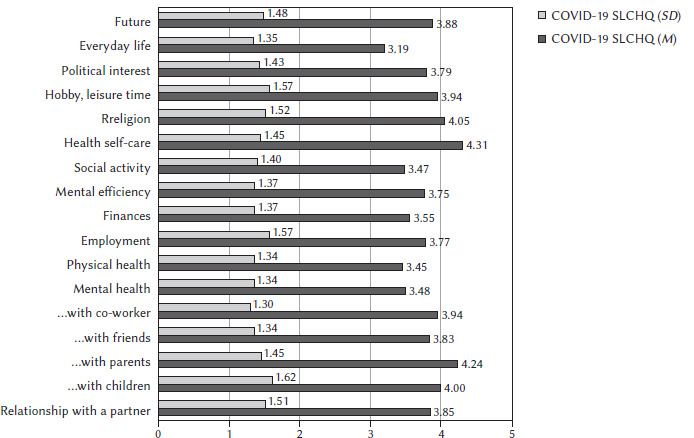
The first step of the analysis was to characterise participants’ perception of the changes in different aspects of their life during the 2-year pandemic time. The standard deviation total result of COVID-19 SLCHQ shows that the respondents included both people who negatively assess changes in life due to the pandemic and people who notice some positive changes (M = 67.26, SD = 15.50). Comparisons of the results of 17 scales (Figure 1) showed significant differences (F = 9.48, p = .001, η2 partial = .06). Post-hoc comparisons showed that the changes caused by the pandemic in taking care of one’s health, relationships with parents and religiosity were assessed more positively (that is, above 4 points on a 7-point scale). In turn, changes in everyday life, mental and physical health, finances and social activity were assessed more negatively (< 4 points). Pandemic-related changes in relationships with partners/spouses, relationships with friends and colleagues, changes in professional work, intellectual abilities, hobbies, interests in politics and perception of the future were rated as average (within 4 points). The differences in health self-care, religiosity and relationships with parents and others were significant at the .001 level.
Figure 1
Results of the COVID-19 SLCHQ questionnaire in terms of estimating changes caused by COVID-19 in various aspects of life
Note. COVID-19 SLCHQ – COVID-19 Sense of Life Changes Questionnaire.
Participants obtained the highest scores in conscientiousness (M = 10.55, SD = 2.84) and agreeableness (M = 10.51, SD = 2.45). The mean scores in extraversion and in openness to experience were about 10 (M = 10.29, SD = 2.87; M = 10.21, SD = 2.76, respectively). The lowest score was noted in emotional stability (M = 8.52, SD = 3.22). The IES-R sum for the entire group indicates the presence of COVID-19 PTSD symptoms (M = 25.14, SD = 12.64). The standard deviation suggests that some participants had full-blown PTSD (a score of 33 and above represents the best cut-off for a probable diagnosis of PTSD and a score of 37 indicates severe PTSD symptoms resulting from experiences related to the pandemic).
To explore the second aim of the study a hierarchical regression analysis was performed to determine which factors contribute to a sense of negative or positive changes due to the pandemic. Hierarchical regression analysis using the COVID-19 SLCHQ score as the criterion, socio-demographic factors (gender, age, education, nationality and type of activity), health variables (COVID-19 history, COVID-19 vaccination and COVID-19 in relatives), and psychological factors (personality traits: extraversion, emotional stability, agreeableness, conscientiousness, openness to experience; PTSD symptoms – IES total) as predictors demonstrated that socio-demographic factors contributed minimally to model 1 (these variables explained only 3.5% of variance). Although age appeared to be a significant predictor, model 1 was not well fitted (p = .074; Table 1). Furthermore, none of the health variables contributes significantly above and beyond the socio-demographic factors to model 2 (these factors explained only an additional 0.6% of variance), which is also not well fitted (p = .204, Table 1). Finally, the third model fits well with the data (p < .001, Table 1). In the regression model after including psychological factors, age was still a significant independent predictor. Nevertheless, emotional stability and conscientiousness were the only psychological factors that significantly and uniquely contributed to model 3 above and beyond socio-demographic and health variables, accounting for approximately an additional 22.9% of variance.
Higher intensity of conscientiousness and emotional stability were found to increase positive perception of changes resulting from the pandemic, whereas health and other psychological variables were not significant predictors. Among socio-demographic factors, only age significantly contributed to the perception of the changes in life. The older the respondents were, the more negatively they assessed the changes in life caused by the pandemic.
DISCUSSION
The purposes of this study were to describe in which aspects changes in life after the two years of the pandemic were assessed as negative or positive by participants, and to assess the impact of selected socio-demographic, related to health, and psychological factors on the perception of the changes in life following a few waves of the COVID-19 pandemic.
Firstly, in the respondents’ opinion, the pandemic changed their lives to a small degree only. Participants assessed different aspects of their life varying from relations with other people, their health as well as their financial status. To the best of our knowledge, no previous studies have encompassed such a variety of life areas. Changes in taking care of one’s health, relationships with parents and religiosity were assessed most positively by participants. In turn, changes in everyday life, mental and physical health, finances and social activity were assessed more negatively. This finding is consistent with results reported by other studies showing that indeed we have experienced negative changes in these spheres of our life (Bueno-Guerra, 2022; Cénat et al., 2021; Serafim et al., 2021; Stockwell et al., 2021). Nevertheless, the present findings indicating not only negative but also positive changes in individual aspects of life are interesting compared to research reports from the early stages of the pandemic when a sense of loss was emphasised in all domains of life. For example, Benatov et al. (2022) reported deterioration of physical and mental health among adults aged 20-40 years from Germany, Israel, Poland, and Slovenia. Stockwell et al. (2021) based on a systematic literature review between 2019 and 2020 found that physical activity changes were reported in 64 studies, with the majority of studies reporting decreases in physical activity during lockdowns across several populations. Repišti et al. (2020) examined adults from four countries in the Balkans, both from clinical and non-clinical groups between 17 and 89 years old, and found that participants from both samples, on average, perceived that COVID-19 had, among the tested domains, the greatest impact on their quality of life. The lowest perceived impact was found for the mental health domain in the non-clinical group and for personal safety in the clinical sample.
Our study was related to a situation which was still in progress, due to which the opinions concerning the past years of the pandemic may be seen as cautious and anticipatory. Currently, opinions related by our participants regarding the effect of the pandemic on various domains emphasise certain benefits, especially in taking care of one’s health, relationships with parents and religiosity. There are reports in the literature confirming beneficial changes in family relationships (Colucci et al., 2023; Wong et al., 2021) and an increased interest in spiritual values (Chen et al., 2020). With regard to religiosity, data from the literature are not entirely consistent. A Polish study did not report an intensification of religious practices (Dobosz et al., 2022), while a meta-analysis covering studies from 107 countries showed a significant increase in religiosity (Bentzen, 2021). Therefore, it is worth considering that turning to religiosity and spiritual values may be a strategy supporting coping with the trauma of the pandemic. Research data indicate that the recorded increase in self-care (e.g. healthy eating, exercise, relaxation/meditation, compliance with restrictions) during successive waves of the pandemic contributed to the strengthening of positive emotions (Disabato et al., 2022). In turn, according to research by GlaxoSmithKline (2020) during the pandemic, 65% of Europeans took their health into account more often during everyday decisions and most of the respondents cared more about their loved ones.
The hypothesis that older age, gender (female), lower level of education, lack of professional activity, experiences related to the pandemic (own experience of COVID-19, the lack of vaccination, COVID-19 in relatives), higher intensity of PTSD, lower emotional stability, extraversion, agreeableness, conscientiousness and openness to experience contribute to opinions on more negative changes in various spheres of life caused by the pandemic was partially confirmed in this study. A hierarchical regression analysis was applied to determine which factors contribute to a sense of positive and negative changes due to the two-year period of the pandemic between 2020 and 2021. Among all variables encompassed by three major factors included in the analysis (socio-demographic, health and psychological), personality traits in the FFM were the most important predictors of the sense of life changes. Regression analysis revealed that the contribution of conscientiousness and emotional stability to the sense of life changes predominated over socio-demographic and health variables. Within socio-demographic variables, only age was found to be an independent predictor of sense of life changes. Younger age of participants facilitated positive perception of life changes, whereas older age increased the risk of negative perception. This result goes in line with previous research (Hong et al., 2021; Morrow-Howell et al., 2020; Na et al., 2022). Previous evidence suggests that older participants suffered more isolation and financial difficulties during the pandemic (Cavazzoni et al., 2023; Sozański et al., 2021). Probably the time of conducting this study, which was the zenith of this difficult situation, revealed that age matters. Not only the chronological age, but rather possibilities to adapt to new circumstances, which partially arise from health status and a slow decrease in cognitive functions due to physiological ageing, may play a crucial role in explaining how people interpret challenges which they encounter. Some data suggest that older age may decrease abilities to flexibly react to new demands, get used to new opportunities and cope with stress (Almondes et al., 2017; Hashemi & Einy, 2019).
The present results are partially supported by previous data, especially with reference to the role of age of participants. At the same time, the results of this study show that variables which have been identified in previous studies (such as gender, level of education, type of activity, e.g. Cavazzoni et al., 2023; Rodriguez-Besteiro et al., 2021; Sozański et al., 2021) do not have significant importance in predicting the perception of life changes. It is possible that the different times of conducting previous and the present research could have an impact on the differences in the obtained results. For example, people had to face different challenges at the onset and during different phases the pandemic. During the whole period, the situation has often changed dynamically from one month to another due to new restrictions, an increase in deaths, government policies dependent on local decrees, etc. Therefore, these external and changeable factors could explain why the role of particular socio-demographic factors, e.g. level of education, nationality, or socio-economic status, could play a different role (protective or a risk factor) at different stages of the pandemic.
Interestingly, in the present study none of the health variables was found to predict a sense of life changes. Health variables connected with being infected with COVID-19, or being vaccinated or not, could also play a different role in explaining subjective changes in life at the onset of the pandemic and during it. For example, probability of COVID-19 in relatives or oneself increased dramatically during the course of the pandemic, whereas the access to vaccines was lowest at the onset of the pandemic. Sozański et al. (2021) reported that the sense of loss during the pandemic occurred in persons who had experienced illness. For those who could not gain access to the vaccine, perception of life changes could be worse than for those who could get vaccinated. Such discrepancies could result from different contributions of particular socio-demographic, health and psychological variables to the perception of life changes at different stages of the pandemic.
Not only socio-demographic and health-related variables can be attributed differently to perception of life changes during different stages of the pandemic. Several studies have revealed that such personal characteristics as emotion regulation strategies, cognitive attribution styles or resilience can be malleable to external demands, as usually people learn to get used to a new, unpredictable situation through the habituation process (e.g. Martin-Lapoirie et al., 2024). Personality traits are considered as internal dispositions which are to some extent inherited, and are less susceptible to changes (Costa & McCrae, 1999). However, they can serve as a buffer in responding to difficult situations. Our study revealed that higher conscientiousness and emotional stability promote a positive perception of life changes. Many past studies, conducted before and during COVID-19, have indicated the role of emotional stability and conscientiousness in predicting well-being and mental health of adults (Graham et al., 2020; Schwaba et al., 2022). Conscientiousness and emotional stability represent two of the most adaptive personality traits which increase in adulthood and are positively related to interpersonal and occupational functioning and health (Schwaba et al., 2022). Both these traits were found to promote post-traumatic growth during the COVID-19 pandemic (Xie & Kim, 2022). Conscientious individuals were more compliant with safety measures (Airaksinen et al., 2021; Blagov, 2021), presented lower level of anxiety and depression, and were likely to apply adaptive defence mechanisms (Gori et al., 2021). Consequently, conscientiousness promoted opinions about the insignificant impact of the pandemic on one’s life (Gori et al., 2021). On the other hand, lower emotional stability was associated with more profound experience of distress and greater sense of negative effects (Gori et al., 2021; Liu et al., 2021; Shokrkon & Nicoladis, 2021), and with a belief about longer duration of COVID-19 (Garbe et al., 2020). Therefore, it is possible to conclude that in difficult times, personality traits, that is conscientiousness and emotional stability, considered as basic dispositions to cope with stress, more than other psychological factors, such as symptoms of PTSD and non-psychological factors, play a protective role in the perception of life changes. This conclusion provides an important cue for planning health care strategies at the international level in case of future possible threats (e.g. wars, natural disasters).
CONCLUSIONS
Younger age, conscientiousness and emotional stability were the variables which were found to favour a more positive perception of the past years of the pandemic. From the practical point of view, this result stresses the necessity of promoting abilities, which underlie these particular traits, that is diligence, the ability to act patiently and coping with difficult emotions, such as anger, distress and frustration. Shaping such traits could be the focus of personality-tailored interventions towards people of different age in diverse life-long institutional contexts of different levels: education, basic medical care, health care policies, and also in workplaces. Moreover, these results can also serve as an important cue for developing and broadening the social support systems aimed at people experiencing difficulties resulting from a sense of loneliness, chronic illness, or living in social welfare homes.
LIMITATIONS AND FUTURE DIRECTIONS
Our study has certain limitations, such as the varied number of participants and high proportion of females, individuals representing young/middle adulthood, and those with higher education. While most participants reported not being infected with COVID-19, we do not exactly know how many participants were actually infected. Since we included students as an active group, it may be worth mentioning that despite the data on the increase in the sense of loss, i.e. loss of motivation to learn and the feeling of poorer access to knowledge (due to the lockdown, online learning) among students in the initial phase of the pandemic, the perception of the pandemic situation as stressful did not increase in subsequent waves (VanRoo et al., 2023). Moreover, some factors which may contribute to explaining the results (e.g., basic hope, dispositional optimism or personal values) were not assessed. Additionally, this study did not take into account the current situation (Russia’s attack on Ukraine). Despite these limitations, further research in addition to personality traits should investigate the role of nationality-related factors in the emotional response to the COVID-19 pandemic.