

BACKGROUND
The number of suicides in South Korea has been rising steadily, raising serious social concern. According to the World Health Organization (WHO, 2021), suicide rates in South Korea are particularly high: in 2019, the rate reached 29.7 per 100,000 population, compared with the global rate of 5.4 and South Korea’s 2000 rate of 20.4. Suicide, as a death resulting from self-determination, raises complex questions across philosophical, sociological, and psychological perspectives.
Philosophical debates have long questioned whether suicide is an act of freedom, inevitability, or rationality. Schopenhauer (Masny, 2021) described suicide as a “negation of the will,” a strategy to escape the suffering caused by an insatiable will. However, he argued that suicide does not resolve present affliction, nor does it facilitate understanding of the universal will beyond individual existence. Similarly, the existentialist Camus (Berthold, 2013) contended that “there is but one truly serious philosophical problem, and that is suicide,” ultimately rejecting suicide as a solution to human existential despair. He advocated that individuals must confront their existential condition rather than evade it.
Suicide is often not merely a private act but a social phenomenon, as it can be influenced by and transmitted through social relationships. Kwon et al. (2009) observed that suicide emerges from a combination of intrapersonal and interpersonal factors, spreading rapidly within a society and sometimes generating an epidemic. Fässberg et al. (2012) similarly noted the social dimension of suicide, emphasizing its connection to critical life problems and the overlap between individual and societal processes. From a sociological perspective, Durkheim (Bernburg, 2002) argued that anomie – social instability caused by conflicting value systems – can increase suicide rates by fostering negative emotions and diminishing respect for life. Consistent with these comments, suicide pacts motivated by diverse reasons have been reported across different societies (Fishbain & Aldrich, 1985). Prat et al. (2013) noted that some are based on religious beliefs, social deprivation, and pessimistic lifestyles. In reviewing the discussions above, the philosophical perspectives tend to link suicide to a pessimistic worldview, while the sociological perspectives emphasize a variety of social factors of suicidal behavior.
Suicide is also understood as a psychological process (Balkcom et al., 2019), although some kinds of reasons may be influenced by philosophical and sociological factors. Psychological analyses can elucidate the inner dynamics of suicidal behavior. Individuals facing crises may seek escape, and learned helplessness has been identified as a key factor motivating suicidal thoughts (Al-Masry, 2022). Related to this, Caine (2015) noted that problems with social relationships can precipitate suicide, often suggesting the image of a lonely individual. Maladaptive behavioral habits linked to learned helplessness further increase the risk of suicide (Pollock & Williams, 2004). Following a failed attempt, individuals may develop increased motivation to complete the act, resulting in repeated behavior and habituation.
Psychological studies provide an overview of suicide incidents, focusing on belief systems, emotions, and cognition. Behavioral belief (Early & Akers, 1993) and self-destructive belief (Firestone & Seiden, 1990) influence suicidal behavior, while depression and other intense emotional states can block rational coping strategies, leaving suicide as a perceived solution (Jeon, 2011). Cognitive factors also play a critical role (Rudd, 2010), while biased thinking or fatalistic world-views can precipitate suicide (Lee, 1987). For example, some religious individuals may interpret suffering as inevitable and view suicide as the only escape from prolonged agony (Lawrence et al., 2016).
Related to the psychological perspective, Lee et al. proposed a flowchart, called Lee’s BEC (Behavior-Emotion-Cognition) model, which was applied in the present study. In this model, cognitive factors influence emotional states, which in turn motivate behavioral commitment. They elaborated on BEC dimensions, including daily activities, levels of information processing from input to output, and individual characteristic profiles (Jeong et al., 2022; Ju et al., 2018, 2019; Kim et al., 2022; Lee et al., 2017, 2019; Sohn et al., 2018). According to the BEC framework, cognitive biases toward suicide elicit emotional motivation, which subsequently evokes behavioral commitment. The BEC loop for suicidal processes bears similarity to the model proposed by Klonsky et al. (2016), which conceptualized a feedback loop between suicidal ideation and behavior, though it limited its focus to cognition and behavior, excluding emotional motivation.
Human activities are generally assumed to have purposes (personal or public) and are carried out through means (active or passive). In suicide cases, questions arise regarding whether the acts are driven by personal or public motives and whether they unfold through active or passive behaviors, as examined in this study. For reference, Liu et al. (2020) compared suicidal ideation between active and passive actions, while Kučukalić and Kučukalić (2017) analyzed suicidal purposes in the context of stigma, distinguishing between public and private motivations.
DESIGN AND PREDICTION
While the multiple variables involved in suicidal incidents can be discussed philosophically, most psychological and sociological observations rely on case reports. This study, however, aimed to demonstrate a model of suicidal processes illustrated through BEC dynamics (Behavioral, Emotional, Cognitive), suicidal purposes (Public, Private, and Mixed), and activation modes (Active and Passive) using virtual observations via a questionnaire. It was predicted that participants’ responses on the seven-point rating scales would vary according to the influences of BEC levels in the manipulated cases.
PARTICIPANTS AND PROCEDURE
PARTICIPANTS
Two hundred and five people voluntarily participated in the study. Among them, 113 were male and 92 were female. All participants provided informed consent, and their rights were protected in the research.
QUESTIONNAIRE
In this study, a questionnaire was constructed, consisting of instructions, six suicide scenarios, and corresponding questions. Participants read instructions explaining the study’s purpose, the response procedures, and protection of their rights. The six suicide scenarios depicted hypothetical cases of suicide, consisting of three suicide purposes (public, private, or mixed), varying by two suicidal actions (active or passive). The question items were numbered according to three characteristics (cognitive, emotional, or behavioral) under each scenario, totaling 18 (6 scenarios × 3 characteristics).
The suicide scenarios are described as follows: 1) “A soldier in a defeated army will attack his enemy with no chance for survival but a high chance to kill several enemies”, 2) “A politician accused of wrong-doing commits suicide”, 3) “A person commits suicide following a religious doctrine”, 4) “A student receives low grades at school and commits suicide”, 5) “A person is abandoned by their spouse and commits suicide”, and 6) “A person loses all of their money and home and commits suicide”. Regarding suicidal purpose, cases 1 and 2 were categorized as public, cases 3 and 4 as mixed (both public and private), and cases 5 and 6 as private. In terms of suicidal action, cases 1, 2, and 3 were classified as active suicides, whereas cases 4, 5, and 6 were considered passive, depending on the degree of intentional planning involved.
Each scenario included three items assessing the participant’s perception of the model’s characteristics: cognitive, emotional, and behavioral. Participants rated, on a 7-point scale, the level of cognition, emotion, and behavior exhibited by the model in each scenario.
PROCEDURE
Participants read the instructions and evaluated the six suicide scenarios. For each scenario, they rated the model’s cognitive, emotional, and behavioral characteristics on a 7-point Likert-type scale, indicating the perceived influence of each characteristic on the model’s decision to commit suicide.
The experimenter met with people in the class hallways, cafes, and public parks and asked whether they were willing to participate in a survey. With their consent, the experimenter requested that participants read the introduction, which informed them of the purpose of this study. Next, the experimenter provided participants with the questionnaire and let them complete their responses within 10 minutes. The period of the experiment was from October 1 to October 20, 2022. The statistics were processed by SPSS v. 26 in November 2022.
RESULTS
The participants’ responses, measured on seven-point rating scales, were subjected to factor analysis and ANOVA. Factor analysis was conducted to identify underlying latent factors among the 18 items, while ANOVA examined the effects of behavioral, emotional, and cognitive characteristics across suicidal actions (active vs. passive) and purposes (public, private, and mixed).
The reliability of all 18 questions on the 7-point rating scales in the questionnaire was tested by Cronbach’s α = .87. It was found to have high reliability.
RESULTS OF FACTOR ANALYSIS
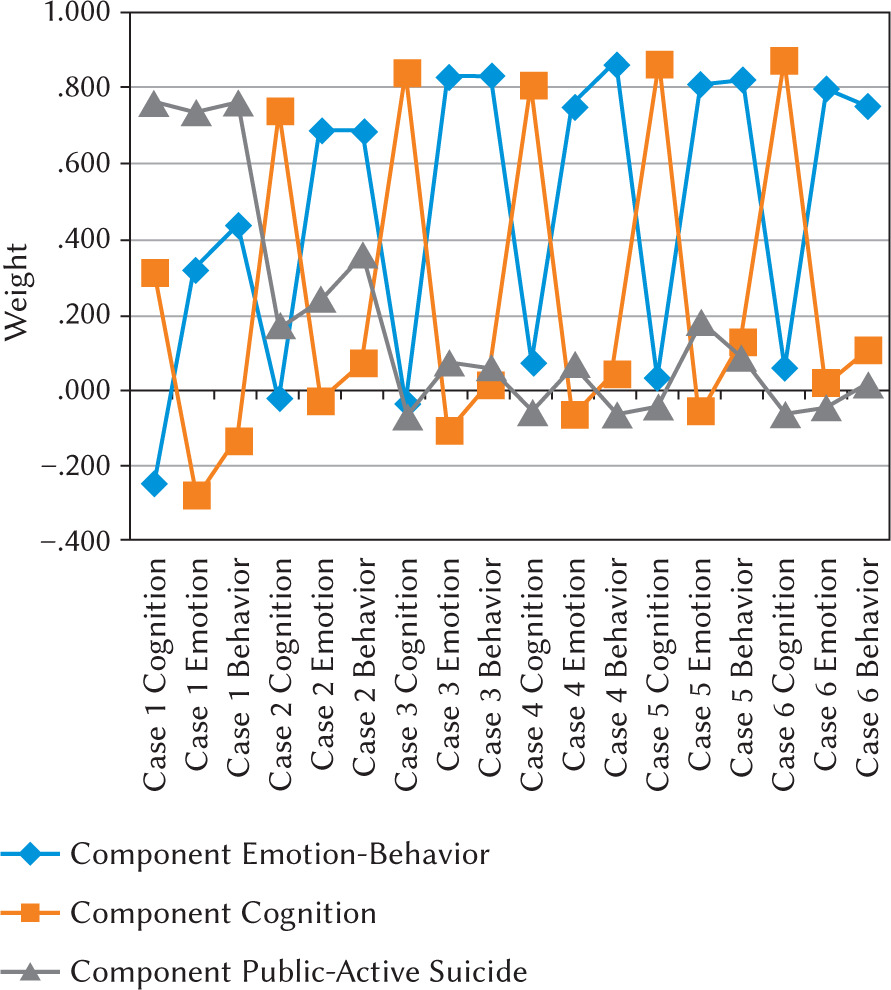
Three factors were extracted, explaining 68.29% of the total variance. The factorability of the data was supported by the Kaiser-Meyer-Olkin measure of sampling adequacy (KMO = .852) and Bartlett’s test of sphericity (χ2 = 2718.70, df = 153, p < .001). Factors were rotated using Varimax rotation.
As shown in Figure 1, the cognitive items were independent, while the emotional and behavioral items were mutually dependent. Notably, case 1, depicted as active suicide with a public purpose, showed that cognition, emotion, and behavior exhibited similar levels across cognition, emotion, and behavior, consistent with the overall pattern. The above factor loadings corresponded to the ANOVA results, in which the cognition levels were separated but the emotion and behavior levels were in conjunction.
RESULTS OF ANOVA
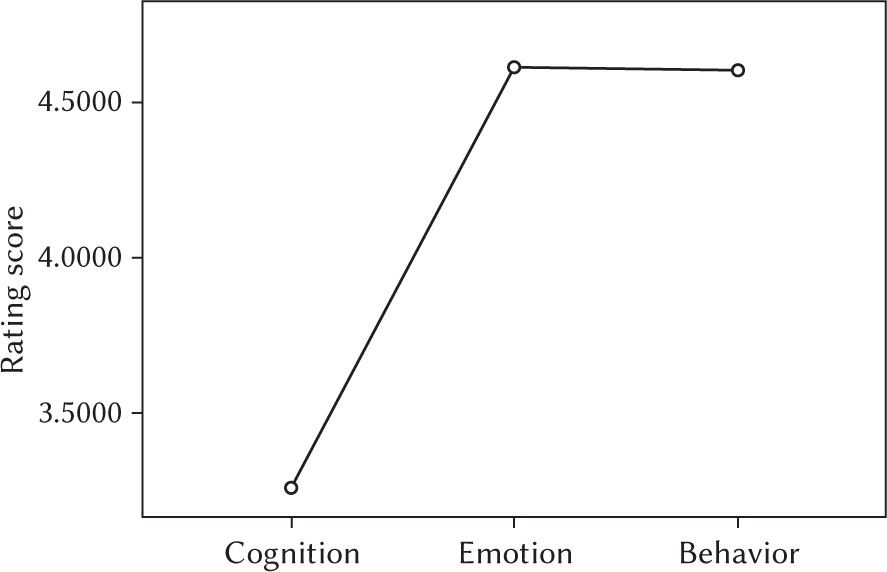
The analysis found BEC effects that varied according to the suicide conditions. At first, the BEC effect was overall significant, F = 111.90, df = 2/408, MSe = 1.13, p < .001, β = 1.00, as shown in Figure 2. Reviewing it, the cognition level of all suicide cases, M = 3.25, SD = 1.21, was the lowest, but the emotion level, M = 4.62, SD = 1.18, and the behavior level, M = 4.61, SD = 1.29, were similar to each other. It suggested that all the suicides were driven by minimal cognition but motivated by the high emotional state to progress to behavioral activation.
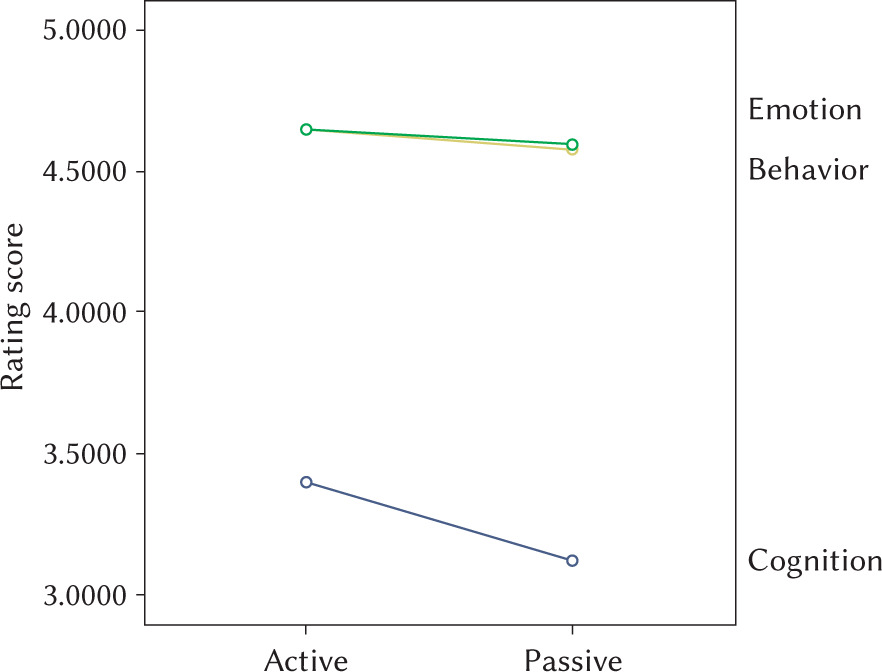
Second, concerning the suicidal action (active cases 1, 2, and 3; passive cases 4, 5, and 6), a significant interaction was observed between the BEC and the action, F = 6.10, df = 2/408, MSe = .41, p = .002, β = .89, as shown in Figure 3. For passive actions, the mean cognition score (M = 3.12, SD = 1.45) was lower than both the emotion (M = 4.59, SD = 1.34) and behavior scores (M = 4.58, SD = 1.48), and also lower than the cognition score for active actions (M = 3.39, SD = 1.20). Emotion and behavior scores were similar across active and passive actions. These results indicate that lower cognitive engagement was associated with more passive suicidal behavior.
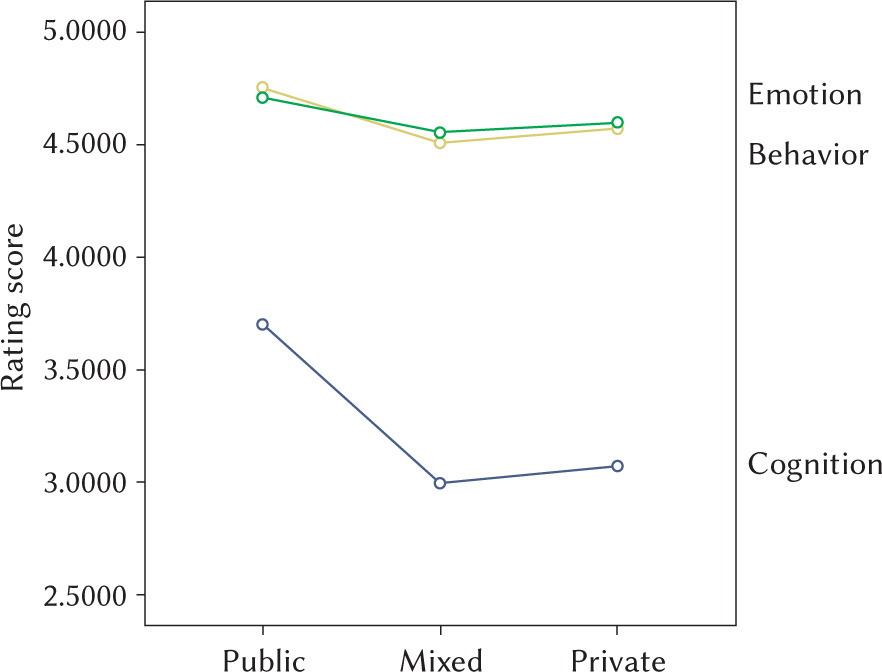
Finally, regarding the public (cases 1 and 2), mixed (cases 3 and 4) and private purposes (cases 5 and 6) for suicide, the BEC effects exhibited a significant interaction, F = 14.01, df = 4/816, MSe = .40, p < .001, β = 1.00, as shown in Figure 4. For private purposes, cognition scores (M = 3.07, SD = 1.48) were lower than emotion (M = 4.60, SD = 1.40) and behavior scores (M = 4.57, SD = 1.56), and also lower than cognition scores for public purposes (M = 3.70, SD = 1.32). For mixed purposes, cognition scores (M = 3.00, SD = 1.45) were similarly lower than emotion (M = 4.55, SD = 1.43) and behavior (M = 4.51, SD = 1.52) scores, and also lower than public-purpose cognition scores. Across all purpose types, emotion and behavior scores remained consistently higher than cognition scores. These results indicate that public suicide purposes were associated with higher cognitive engagement compared with private or mixed purposes.
DISCUSSION
The varieties of suicides have been discussed to set up philosophical, sociological, and psychological frameworks. The present study aimed to analyze the factors of the suicide processes manipulated by this questionnaire. The designed variables were the BEC profiles, the public, private, and mixed purposes, and the active and passive actions of suicides.
The above results suggest that the simulated suicide cases were related to various conditions of philosophical purposes, sociological activations, and psychological characteristics. Considering the modeled cases, some suicides were evoked by public and private purposes, which aligns with philosophical pessimism, as discussed mainly by Schopenhauer (Masny, 2021). The social spread of suicide is construed as being influenced by anomie, as propounded by Durkheim (Bernburg, 2002). However, the philosophical and sociological bases are associated with the psychological characteristics of BEC, which were manipulated by this study in line with Lee and colleagues.
The psychological processes underlying the suicide scenarios reflected the BEC characteristics of the models, as assessed by participants. At first, the behavioral, emotional, and cognitive effects were differentiated. Generally, the suicide cases illustrated were not due to cognitive processes but to both emotional motivation and behavioral activation. The emotional and behavioral levels were concomitantly higher than the cognitive level, implying that suicide behaviors were prompted by emotion but evaluated by the prudence of cognition. Second, cognitive prudence was found to be not constant but changeable. The cognition levels fluctuated higher or lower, depending on the level of activation and the degree of publicity. One of the prominent cases, case 1, which was an active suicide for a public purpose like a battle death, set the cognitive level higher compared with other cases.
The uniqueness of the BEC effect identified in this study, characterized by the concomitance of emotional and behavioral activation, can be explained as follows. In private situations, behavioral output tends to be fully expressed once emotional accumulation exceeds a certain threshold. However, in public contexts lacking social protection, behavioral expression may be inhibited and remain below the level of emotional arousal. This pattern suggests the existence of a hesitation gate that regulates overt behavior in accordance with social expectations. The private context may correspond to romantic love between partners, whereas the public context may reflect children’s love for their parents. Ju et al. (2018) demonstrated that romantic love typically exhibits concomitance of emotion and behavior, whereas in filial love, behavioral expression is often lower than emotional intensity.
To extend this study to others, the manipulation of suicide purposes (public and private) can be interpreted in light of Kučukalić and Kučukalić (2017), who noted that suicidal people care about stigma in public and private, but are limited in negative emotion. The study’s classification of suicidal actions (active vs. passive) aligns with Liu et al. (2020), who conceptualized suicidal ideation as active or passive but focused primarily on its cognitive aspects.
This study’s findings, such as the effects of psychological characteristics, suicidal purposes, and activations, may be culturally specific or common. Therefore, subsequent studies are needed that employ diverse samples to examine cross-cultural differences worldwide. This requirement aligns with the present study’s aim to integrate multiple disciplines across Western and Eastern systems. One corresponding framework can be found in Confucian (孔子) ethics, which has long governed much of the Eastern world and may provide conceptual commonality, even though it has not yet been empirically examined. The Confucian principles of loyalty and filial piety (忠孝) (Wang & Tian, 2023) hold that one’s life does not belong solely to oneself, but rather to one’s parents, nation, ruler, or Heaven (God). Consequently, taking one’s own life is regarded as a violation of this moral commandment. However, self-immolation may be condoned – or even respected – when it serves to preserve the honor of one’s family or nation. This suggests that Confucianism condemns suicide for private reasons but honors self-sacrifice performed for public or moral purposes.
This study can be evaluated based on the adaptability of its methodology, which was designed to integrate a mixed procedure combining virtual phenomena with experimental traditions. The phenomenological observations were derived from simulated suicide cases constructed to approximate real-life scenarios. The experimental measurement, employing seven rating scales, enabled statistical analyses of participants’ responses to complement phenomenological findings and enhance objectivity. The methodology has been continuously developed by Lee and colleagues (Jeong et al., 2022; Sohn et al., 2018); however, further refinement is still required. To generalize the phenomenological observations, future research should require inclusion of the actual suicide cases to support the virtual model proposed here and to enhance ecological validity.
In addressing the limitations of this study’s variables, it should be noted that the conditions surrounding suicide are diverse across different variables, as suggested by previous research. Lester and Young (1999) discussed external and internal attributions in suicide. Subsequent studies could further explore more variables, adding distinctions between self- and other-oriented attributions of suicide to extend the relevance of the present study.

